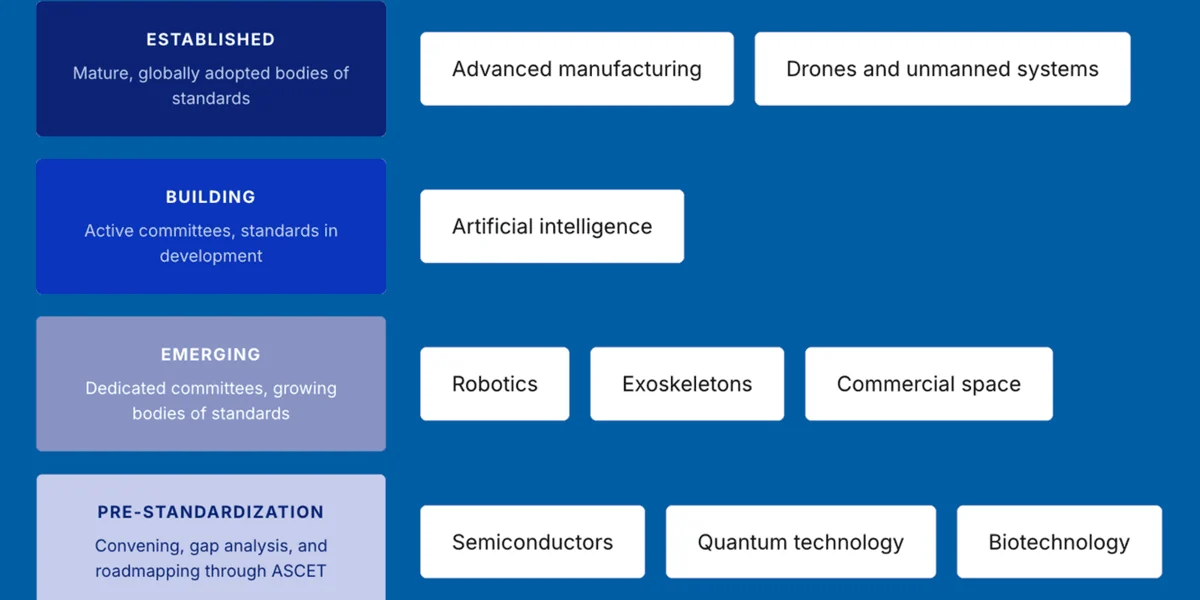
In an era defined by the rapid-fire evolution of artificial intelligence, advanced robotics, and complex semiconductor architectures, the traditional pace of industrial standardization is struggling to keep up. Historically, global standards have followed the path of established innovation—codifying safety and performance long after a technology has saturated the market. However, a seismic shift is underway. ASTM International, the global organization renowned for its foundational role in setting manufacturing and materials standards, has launched a strategic initiative to flip this model on its head. By launching a new Critical and Emerging Technologies (CET) Division, the organization aims to set safety and performance thresholds for "rapidly converging technologies" while they are still in their infancy.
The Convergence Challenge: Defining the New Frontier
At the heart of ASTM’s new initiative is the concept of "converging technologies." In the past, industry sectors operated in silos. Mechanical engineering, electrical engineering, and software development were distinct fields with separate regulatory and standardization frameworks. Today, those boundaries have effectively dissolved.
As ASTM notes, these technologies advance interdependently. Artificial intelligence is no longer a standalone software product; it is the "brain" embedded in autonomous robotics and smart manufacturing systems. These systems, in turn, are powered by advanced semiconductors and highly specialized energy infrastructure. When these pillars of modern industry converge, the risk profile shifts, and the need for universal, repeatable standards becomes critical.
ASTM defines these as technologies that lie at the absolute forefront of innovation. Because they are deeply intertwined, a failure in one component—such as a sensor or a piece of firmware—can have a cascading effect across an entire industrial ecosystem. By focusing on these intersections, ASTM is attempting to move away from the reactive posture of the past toward a proactive, anticipatory framework.
Chronology of a Strategic Pivot
The formation of the CET Division is not a spontaneous reaction but the culmination of a multi-year assessment of global industrial trends.
- The Foundational Era: For decades, ASTM functioned primarily through its Advanced Manufacturing Division, which focused on mature, high-stakes sectors like aerospace, automotive, and medical device manufacturing.
- The Identification Phase (2020–2022): As AI and machine learning began to infiltrate industrial supply chains, ASTM leadership recognized that the "Advanced Manufacturing" moniker was becoming insufficient to cover the rapid horizontal integration of technologies like digital twins, additive manufacturing, and quantum-ready materials.
- The Strategic Realignment (2023): ASTM observed that over 40 national governments had begun publishing their own distinct lists of "critical technologies." While well-intentioned, these lists often shifted based on geopolitical climates, creating a fragmented global landscape that hampered cross-border commerce and interoperability.
- The Launch (2024): ASTM officially rebranded and expanded its Advanced Manufacturing arm into the Critical and Emerging Technologies (CET) Division. This transition marked a formal commitment to embedding standardization directly into the research and development lifecycle of global industry.
Supporting Data: Why Speed is the New Standard
The urgency behind this initiative is supported by the sheer pace of modern industrial evolution. In the 20th century, a new manufacturing technology might take two decades to reach global scale. Today, that window has shrunk to mere years.
ASTM’s new division is currently active across approximately 10 of its core committees and maintains cooperative frameworks across roughly 25 countries. This global footprint is essential because, as the organization points out, "A technology is industrialized and at scale when the quality holds, the results repeat, and it performs the same way globally."
Without a standardized approach, companies face the "Valley of Death"—the gap between a successful laboratory prototype and a mass-market, safe-to-deploy industrial solution. ASTM’s market intelligence indicates that by developing roadmaps for these technologies while they are still in the R&D phase, they can reduce the time-to-market for safe, interoperable products by an estimated 30% to 40%.
Official Perspectives: Shaping the Future
Dr. Mohsen Seifi, Vice President of the Critical and Emerging Technologies Division at ASTM International, has been the primary architect of this new direction. In a recent statement, he emphasized that the organization’s role is no longer just to "write the rules," but to "shape the environment" in which technologies take form.
"We reach that bar of industrialization faster by engaging early," says Dr. Seifi. "We are shaping standards while the technology is still taking form, and carrying the work through to training and certification with partners across industry, government, and academia worldwide."
For ASTM, this is a holistic approach. It is not enough to publish a document; the organization is now actively building "Compass" portals and certification programs that ensure that as soon as a standard is ratified, it is immediately accessible to engineers, manufacturers, and policy-makers globally. This ensures that the standards are not just theoretical, but are embedded into the workforce through training and proficiency testing.
Implications for the Global Economy
The shift toward proactive standardization has profound implications for the global economy, industrial policy, and national security.
1. Reducing Regulatory Fragmentation
As mentioned, the fact that over 40 governments have individual lists of "critical technologies" creates a bureaucratic nightmare for multinational corporations. If a company must adhere to 40 different standards for a single AI-driven robotics platform, innovation slows to a crawl. By providing a neutral, global venue for standardization, ASTM is essentially acting as a diplomatic bridge, helping to harmonize these disparate national requirements into a singular, globally accepted language of safety and performance.
2. De-risking Innovation
Investors and venture capitalists are often wary of "deep tech" because of the regulatory uncertainty. By creating standards at the early stages of technology development, ASTM is providing a roadmap for what "good" looks like. This reduces the risk for companies attempting to scale, as they know exactly what performance metrics they must hit to achieve global compliance.
3. Strengthening Supply Chain Resilience
When technologies converge, supply chains become highly sensitive. A single point of failure in a semiconductor design can shut down automotive plants globally. The CET Division’s focus on the intersections of technology ensures that safety protocols are not just focused on the end product, but on the entire stack of components that make that product possible.
4. A New Model for Collaboration
The CET Division represents a departure from the "ivory tower" model of standards development. By building roadmaps that incorporate market intelligence and feedback from academia and government, ASTM is fostering an ecosystem where the best ideas win. This collaborative model is essential in an age where the pace of change is dictated not by a single firm, but by a global network of researchers and engineers.
Looking Ahead: The Future of the CET Division
The newly launched division maintains advanced manufacturing as its flagship, but it is already incorporating cutting-edge topics that were previously considered "too volatile" for standardization. These include:
- Cyber-Physical Systems: Ensuring that the digital control systems of modern factories are as secure as they are efficient.
- Digital Twins: Creating standards for the high-fidelity simulations that are increasingly used to test products before they are ever built.
- Sustainable Materials: Standardizing the performance metrics for next-generation, environmentally friendly materials that must compete with the structural integrity of traditional steel and plastic.
The success of this initiative will be measured by its ability to maintain relevance. As the "rapidly converging technologies" of today become the "legacy technologies" of tomorrow, the CET Division must remain agile. By defining the roadmap now, ASTM is ensuring that when the next wave of innovation hits, the global industrial foundation will be strong enough to support it.
In the final analysis, ASTM International’s pivot is a recognition of a simple truth: in the 21st century, technology does not wait for standards. If organizations like ASTM do not move to lead the conversation, the vacuum will be filled by a fractured, confusing, and potentially unsafe array of localized regulations. By stepping into this role, ASTM is not just writing standards—it is writing the blueprint for the next industrial revolution.
Whether it is in the labs of Pennsylvania or the factories of Southeast Asia, the work of the CET Division will likely be the invisible hand that ensures the next generation of technological marvels is safe, reliable, and capable of operating on a truly global scale. The race for the future is on, and for the first time, the rulebook is being written in real-time.
About the Author