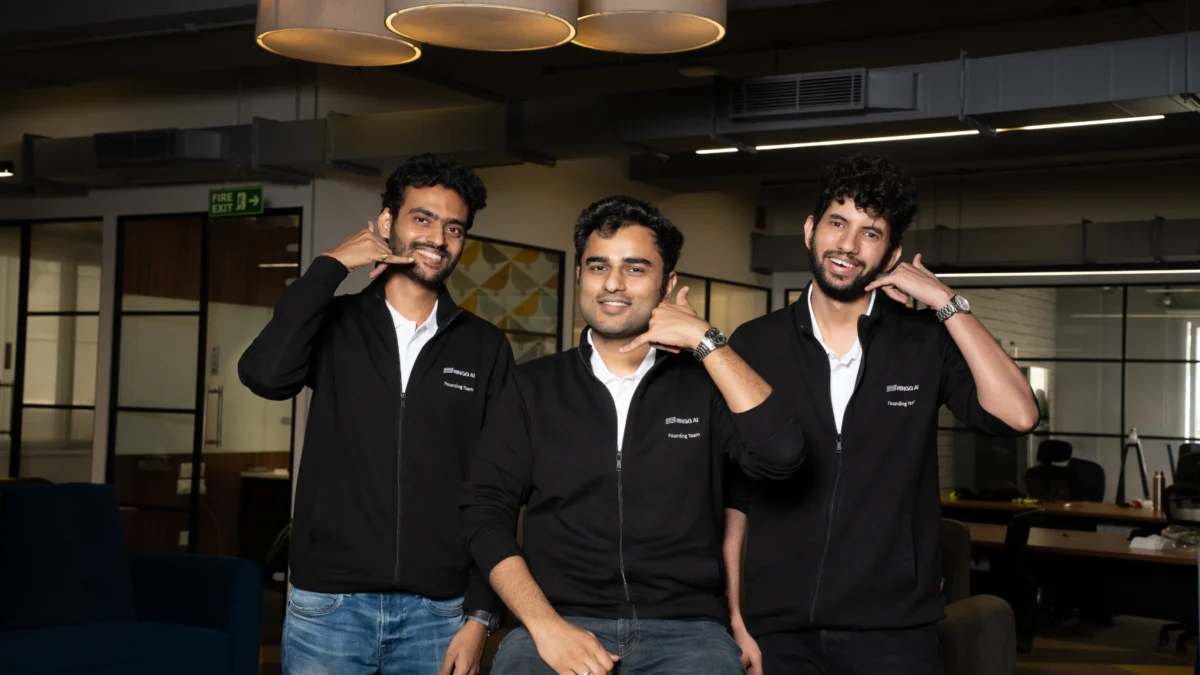
In a market where voice remains the undisputed king of consumer interaction, Indian AI startup Ringg is betting big on the future of automated, intelligent communication. Recent data from Truecaller underscores this reality, revealing that over 76% of Indian consumers prefer phone calls when interacting with businesses. This preference has created a massive, untapped reservoir for voice AI integration, and Ringg is positioning itself as the primary architect of that transformation.
Today, the company announced it has secured $10 million in fresh capital from Peak XV Partners. This investment serves as an extension to its earlier $5.5 million Series A, bringing the startup’s total Series A funding to $15.5 million. With a platform already processing 20 million call attempts monthly, Ringg is rapidly evolving from a niche speech startup into a pivotal enterprise utility.
The Evolution: From DesiVocal to Enterprise Orchestration
Ringg’s journey is a case study in strategic pivoting. The company originated as "DesiVocal," a text-to-speech venture. However, the founders quickly hit a wall common to many AI hardware and software developers: the prohibitive cost of training and maintaining proprietary speech models.
Recognizing that the true value lay not just in the synthesis of voice, but in the application of that voice to solve complex business problems, the team moved "up the stack." Instead of merely selling speech synthesis, they began building autonomous voice AI agents capable of handling intricate enterprise workflows.
This transition proved successful. After securing India’s fintech giant Cred as its inaugural customer, the company’s client roster expanded to include industry titans such as Flipkart, Practo, Groww, and PolicyBazaar. This shift marked a transition from a commodity-based model to a high-value partnership model.
Chronology of Growth and Strategic Shifts
Ringg’s trajectory reflects the maturing nature of the Indian AI ecosystem:
- The Inception: Founded as DesiVocal, the team focused on foundational text-to-speech technology.
- The Pivot: Realizing the capital intensity of model training, the company pivoted to enterprise-grade AI agent orchestration.
- Early Traction: Cred becomes the first major fintech partner, validating the product-market fit.
- Series A (Initial): Raised $5.5 million earlier this year to stabilize operations and expand the engineering team.
- The Expansion: Branching out from simple outbound calling to complex, multi-step workflows like healthcare appointment scheduling and KYC onboarding.
- Series A (Extension): Secures an additional $10 million from Peak XV Partners to aggressively scale infrastructure and product capabilities.
Shifting from Simple Scripts to Complex Workflows
Co-founder Siddharth Tripathi is candid about the limitations of the early AI voice market. "At the start, we were doing high-volume, low-complexity use cases like outbound calling, lead qualification, and loan collection," Tripathi told TechCrunch. "We quickly realized these are not sticky use cases, and so it’s always going to be a price game."
To escape the "race to the bottom" regarding pricing, Ringg has pivoted toward high-value, high-complexity enterprise tasks. These include:
- Healthcare Integration: The company’s agents are currently deployed across 1,200 clinics for the healthcare platform Practo, managing patient bookings and complex post-visit follow-up sequences.
- E-commerce Logistics: Automating abandoned-cart recovery, a process that requires nuanced understanding and real-time intervention to prevent lost revenue.
- Fintech Onboarding: Managing the stringent, multi-step Know Your Customer (KYC) requirements that are vital to India’s rapidly growing financial sector.
While voice calls still comprise over 70% of Ringg’s operations, the company is diversifying. It has expanded into chat and WhatsApp automation, and is even automating browser-based support requests for global entities like Shell.
Official Perspectives: The Tech Behind the Voice
Rishen Kapoor, a principal at Peak XV, highlights why Ringg stood out in an increasingly crowded market. "Because of the technical capabilities, they can actually do these hard-won enterprise workflows end to end," Kapoor noted. "They can complete these higher-value tasks like merchant onboarding, like L1 and L2 support, with quality and with consistency."
Kapoor points to Ringg’s roots as a research lab as a distinct advantage. Because the team spent significant time building their own speech recognition and generation models, they possess a technical depth that many "wrapper" startups—those that simply plug into existing APIs without understanding the underlying mechanics—lack.
Currently, Ringg functions as an "orchestration layer." While the startup is developing its own models, it currently routes tasks to various models based on the specific requirements of the use case. This modularity allows them to maintain high quality while keeping costs manageable, avoiding the trap of being tied to a single, potentially expensive or underperforming, proprietary model.
The Competitive Landscape
The Indian voice AI market is currently a battleground. Startups are generally divided into three categories:
- Model Makers: Companies like Deepgram, ElevenLabs, and India’s own Sarvam AI and Smallest.ai, which focus on the raw, underlying AI architecture.
- Orchestrators: Startups like Bolna and Blue Machines, which, like Ringg, focus on the "glue" that connects models to specific business outcomes.
- Sector-Focused Players: Companies like Gnani and Arrowhead, which concentrate exclusively on deep domain expertise within the financial services sector.
The industry consensus is shifting: the real defensibility lies not in the models themselves—which are rapidly becoming commoditized—but in the ownership of the customer relationship and the consistent delivery of measurable business outcomes. By positioning itself as a platform that "gets things done" rather than just a voice interface, Ringg is aiming to secure long-term loyalty from its enterprise clients.
Future Implications: The Rise of Global Capability Centers
Perhaps the most interesting facet of Ringg’s growth strategy is its relationship with Global Capability Centers (GCCs). Rather than attempting to break into the U.S. or European markets directly, Ringg is positioning itself as a partner for the massive offshore hubs that multinational corporations maintain in India.
By integrating its voice AI capacity into the workflows of these GCCs, Ringg allows them to scale their operations without a proportional increase in human headcount. This "co-pilot" approach—where AI handles the bulk of routine and semi-complex tasks while human agents intervene only when necessary—is likely to be the standard operational model for multinational support centers over the next decade.
Scaling for the Future
The $10 million infusion of capital will be primarily directed toward human capital and research. With 40 employees and a hiring surge that saw 15 new staff members added in the last quarter, Ringg is aggressively expanding its engineering ranks.
The startup is specifically looking for "forward-deployed engineers"—a hybrid role that combines deep technical expertise with the product-management skills required to deploy AI solutions within complex, legacy enterprise environments. Furthermore, the company is doubling down on research aimed at driving down the compute costs of running these models, a move that will be critical as they seek to increase their processing volume from 20 million calls a month to a significantly higher threshold.
As voice AI matures from a novelty into a critical business utility, Ringg’s strategy of balancing proprietary research with pragmatic, high-value enterprise orchestration places it at the forefront of a significant technological shift. In a country where the phone remains the preferred medium for commerce, the race to own the "voice experience" is just beginning, and Ringg has clearly signaled that it intends to lead the pack.
About the Author