In a move that underscores the ongoing consolidation and technological maturation of the North American logistics sector, the Descartes Systems Group has officially announced the acquisition of TAI Software for $100 million. This high-profile deal marks a significant milestone in Descartes’ broader strategy to build a unified, AI-powered ecosystem for freight brokers, positioning the company as a dominant force in the battle against margin compression, operational fragmentation, and the escalating threat of freight fraud.
By folding TAI Software—a robust, cloud-native freight brokerage platform—into its existing portfolio, which already boasts industry mainstays like MacroPoint, MyCarrierPortal, and Aljex, Descartes is signaling that the future of logistics is not just about connectivity, but about the seamless integration of intelligence into every step of the shipment lifecycle.
The Core Facts: A $100 Million Strategic Investment
The $100 million cash transaction represents one of the most significant pieces of M&A activity in the freight-tech space this year. For Descartes, the acquisition is not an isolated event but rather a calculated expansion of its Transportation Management Solutions (TMS) footprint.
The acquisition addresses a fundamental pain point in the current brokerage market: the "swivel-chair" workflow. Brokers have historically been forced to toggle between disconnected applications to manage quoting, carrier sourcing, tracking, and compliance. By integrating TAI’s intuitive brokerage platform with Descartes’ massive data network, the company aims to create a single, unified execution layer. This allows brokers to ingest data, generate quotes, and secure capacity without leaving a centralized interface, effectively eliminating the inefficiencies that have plagued the brokerage industry for decades.
Chronology: The Road to Consolidation
Descartes’ path to this acquisition has been defined by a methodical approach to market dominance. Over the last several years, the company has focused on acquiring high-value, specialized logistics software providers to fill critical gaps in its portfolio.
- 2023-2024: Descartes began identifying a need for deeper integration within the managed transportation and brokerage sectors. The acquisition of 3G, a move focused on the managed transportation market, served as the initial precursor to the current strategy.
- Early 2025: Descartes began internal discussions regarding the potential of TAI Software, recognizing that TAI’s technological capabilities—specifically its automation-heavy approach to freight management—complemented Descartes’ existing data assets perfectly.
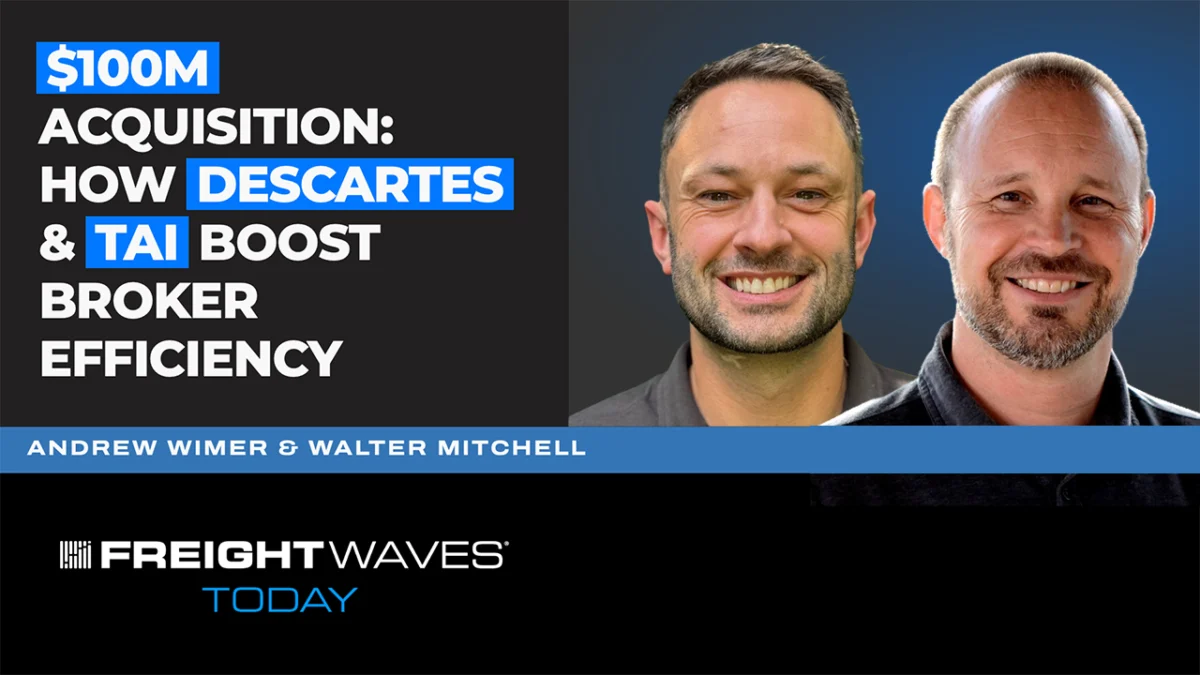
- The Announcement: During a recent interview on FreightWaves Today, leadership from both companies confirmed the deal. The announcement was presented not as an exit for TAI, but as an evolution, with TAI’s former CEO, Walter Mitchell, transitioning to the role of VP of Transportation Management Solutions at Descartes.
- Future Outlook: Moving forward, the integration process is expected to be iterative. While TAI’s existing customers will continue to operate with their current tools, they will gradually gain access to Descartes’ proprietary data feeds, including MacroPoint’s visibility solutions and MyCarrierPortal’s compliance data.
Supporting Data: Why the Market Demands This Merger
The logic behind this $100 million investment is rooted in harsh industry realities. Modern freight brokers are navigating an environment characterized by thinning margins and high-stakes operational risks.
1. Combating Margin Pressure
Brokers are currently dealing with a hyper-competitive rate environment. The ability to quote accurately and in real-time is no longer a luxury; it is a requirement for survival. TAI’s inbound email automation, which can ingest spot-quote requests and generate execution-ready responses, significantly reduces the time-to-quote. When layered with Descartes’ carrier analytics, these quotes become more precise, allowing brokers to maintain healthy margins while remaining competitive.
2. The War on Freight Fraud
Fraud has become the single most significant operational risk in the trucking industry. Cargo theft, identity theft, and double-brokering have eroded trust in digital marketplaces. By integrating TAI’s platform with Descartes’ extensive fraud-mitigation data, the combined entity provides brokers with a "safety-first" operating environment. The platform can now cross-reference carriers against historical data, insurance gaps, and industry blacklists in near-real-time, effectively automating the due-diligence process.
3. Workflow Efficiency
Fragmentation is the "hidden tax" on brokerage profitability. The average broker uses between five and seven different software tools to manage a single load. Descartes’ vision of a "single execution layer" aims to slash this number. By centralizing the tech stack, firms can reduce administrative overhead, minimize human error, and allow their staff to focus on high-value tasks like relationship building rather than data entry.
Official Responses and Strategic Vision
The leadership at both Descartes and TAI have been vocal about the "why" behind the merger. Walter Mitchell, now of Descartes, emphasizes that the goal is not to force immediate change, but to offer a clear path toward technological maturity for brokers of all sizes.
"What it means for our new customers, the customers who are coming with us and the rest of the freight brokers, is [the] opportunity to continue to level up and continue to have great products available to them that will help them become better freight brokers," Mitchell noted.
Andrew Wimer, Associate GM of Transportation Management Solutions at Descartes, echoed this sentiment, framing the move as a deliberate portfolio strategy rather than opportunistic shopping. Wimer pushed back against the narrative that this is merely another wave of market consolidation, arguing that it is instead a "methodical" build-out of a comprehensive logistics network.
"We really believe that the future state here is a single execution layer for the customers, for the brokers to operate efficiently," Wimer said. "Not for AI’s sake or automation’s sake… but for realizing and earning or seeing value in saving time, in delivering value to their customers."
Implications: The Future of Freight Brokerage
The acquisition carries profound implications for the industry. First, it sets a high bar for competitors. Independent TMS providers will now face increased pressure to either build out similar integration capabilities or risk losing market share to firms that offer a "one-stop-shop" ecosystem.
Second, the product roadmap for TAI has been accelerated. Prior to the acquisition, TAI had two aspirational goals: to build a platform where a broker would never have to make a "check call" again, and one where a broker would "never lose a load again." With the combined resources of the Descartes network, these goals have shifted from aspirational to highly attainable.
Mode-Specific Impacts
While the platform is multimodal, the immediate impact will be felt in the truckload segment, where the majority of TAI’s current volume resides. However, the roadmap clearly defines a trajectory for drayage, cross-border, and LTL integration. By centralizing these modes, Descartes is positioning itself as the primary infrastructure provider for brokers who handle complex, multi-modal supply chains.
Conclusion: A Turning Point for Freight-Tech
The $100 million acquisition of TAI Software by Descartes is a bellwether for the logistics industry. It signals that the era of the "siloed software provider" is nearing its end. As brokers face increasing complexity, the winners of the next decade will be those who can harness the power of unified data to drive automated decision-making.
For the broker, the message is clear: the technology stack of the future will be defined by integration, intelligence, and the relentless pursuit of operational efficiency. As Descartes continues to weave its disparate assets into a cohesive fabric, the freight brokerage landscape looks set to become significantly more professionalized, secure, and, ultimately, more profitable for those who embrace the new, unified paradigm.
About the Author