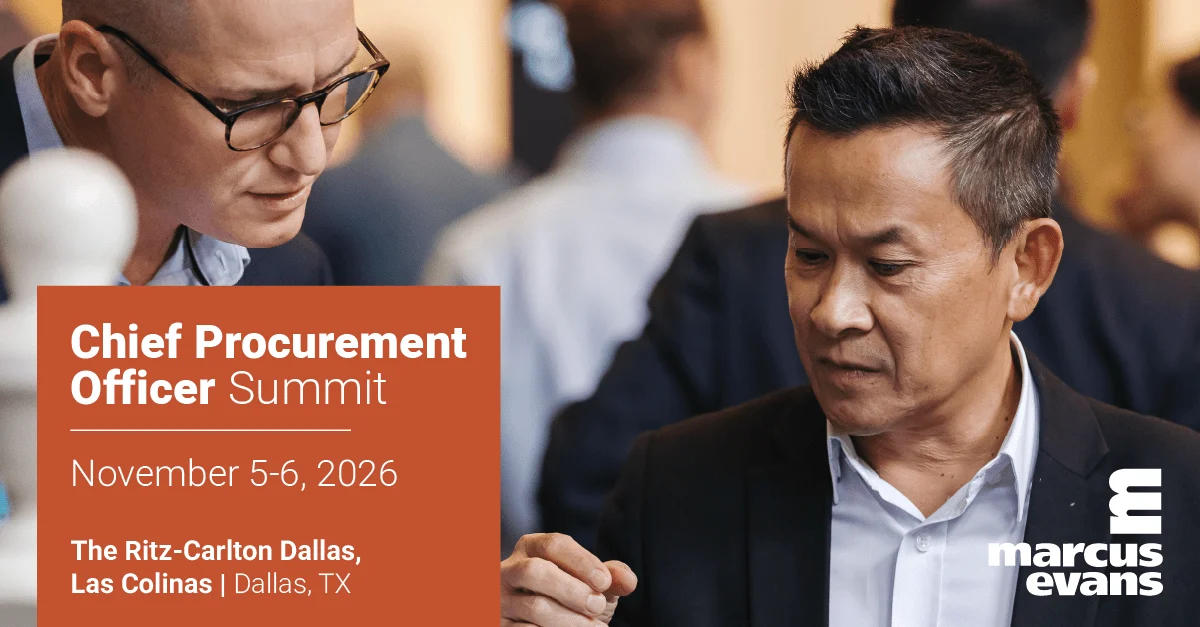
DALLAS, TX – In an era defined by geopolitical volatility, rapid technological disruption, and the imperative for sustainable growth, the role of the Chief Procurement Officer (CPO) has shifted from a back-office support function to a strategic boardroom pillar. Recognizing this pivotal transition, global business intelligence leader Marcus Evans has officially announced the Chief Procurement Officer Summit, scheduled to take place from November 5 to 6, 2026, at the prestigious Ritz-Carlton Dallas, Las Colinas.
This invitation-only, premium summit is set to serve as a high-level nexus for senior procurement executives, industry pioneers, and elite solution providers. By fostering an environment of exclusive, peer-to-peer collaboration, the event aims to equip leaders with the strategic foresight and operational agility required to navigate the complexities of the modern global supply chain.
Main Facts: A Convergence of Procurement Leadership
The 2026 CPO Summit is engineered for a specific audience: the C-suite and high-level executives responsible for steering massive supply chain organizations. Unlike broad-spectrum industry conferences, this event is curated to ensure that every participant—whether an executive attendee or a solution partner—engages in high-stakes, high-impact dialogue.
The event’s value proposition is rooted in its structure. Over the course of two days, attendees will participate in:
- Visionary Keynotes: Insights from global industry titans on the trajectory of the procurement function.
- Real-Life Case Studies: Practical, "war-room" style breakdowns of successful transformations at major enterprises.
- Interactive Forums: Small-group discussions led by expert moderators designed to solve specific, granular pain points.
The summit is not merely a lecture series; it is a collaborative laboratory. By integrating senior decision-makers with a select group of vetted suppliers, Marcus Evans facilitates a unique ecosystem where theoretical strategies meet practical implementation, effectively bridging the gap between ambition and execution.
Chronology of Challenges: Why 2026 Is the Critical Year
To understand the urgency behind this year’s agenda, one must look at the timeline of global trade. The years leading up to 2026 have been characterized by a "permacrisis"—a state of constant disruption that has permanently altered the procurement landscape.
2023–2024: The Era of Reactive Resilience
The procurement sector spent this period focusing on basic continuity. Following the global shocks of the early 2020s, organizations prioritized inventory buffers, dual-sourcing strategies, and the stabilization of shaky vendor relationships.
2025: The Year of Digital Maturation
As highlighted by recent Marcus Evans initiatives—including the 2nd Supply Chain & Logistics Summit—2025 served as the year where digital transformation moved from a buzzword to a requirement. Organizations began experimenting with AI-driven analytics and early-stage automation, learning from the pitfalls of rapid, uncoordinated adoption.
2026: The Year of Strategic Integration
The upcoming November summit arrives at a critical juncture. By late 2026, the industry will have moved beyond the "pilot phase." The focus will shift from if a company is using AI or data-governance models to how those models are delivering measurable, bottom-line impact. The agenda is designed to address the specific fatigue of "transformation-heavy" organizations that are now struggling to scale their successes.
Supporting Data: The Pillars of Modern Procurement
The 2026 summit agenda is built upon data-backed pillars that reflect the primary concerns of the modern CPO.
1. AI Integration and the Implementation Gap
Current market research indicates that while 85% of procurement leaders intend to integrate AI into their workflows by 2027, fewer than 30% have successfully moved beyond proof-of-concept. The summit will dedicate significant time to dissecting this gap, focusing on "practical, measurable implementation."
2. The Data Governance Foundation
AI is only as good as the data it consumes. A key theme of the summit is data integrity. As enterprises consolidate fragmented datasets, the focus will be on the architecture of procurement data—ensuring that information is cleansed, standardized, and ready for AI-enabled decision-making.
3. Macro-Economic Volatility and Trade Policy
The geopolitical landscape remains a primary source of risk. The summit will provide expert-led sessions on:
- Tariff Uncertainty: Strategies for mitigating the impact of fluctuating trade policies.
- USMCA Renewal: Understanding the long-term implications of the United States-Mexico-Canada Agreement and how it dictates cross-border sourcing.
- Macro-Economic Hedging: How procurement strategy must align with fiscal policy and inflation trends to protect organizational margins.
Official Responses: Voices from the Vanguard
The credibility of the CPO Summit is cemented by its confirmed speaker lineup, which features some of the most influential minds in the global supply chain. These leaders represent diverse sectors, from industrial manufacturing to luxury retail, providing a holistic view of the profession.
- Michael Shin (Chief Supply Chain Officer, Trinity Industries): Bringing a wealth of experience in heavy-duty logistics and industrial manufacturing, Shin’s insights into scaling operations during economic cycles are expected to be a highlight of the summit.
- Adam Paul (Head of Procurement, Analog Devices): In the semiconductor and electronics space, Paul represents the cutting edge of supply chain security and high-tech procurement.
- Gary Levitian (Chief Procurement & Supply Chain Executive, Louis Vuitton): Levitian’s presence underscores the evolution of procurement in luxury, where sustainability, provenance, and ethical sourcing are as critical as cost-efficiency.
- Alex Lundstrom (VP of Indirect Procurement, Danone): Representing the fast-moving consumer goods (FMCG) sector, Lundstrom will lead discussions on managing indirect spend—a critical lever for profitability in high-volume, low-margin environments.
These executives are not merely presenters; they are active participants in the "strategic partnering" aspect of the summit, contributing to the dialogue on how to build "disruption-proof" operating models.
Implications: The Future of the Procurement Function
The implications of the 2026 CPO Summit extend far beyond the two days spent at the Ritz-Carlton. The themes addressed at the summit will likely dictate the "procurement playbook" for the remainder of the decade.
The Shift Toward Co-Creation
A central takeaway from the summit’s mission is the shift from transactional vendor management to strategic supplier collaboration. The era of squeezing suppliers for the lowest price is waning; the new era involves "co-creating value." This means building long-term, structured partnerships where procurement leaders and their suppliers jointly pursue innovation, R&D, and performance outcomes that create a competitive moat for both parties.
Talent and Capability Transformation
Perhaps the most human-centric challenge discussed will be the evolution of the procurement workforce. As automation takes over rote tasks, the "procurement professional of the future" requires a vastly different skillset. The summit will explore the "people capabilities" needed to manage this shift, emphasizing emotional intelligence, strategic negotiation, and data literacy over traditional administrative expertise.
Sustainability as a Business Driver
While not explicitly labeled as a standalone topic, the concept of "resilient strategies" inherently encompasses sustainability. In 2026, the ability to maintain supply chains that are both compliant with increasingly stringent global ESG (Environmental, Social, and Governance) regulations and economically viable is the ultimate test of a CPO’s leadership.
Conclusion: A Premier Networking Ecosystem
With over four decades of experience in the business events sector, Marcus Evans has refined the art of the "executive summit." In a world of digital fatigue, the company’s commitment to high-touch, face-to-face engagement remains its most potent tool.
For the Chief Procurement Officer, the summit offers a rare opportunity to step out of the daily churn of supply chain management and into a space of reflection and high-level strategy. It is a venue for finding solutions that are not just theoretically sound but tested by peers in real-world scenarios. For solution providers, it offers an efficient, direct line to the decision-makers who hold the keys to the future of the enterprise.
As the industry prepares for the 2026 CPO Summit, the message is clear: the challenges of the coming decade will not be solved by business as usual. They will be solved by the collective intelligence, strategic partnerships, and bold leadership fostered within the halls of the Ritz-Carlton Dallas, Las Colinas.
About Marcus Evans
Marcus Evans is a preeminent global media and information company, facilitating the flow of intelligence and professional networks across 59 worldwide locations. With a professional workforce of 3,000, the organization remains dedicated to delivering high-impact, sector-focused events that define the leading edge of corporate strategy.
For those interested in participating, the 2026 Chief Procurement Officer Summit remains an invitation-only event. Prospective attendees and solution providers are encouraged to connect with Marcus Evans early to ensure alignment with the high-level executive profile of the delegation.
About the Author