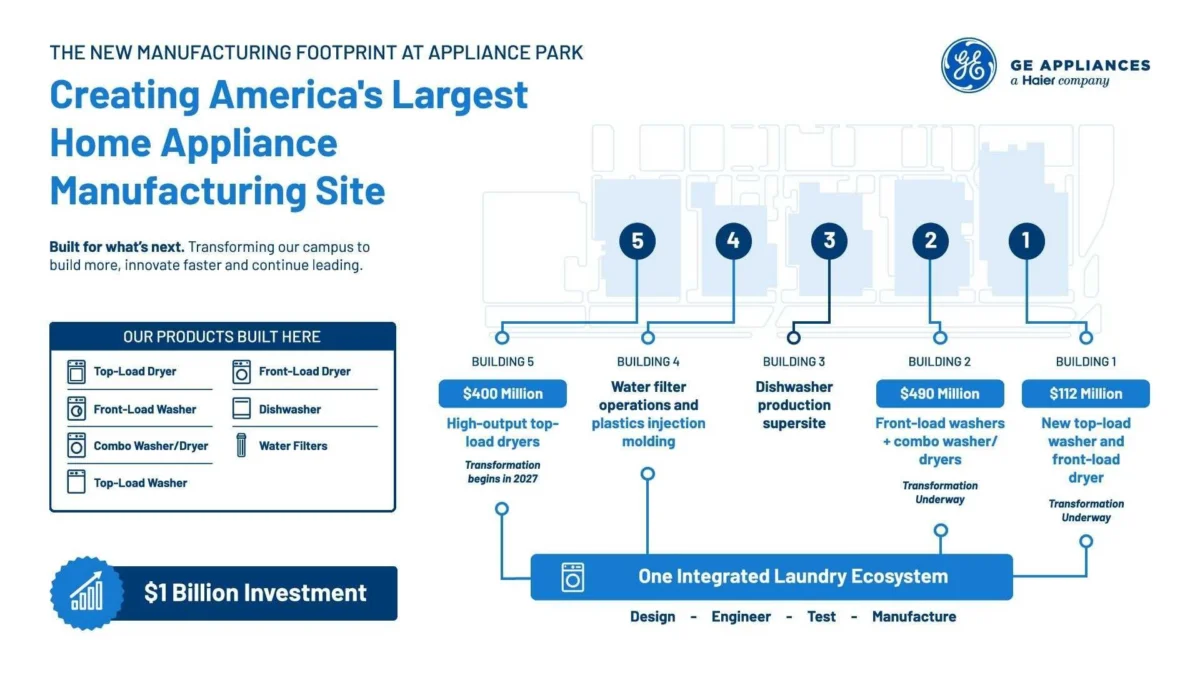
In a landmark announcement that underscores a significant shift in domestic industrial strategy, GE Appliances (GEA)—a subsidiary of the Haier Corporation—has unveiled a sweeping $1 billion investment plan for its historic Appliance Park facility in Louisville, Kentucky. The capital injection is set to transform the sprawling campus into the largest home appliance manufacturing site in the United States, cementing the region’s role as the beating heart of American white-goods production.
This strategic overhaul is designed to hyper-scale the production of laundry appliances, specifically washers and dryers, while realigning the company’s broader manufacturing footprint. By centralizing high-output laundry operations in Kentucky and shifting refrigeration manufacturing to specialized facilities in the South, GEA is betting heavily on domestic manufacturing efficiencies and supply chain resilience.
The Strategic Shift: Core Facts and Objectives
The centerpiece of this $1 billion investment is the comprehensive modernization of "Building 5" at Appliance Park. This facility, which has served as a cornerstone of GEA’s production capacity for decades, will undergo a massive technological retrofit.
According to joint statements from GE Appliances and the IUE-CWA (International Union of Electronic, Electrical, Salaried, Machine and Furniture Workers–Communications Workers of America), the investment will not only increase physical output but will also integrate advanced automation and robotics. The primary objective is to create a "mega-site" capable of meeting the surging demand for modern laundry appliances, which have seen a shift in consumer preference toward higher-capacity, connected, and energy-efficient models.
The expansion is not merely an increase in floor space; it represents a fundamental pivot in how GEA approaches the North American market. By consolidating laundry production, the company aims to reduce logistical friction, optimize its raw material supply chain, and leverage the existing skilled workforce in the Louisville metropolitan area.
Chronology of the Transition
The transition period for this project is marked by a clear, phased approach to ensure minimal disruption to the company’s retail distribution network.
Phase 1: Preparation and Sunset (2024–2026)
Following the announcement, the next three years will be dedicated to tooling and facility reconfiguration. GEA has outlined a specific timeline for the phasing out of current refrigeration production lines within Building 5. This period allows the company to balance existing inventory commitments with the necessary structural upgrades required for heavy-duty laundry appliance manufacturing.
Phase 2: The Operational Transition (Early 2027)
Early 2027 marks the official conclusion of refrigeration production at the Louisville facility. This is a critical milestone, as it signals the end of a long-standing manufacturing legacy for that specific building, paving the way for the arrival of new, state-of-the-art laundry production machinery.
Phase 3: Launch and Scaling (Late 2027)
The final phase of the initial plan involves the commencement of new dryer production. By late 2027, the facility is expected to be fully operational, with production lines synchronized to meet the anticipated holiday and Q4 demand cycles. Following this, GEA will systematically ramp up output, leveraging the new layout to increase throughput compared to previous capacities.
Supporting Data: A National Manufacturing Network
One of the most common questions regarding the consolidation at Appliance Park is the future of GEA’s refrigeration portfolio. The company has moved to reassure stakeholders that while Louisville is pivoting, the company’s total U.S. manufacturing footprint remains robust.
The refrigeration manufacturing capacity previously housed in Building 5 will be seamlessly absorbed by GEA’s existing network:
- Decatur, Alabama: As the largest refrigeration manufacturing operation in the United States, the Decatur plant is slated to absorb the bulk of the redirected workload. Its scale and existing supply chains make it the ideal candidate for high-volume refrigerator production.
- Selmer, Tennessee: This facility will continue to play a vital role in specialized refrigeration production, providing necessary redundancy and capacity to support the national market.
By centralizing laundry in Kentucky and refrigeration in Alabama and Tennessee, GEA is creating a "center of excellence" model. This approach minimizes the complexity of individual plants by allowing them to focus on specific product categories, thereby increasing the technical expertise of the local workforce and streamlining quality control processes.
Official Responses and Stakeholder Perspectives
The project is the result of intensive collaboration between GE Appliances’ executive leadership and the IUE-CWA.
GE Appliances’ Stance
"This investment is a testament to our commitment to American manufacturing and the skill of our Louisville workforce," a company spokesperson noted. "By concentrating our efforts, we are creating a facility that is not just bigger, but smarter and more efficient. This is about securing the long-term viability of Appliance Park in a global marketplace."
The Union Perspective
The IUE-CWA has been a vocal supporter of the project, highlighting the role of organized labor in securing these investments. Leadership from the union noted that the $1 billion plan provides job security for thousands of workers and emphasizes the importance of maintaining high-quality, unionized manufacturing jobs within the United States. The partnership between the company and the union is widely viewed as a blueprint for modern industrial relations, focusing on job retention and skill development in the face of rapid technological change.
Implications: The Broader Economic Impact
The implications of this $1 billion investment extend far beyond the walls of the Louisville factory.
1. Strengthening the "Rust Belt" Resurgence
For Kentucky, the project is a significant economic win. As manufacturing continues to return to the U.S. due to volatile global shipping costs and geopolitical instability, Louisville is positioning itself as a primary beneficiary. The expansion is expected to bring new vendors, logistics providers, and secondary service businesses to the region, creating a "multiplier effect" on the local economy.
2. Supply Chain Resilience
By moving away from a reliance on long-distance ocean freight, GEA is shortening its supply chain. In an era where "just-in-time" manufacturing is being replaced by "just-in-case" inventory strategies, producing appliances closer to the point of consumption is a strategic masterstroke. It allows the company to respond more rapidly to consumer trends—such as the sudden demand for smart appliances or specific aesthetic finishes—without the lag time associated with overseas shipping.
3. Technological Leadership
The integration of Industry 4.0 standards into the new laundry facility suggests that GEA is looking to compete not just on price, but on quality and innovation. The use of advanced robotics, AI-driven predictive maintenance, and IoT (Internet of Things) connectivity in the factory itself will likely make the Louisville site one of the most technologically advanced appliance plants in the world.
4. Setting a Precedent for Haier
The decision by the Haier Corporation to pour $1 billion into a U.S.-based facility sends a strong signal to global markets. It demonstrates that domestic production in high-cost labor markets remains viable when supported by capital investment, automation, and a highly skilled workforce. This could influence future investment decisions by other multinational corporations currently evaluating their global manufacturing strategies.
Conclusion: A New Era for Appliance Park
The transformation of Appliance Park is more than just a facility upgrade; it is a declaration of intent. As GE Appliances navigates the complexities of the 21st-century global economy, its decision to double down on Kentucky highlights the enduring power of American manufacturing.
By 2027, the Louisville facility will look vastly different than it does today. With a laser focus on laundry production, a massive influx of technological capital, and the support of a unionized workforce, the plant is poised to become the undisputed leader in U.S. appliance manufacturing. For the thousands of employees at the site, the community of Louisville, and the broader American industrial landscape, this $1 billion investment represents a promising future—a future built on the foundation of stability, innovation, and large-scale domestic output.
As the industry watches, the successful execution of this plan will likely serve as a benchmark for how large-scale manufacturing can evolve, adapt, and thrive in a rapidly changing world. The journey from refrigeration to a laundry powerhouse is just beginning, and all eyes are on Louisville.
About the Author