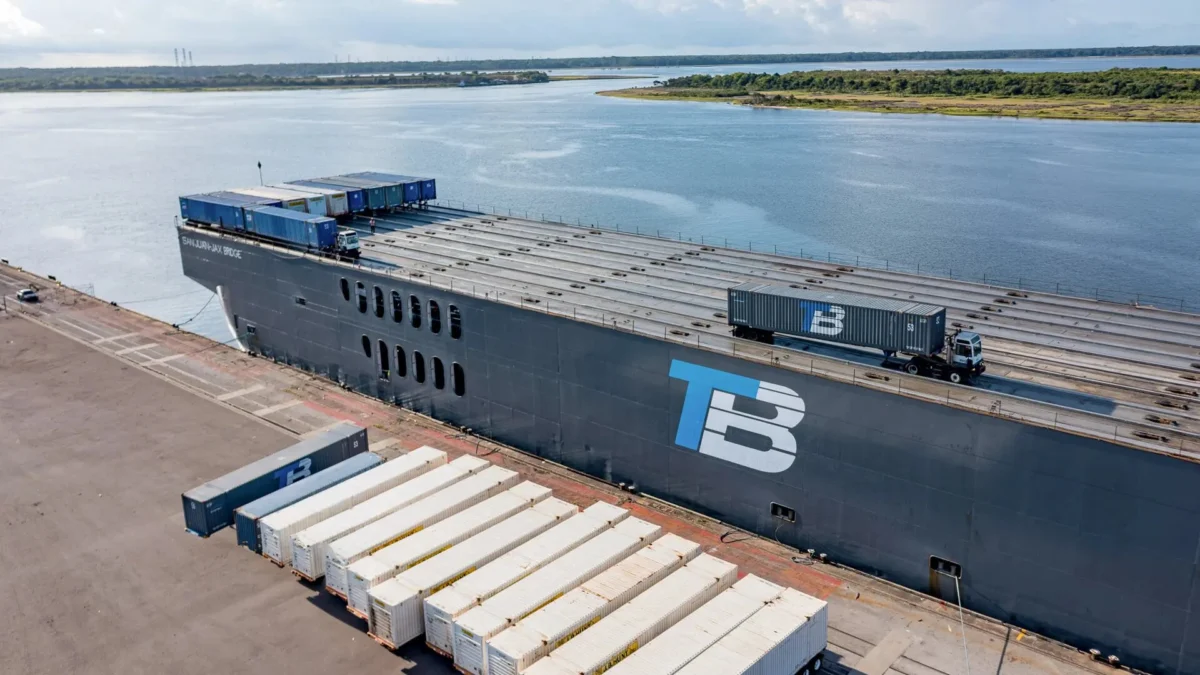
In a move set to redefine the logistics landscape of the vital Jacksonville-to-San Juan trade lane, Jacksonville-based carrier Trailer Bridge has entered into a landmark 10-year agreement with terminal operator Ports America. This partnership, which features options for two five-year extensions, effectively secures a potential 20-year operating horizon for one of the most critical Jones Act routes in the United States.
By consolidating stevedoring, terminal management, and cutting-edge digital infrastructure under the experienced purview of Ports America, the alliance aims to transform the efficiency of the Blount Island terminal at Jaxport. For shippers, this means a shift toward a more transparent, predictable, and technologically advanced supply chain.
The Core Agreement: A Decade of Operational Synergy
At the heart of the agreement is the integration of physical labor and digital oversight. Trailer Bridge, known for its asset-light model and specialized expertise in Jones Act maritime services, has tasked Ports America with the end-to-end management of cargo handling at its Blount Island facility.
The partnership is not merely a service contract; it is a structural realignment. Ports America will leverage its extensive North American footprint—which spans container, roll-on/roll-off (ro-ro), vehicle, and military terminals—to provide the stevedoring labor and operational expertise necessary to streamline the Jacksonville operation. By centralizing these functions, the two companies aim to eliminate the friction often associated with handoffs between disparate service providers.
Implementing the Dockworks Ecosystem
Perhaps the most significant component of the deal is the deployment of Ports America’s proprietary "Dockworks" terminal operating system (TOS). The integration of this platform is expected to be a game-changer for supply chain visibility. While the physical transition is immediate, the rollout of customer-facing digital tools is slated for 2027. Once operational, these tools will provide shippers with real-time, granular data regarding the movement of trailers and containers along the Jacksonville-San Juan corridor.
A Chronology of the Jacksonville-Puerto Rico Gateway
The significance of this deal cannot be overstated when viewed through the lens of Jacksonville’s evolution as a global logistics hub.
- Pre-Agreement Era: For years, the Jacksonville-San Juan lane has relied on a patchwork of service providers, creating pockets of inefficiency in equipment utilization and cargo tracking.
- Early 2024: Strategic discussions between Trailer Bridge and Ports America intensified, focusing on the need for a unified terminal platform to stabilize operations amid increasing volume and shifting regulatory demands.
- July 2024: The broader importance of the port was highlighted when Zim and Mediterranean Shipping Co. inaugurated the ZCP-Amberjack container service, linking Asia to the Caribbean and Latin America via Jacksonville, further solidifying the port’s status as a gateway.
- Present Day: The signing of the 10-year deal marks the formalization of this long-term strategy, setting a template for how specialized Jones Act carriers can scale their operations through collaborative infrastructure.
- 2027 Projections: The targeted launch of the full suite of Dockworks customer-facing visibility tools is expected to mark a new era of "predictable shipping" for the Puerto Rico trade.
Supporting Data: Why Jones Act Stability Matters
The Jones Act trade remains the lifeblood of Puerto Rico’s economy, necessitating a level of reliability that standard commercial routes often do not demand. Trailer Bridge’s operation is uniquely focused on domestic ocean freight, international forwarding, and complex U.S. government logistics.
Data from the maritime industry suggests that the biggest "leakage" in supply chain efficiency occurs during the transition between the terminal gate and the vessel. By utilizing a single operating system (Dockworks) across the terminal, the partners anticipate a measurable reduction in dwell times. Furthermore, the consolidation of ro-ro and breakbulk handling expertise allows for better utilization of vessel capacity—a critical factor for a carrier that must balance high-demand consumer goods with oversized or specialized government cargo.
The investment in technology is a direct response to the industry’s ongoing struggle with transparency. As highlighted in recent freight market reports, container shipping has faced significant volatility, with on-time performance metrics fluctuating wildly. By investing in a dedicated TOS, Trailer Bridge is effectively insulating its Puerto Rican customers from broader market disruptions.
Official Perspectives: The Value of the Partnership
For Trailer Bridge, this agreement represents a "force multiplier." Company leadership has signaled that by offloading the complexities of terminal operations to a specialized global operator like Ports America, they can focus their internal resources on their core competencies: freight forwarding, customer service, and the expansion of their niche logistics services.
Ports America has characterized the deal as an expansion of its already robust presence in the Jones Act market. In public statements, the operator emphasized that its goal is to bring "industrial-grade reliability" to the Puerto Rico trade. By tying physical terminal handling to a modern, integrated digital system, Ports America is essentially promising a "black box" of consistency—where shippers no longer need to navigate the nuances of terminal handoffs or manual reporting.
Strategic Implications: What This Means for the Market
The implications of this deal extend far beyond the docks at Blount Island.
Strengthening the Mainland-Puerto Rico Corridor
Jacksonville has long competed with other East Coast ports for dominance in the Puerto Rico trade. This long-term commitment between two major players effectively "locks in" a significant portion of that trade to Jacksonville for at least the next decade, and potentially two. For the port authority (Jaxport), this provides a level of certainty that allows for future capital investment in berthing, dredging, and landside infrastructure.
The Rise of "Integrated Logistics"
This partnership is a prime example of the "integrated logistics" trend, where carriers move away from being simple providers of transport and toward becoming providers of "visibility." In an era where shippers demand Amazon-like tracking for industrial freight, the Dockworks integration is a necessary competitive response.
Resilience Amid Global Volatility
While the global container market deals with external shocks—such as port congestion, geopolitical tensions, and shifting trans-Pacific spot rates—the Jones Act trades are inherently protected by regulatory structure. However, they are not immune to operational inefficiency. By stabilizing the terminal side of the equation, Trailer Bridge and Ports America are creating a "fortress" of reliability. This allows shippers to plan their inventory cycles with higher precision, reducing the need for safety stock and lowering overall logistics costs.
Conclusion: A New Standard for Jones Act Trade
As the global supply chain continues to prioritize data-driven decision-making, the partnership between Trailer Bridge and Ports America serves as a bellwether for the future of domestic maritime commerce. By marrying the operational scale of Ports America with the specialized, customer-centric focus of Trailer Bridge, the alliance is poised to eliminate long-standing inefficiencies in the Jacksonville-San Juan trade.
For the stakeholders involved—from the government entities relying on these vessels for logistics to the private shippers moving consumer goods—the next 10 to 20 years will likely be defined by a more visible, predictable, and resilient maritime highway. As the industry looks toward the 2027 rollout of full digital visibility, the message to the market is clear: the era of manual, opaque terminal handling is coming to an end, replaced by a modern, integrated, and technology-first future.
About the Author