An arc-flash label is often viewed by maintenance teams and plant managers as the definitive word on electrical safety—a cold, hard fact printed on a sticker that dictates the level of Personal Protective Equipment (PPE) required for a task. However, in the complex landscape of modern industrial facilities, a label that is technically accurate on the day of its installation can become a dangerous liability within 24 hours.
The core of the problem lies in a disconnect between static documentation and dynamic electrical environments. If an arc-flash label reflects a "normal" plant configuration, but the plant is operating in a bypass, maintenance, or backup mode, that label is not just outdated—it is a potential catalyst for catastrophe.
Main Facts: The Illusion of Static Safety
At its most fundamental level, an arc-flash label is the field-facing result of a series of complex engineering calculations, not a live, real-time reading of electrical potential. Following the guidelines set by IEEE 1584: Guide for Performing Arc-Flash Hazard Calculations, engineers model various scenarios to predict incident thermal energy and determine arc-flash boundaries for three-phase AC systems.
However, these models rely on a set of rigid assumptions: available fault current, protective device clearing times, transformer impedance, and the physical distance from the arc source. When any of these parameters shift—due to a utility service change, the engagement of a standby generator, or a closed-tie configuration—the mathematical foundation of that label collapses.

The primary failure point in most industrial facilities is not the quality of the arc-flash study itself, but the lack of configuration control. When a plant cannot definitively confirm which operating mode is active, the arc-flash label effectively becomes a "fixed answer" applied to a "variable system." For the electrical worker standing before a piece of switchgear, this discrepancy can mean the difference between wearing adequate protection and suffering a life-altering injury.
Chronology of Label Degradation
The decline of an arc-flash label’s reliability rarely occurs through a single, catastrophic event. Instead, it is usually a process of "label drift" caused by the cumulative impact of standard facility operations.
- The Baseline (The Study): A facility conducts an arc-flash study, establishing the "normal" operating mode. Labels are printed and affixed to equipment.
- Operational Creep: Over the subsequent months, maintenance teams replace aging breakers, adjust relay settings to improve coordination, or integrate a new battery energy storage system (BESS) for peak shaving.
- The "Temporary" Deviation: During an outage, a rental generator is brought on-site. The plant switches to this secondary source to maintain production. The "temporary" setup remains for weeks longer than anticipated.
- The Disconnect: A technician approaches the equipment to troubleshoot a fault. They read the original, static label. They have no way of knowing that the current fault-current contribution from the rental generator—and the resulting clearing time of the protection devices—has rendered the printed incident energy values obsolete.
- The Incident: Because the system configuration does not match the assumptions of the label, the PPE worn by the worker is insufficient for the actual thermal energy released during a fault.
Supporting Data: Why Multisource Plants are High-Risk
Modern energy infrastructure introduces variables that were rarely considered in legacy safety programs. Each of these "multisource" factors creates a distinct electrical profile:
- Utility Service Shifts: Upstream grid modifications, such as the replacement of a utility transformer or a feeder reconfiguration, can significantly alter the available fault current at the plant’s service entrance. A label based on old utility impedance values may grossly underestimate the energy released during a fault.
- Generator Backup & Outage Recovery: Standby generators often exhibit different fault-current characteristics than the utility grid. Because protective devices are often coordinated for the high-current utility path, they may clear much more slowly during a generator-fed event, leading to higher incident energy levels.
- UPS Bypass and Maintenance Modes: Uninterruptible Power Supply (UPS) systems are frequently placed on maintenance bypass during routine service. This bypass path often lacks the current-limiting features of the UPS, changing the impedance of the circuit and the arc-flash characteristics of the downstream equipment.
- Inverter-Based Resources (PV and DER): According to a 2024 report by the U.S. Department of Energy, inverter-based resources (like solar PV and battery storage) possess fault-current behaviors that are vastly different from traditional rotating machinery. These systems can change their output based on internal control schemes, making static labeling notoriously difficult to maintain.
Official Guidance and Industry Standards
Regulatory bodies and standard-setting organizations provide the framework for managing these risks, even if the "how-to" remains a challenge for facility owners.

- OSHA 2024 Arc-Flash Guidance: OSHA emphasizes that incident energy estimates are essential for determining the arc-flash boundary and necessary PPE. Crucially, OSHA places the burden of proof on the employer to ensure that safety information is up-to-date and reflects the current state of the facility.
- NFPA 70E: This standard remains the gold-standard for workplace electrical safety. NFPA 70E does not simply mandate labels; it mandates safe work practices. It encourages a culture where the label is merely the starting point of the decision-making process, not the end.
- IEEE 1584: While IEEE provides the analytical rigor for the calculations, it explicitly notes that the guide does not provide specific PPE recommendations. This reinforces the concept that the label is an information tool, and the final safety decision rests with the qualified worker and their supervisor.
Implications: Building a Resilient Safety Culture
The shift toward safer facilities requires moving away from the belief that a label is a "permanent record." Instead, arc-flash risk assessments must be treated as living documents that evolve alongside the facility’s infrastructure.
Implementing Configuration Control
To bridge the gap between labels and reality, plants should implement a strict configuration-control process. Before any work begins on energized equipment, the following questions must be answered:
- Which electrical lineup is currently active?
- Which specific study case applies to this configuration?
- Is the field label valid for this operating mode?
Advanced Labeling Strategies
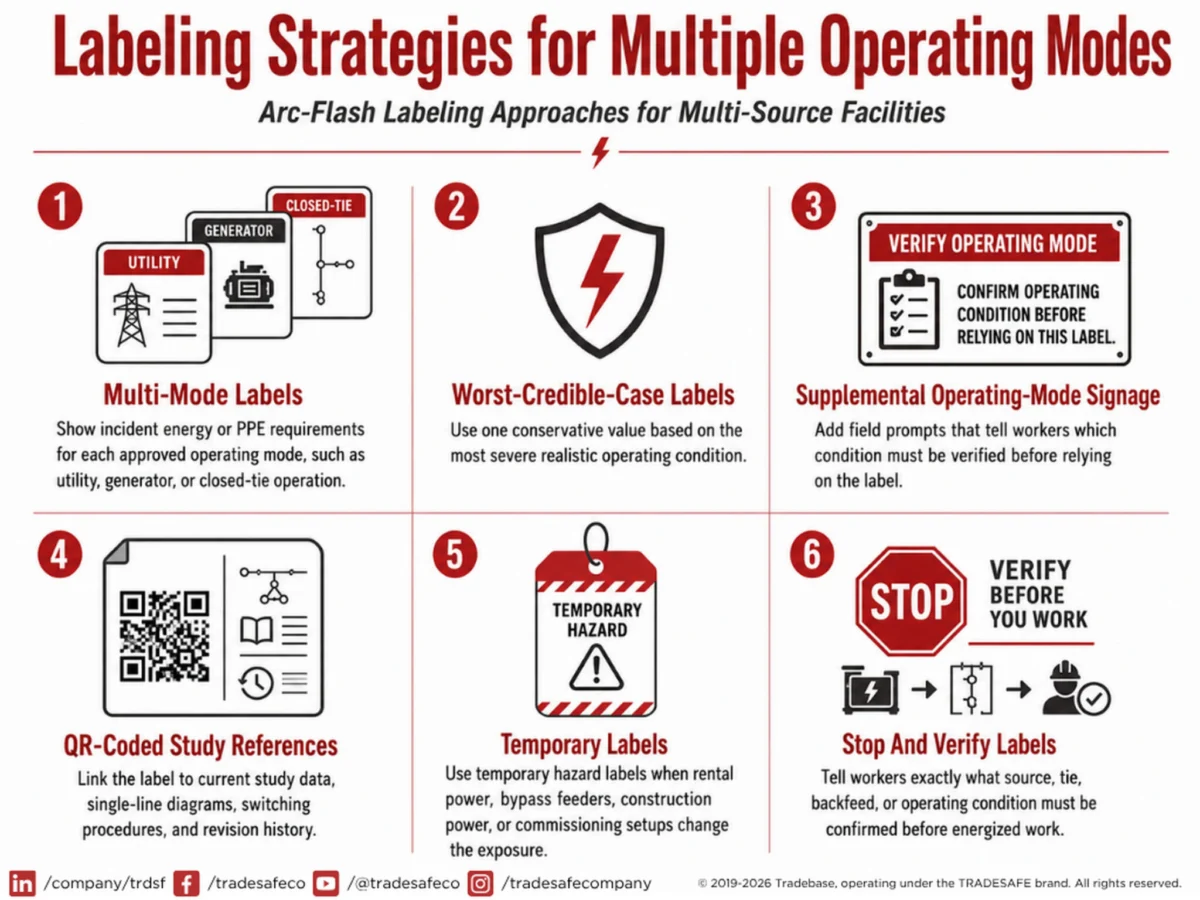
Facilities with complex, multisource electrical systems should consider moving beyond the "one-label-fits-all" approach:
- Multimode Labels: For equipment that frequently switches between two known states (e.g., Utility vs. Generator), use labels that explicitly state the incident energy and PPE requirements for each mode.
- Worst-Credible-Case Labels: In plants where the operating configuration is highly fluid, labeling for the "worst-credible-case" provides a conservative safety margin. While this may lead to higher PPE requirements, it eliminates the ambiguity of switching between modes.
- Supplemental Signage & QR Codes: Use supplemental signs to remind workers to "Verify Source Position" before proceeding. QR codes can be used to link directly to the latest single-line diagrams or the specific engineering study case associated with the current configuration, provided the facility has a robust document control system.
- Stop and Verify Protocols: For critical infrastructure, the most effective tool is a mandatory "Stop and Verify" protocol. This empowers workers to pause the task if the current configuration does not align with the safety documentation, creating a clear escalation path to engineering or operations.
Conclusion: The Label is the Start, Not the End
Information, in and of itself, does not create safety. A label is only as effective as the discipline of the organization behind it. The goal for any modern plant should be to synchronize engineering studies, field labeling, switching procedures, and worker training into a unified safety ecosystem.

In a world of increasing electrical complexity, the most dangerous assumption a worker can make is that the number on the sticker is the final word. By fostering a culture of verification and maintaining strict configuration control, plants can ensure that their safety programs are as dynamic and capable as the systems they operate. The safety of the personnel depends not on the durability of the label, but on the certainty that the label matches the reality of the plant’s current state.
About the Author