By Quinn Poor, Manager of Engineering and Product Development, SLIPNOT
For facility managers in dry food, dairy, and pharmaceutical manufacturing, the factory floor is more than just a foundation—it is a critical control point. Yet, it remains one of the most persistent operational headaches in modern industry. Plant leaders face a binary trap: the need to provide high-traction surfaces to prevent the second-leading cause of workplace fatalities (slips, trips, and falls) often conflicts directly with the stringent sanitation mandates required to prevent biological contamination.
Historically, the industry has accepted this trade-off as an inevitable cost of doing business. However, new engineering paradigms are proving that safety and hygiene need not be mutually exclusive.
The Core Conflict: Why Traditional Solutions Fail
In environments like flour milling, powdered milk production, or pharmaceutical blending, the presence of fine particulate matter is constant. Standard high-traction flooring relies on deep grooves, aggressive textures, or grit-based coatings to provide grip. While these designs are effective at stopping a slip, they are disastrous for sanitation.
The Pathogen Reservoir
In wet-wash facilities, water and detergents can flush out debris from textured flooring. However, dry processing facilities—which account for a vast segment of the food and pharma industries—strictly limit or prohibit water usage to prevent the growth of Listeria, Salmonella, and other dangerous pathogens.
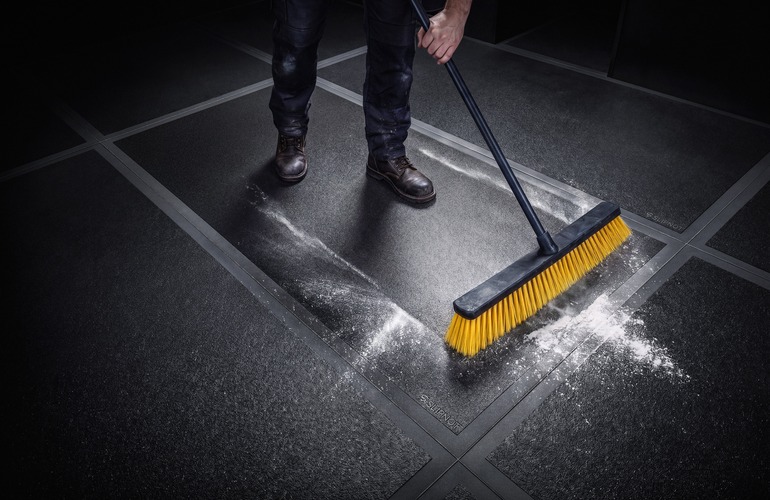
When you introduce fine powders to a deeply grooved floor in a dry environment, those grooves become "harborage points." The powder settles into the valleys of the texture, effectively packing the surface with organic material. This creates a biological petri dish that fails to meet the U.S. Department of Agriculture (USDA) and Food Safety Modernization Act (FSMA) standards.
The Evolution of Ineffective Workarounds
Before modern engineered surfaces, facility managers experimented with various "solutions," each with distinct shortcomings:
- Tapes and Grit Coatings: These provide temporary relief but degrade rapidly under heavy cart traffic and industrial cleaning, creating potential foreign material contamination risks.
- Dotted Metal Plates: Often installed with the assumption that brooms can navigate the spaces between the dots, these plates actually trap fine particles at the base of each welded bead. Furthermore, the beads themselves are prone to snapping under heavy loads, creating sharp, slippery, and hazardous failures.
- Diamond Plate: A staple of industrial flooring, diamond plate relies on raised geometry rather than true frictional surface area. Once a thin film of oil or a dusting of powder coats the surface, the "grip" vanishes, leaving a smooth, treacherous metal surface.
Data-Driven Decision Making: The New Metric for Success
To move beyond the cycle of trial and error, plant leaders must change how they evaluate materials. The industry has long relied on outdated static friction tests. Today, the focus must shift to Dynamic Coefficient of Friction (DCOF).
Why DCOF Matters
Static tests measure friction while an object is stationary. However, human beings rarely slip while standing perfectly still. DCOF measures grip during the act of walking, providing a realistic assessment of floor performance.
Under ANSI A326.3 protocols, a dry DCOF reading of 0.80 or higher on a clean surface is considered the gold standard for excellent traction. However, the true test of a floor is its performance under "in-use" conditions. A floor that boasts a 0.80 DCOF when clean but drops to a 0.40 when covered in flour is a liability. A reliable, high-performance surface should maintain a DCOF above 0.60 even with contamination present.
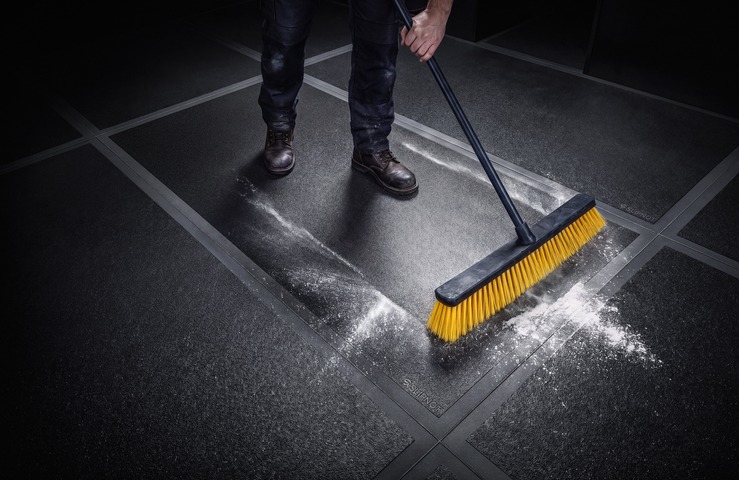
Engineered surfaces, such as those utilizing tool-steel-hard traction peaks that fill in the microscopic valleys of the metal, have demonstrated the ability to maintain a DCOF of 0.71 even when heavily dusted with flour. When selecting a flooring provider, managers must demand documented, third-party DCOF data under contaminated conditions.
Sanitation Compliance and Engineering Precision
Beyond slip resistance, the physical installation of flooring in processing zones is subject to intense regulatory scrutiny. FSMA and USDA standards require that any metal flooring must be fully seam-welded at all perimeters and transitions to eliminate gaps.
The Welding Challenge
Many high-traction finishes are delicate. Traditional field-welding often destroys the surrounding texture or leaves behind hazardous, unsealed edges that act as breeding grounds for bacteria.
Forward-thinking manufacturers now address this by pre-masking the perimeter edges of their flooring products. This allows installation crews to complete a continuous, code-compliant seal without damaging the structural integrity or the slip-resistant finish. When evaluating a potential supplier, plant managers must ask: How is the perimeter sealed, and can the surface withstand the thermal stress of a full-seam weld?
Total Cost of Ownership: A Financial Perspective
The cost of a "bad" floor is rarely reflected in the initial invoice. It is found in the hidden expenses of downtime, workers’ compensation, and audit failures.
The Human Cost
According to the Liberty Mutual Workplace Safety Index, overexertion and slip-related injuries cost U.S. employers over $13 billion annually. These are direct, bottom-line losses that can be mitigated by installing high-performance, long-lasting surfaces during the initial build or facility expansion.
The Operational Lift
Sanitation is a time-sink. If a cleaning crew spends 40 minutes per shift scrubbing a floor that refuses to release debris, that is time lost to production. In a three-line facility, optimizing the floor surface to reduce cleaning time by 20 minutes per line per cleaning can reclaim over 730 hours of production availability annually.
This is not just a safety upgrade; it is a direct boost to Overall Equipment Effectiveness (OEE). The cost of retrofitting an active production line after an incident or a failed health audit is exponentially higher than specifying the correct material from day one.
Conclusion: The Four Questions for Facility Leaders
To break the cycle of the safety-sanitation compromise, plant managers must act as rigorous investigators. Before approving any flooring installation in a dry processing zone, they should demand satisfactory answers to these four questions:
- What is the DCOF (both clean and contaminated)? Ensure the supplier provides data for the specific contaminants present in your facility (e.g., flour, fine powder, or oil).
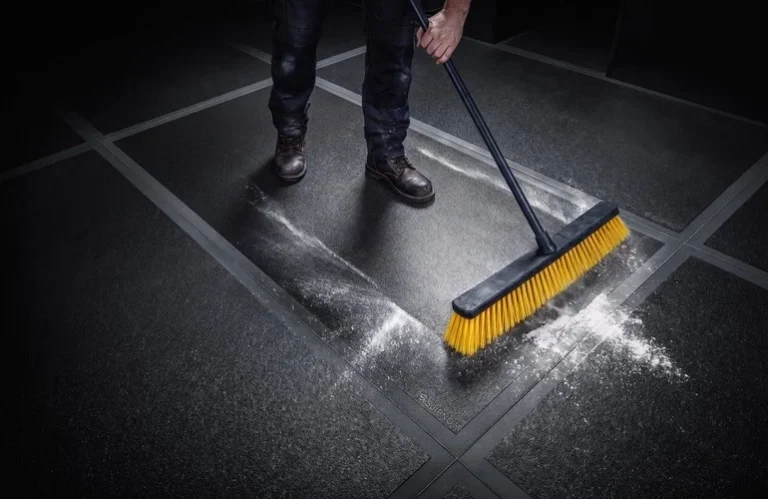
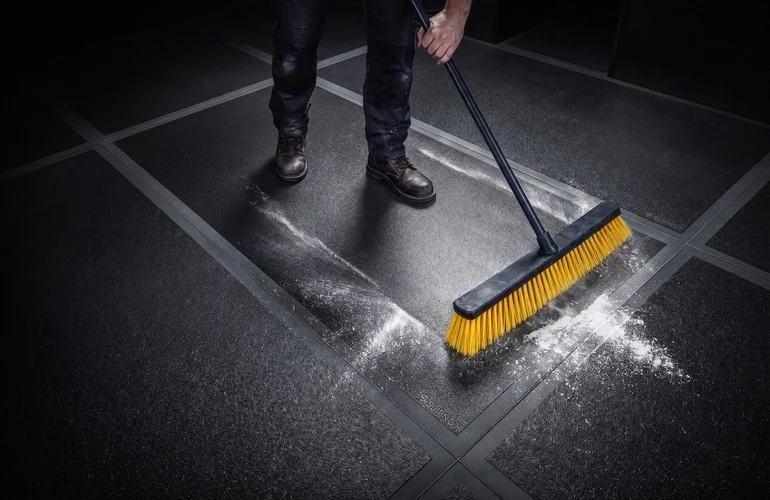
- How is debris removed, and is there data to support the claim? Do not rely on marketing brochures. Ask for comparative lab studies that visualize particle retention before and after cleaning.
- How is the perimeter sealed to meet mandatory seam-welding requirements? Verify that the installation method will not compromise the integrity of the finish or create new, hidden harborages.
- What is the total cost of ownership over a five-year horizon? Factor in cleaning labor, potential for repairs, and the cost of lost production time.
The industry has lived with the compromise between safety and sanitation for decades. But as material science continues to advance, the necessity of that choice is fading. By prioritizing high-traction, sweepable, and fully weldable surfaces, plant leaders can create an environment that satisfies both the safety inspector and the health auditor, ensuring that the only thing slipping through the cracks is nothing at all.
About the Author