As the global supply chain faces unprecedented pressure from e-commerce growth, labor shortages, and the demand for lightning-fast fulfillment, the warehouse floor is undergoing a radical transformation. While mobile robots often dominate the headlines, a quieter, more fundamental shift is occurring in the stationary automation space. According to a new report from Interact Analysis, "Robotic Picking 2026," the market for robotic picking—comprising robotic arms configured for palletizing, depalletizing, and high-speed item sorting—is poised for explosive growth, shifting from a niche industrial tool to the backbone of modern logistics.
Main Facts: A Multi-Billion Dollar Trajectory
The numbers behind the surge are staggering. In 2025, the global market for robotic picking was valued at $1.7 billion. However, analysts at Interact Analysis project this figure will skyrocket to $4.6 billion by 2030. This growth represents a robust compound annual growth rate (CAGR) of 21.7% over the 2026–2030 forecast period.
At the core of this expansion is the evolution of the robotic arm. Historically, these systems were static, high-cost assets deployed primarily in heavy manufacturing or large-scale pallet handling. Today, advancements in artificial intelligence (AI), computer vision, and machine learning have allowed these arms to move beyond simple, repetitive motion. They are now becoming "intelligent" agents capable of handling a chaotic variety of SKUs, identifying damaged goods, and managing the intricate geometry of a messy trailer floor.
Chronology: The Evolution of Robotic Picking
To understand why this growth is happening now, one must look at the timeline of industrial robotics:
- 1980s – 2000s (The Era of Fixed Automation): During these decades, robotic picking was synonymous with rigid, predictable environments. Palletizing and depalletizing robots—large, stationary machines—were installed in automotive plants and large-scale distribution centers. They were efficient but required structured environments and significant safety caging.
- 2010 – 2020 (The Rise of Mobile Robotics): As the e-commerce boom took hold, industry attention shifted toward Autonomous Mobile Robots (AMRs) and Automated Storage and Retrieval Systems (AS/RS). While these systems solved the "transportation" problem, the "picking" problem—getting items into and out of bins—remained largely a manual task.
- 2021 – 2025 (The Integration Phase): The COVID-19 pandemic catalyzed a labor crisis. Warehouses could not hire fast enough to meet demand. This pushed companies to integrate vision systems with robotic arms, allowing for the first major wave of automated bin-picking. By 2025, palletizing and depalletizing still accounted for 83% of the robotic picking market, marking it as a mature, stable anchor for the industry.
- 2026 – 2030 (The Intelligent Frontier): The industry is now entering a new chapter. The focus is shifting away from simple pallet handling toward high-complexity tasks like trailer unloading and bin-to-bin fulfillment. This period is expected to be defined by the democratization of AI, where robots no longer need to be "taught" every single item they touch, but can instead "learn" through deep learning models.
Supporting Data: The Market Shift
The most compelling aspect of the Interact Analysis data is not just the total growth, but the structural transformation of the industry.
The Maturation of Palletizing
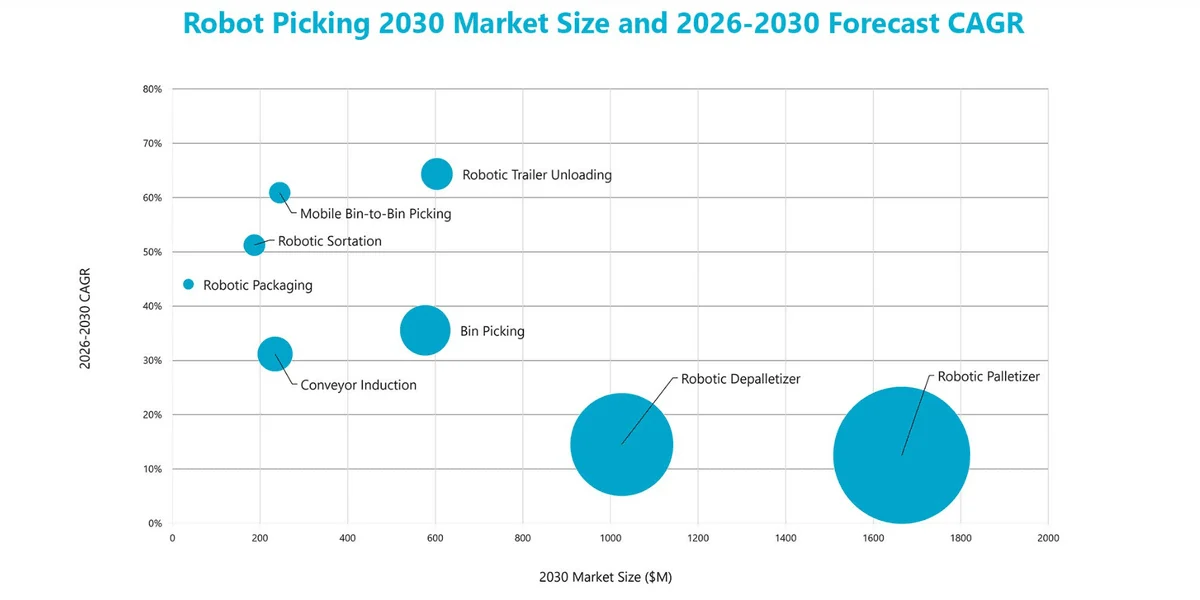
For decades, palletizing and depalletizing were the "bread and butter" of warehouse robotics. Because these processes involve handling standardized shapes and heavy loads, they were the easiest to automate. However, the report indicates that while this segment will continue to grow in absolute terms, its relative dominance is shrinking. In 2025, it held 83% of the market share. By 2030, that figure is forecast to drop to approximately 58%.
The Surge in High-Growth Segments
The decline in the relative market share of palletizing is not a sign of weakness; it is a sign of diversification. The "white space" being captured by newer applications is where the most aggressive growth is occurring:
- Robotic Bin Picking: Projected to grow at a 36% CAGR, this technology allows robots to sort through mixed items in a bin, a task that was once considered impossible for machines due to the complexity of overlapping objects.
- Robotic Trailer Unloading: This segment represents the "Holy Grail" of warehouse automation. Unloading a trailer is a dangerous, physically demanding, and highly variable task. With a projected CAGR of 64%, robotic trailer unloading is the fastest-growing sub-segment, as developers finally crack the code on how to handle the "non-uniform" nature of freight.
Official Responses and Industry Perspectives
Market leaders and industry experts view this data as a validation of the "Intelligent Warehouse" thesis.
"We are moving past the era of ‘dumb’ automation," says one lead analyst at Interact Analysis. "The goal of a warehouse in 2020 was to move goods from point A to point B. The goal in 2026 is to have machines that understand what they are holding, why they are holding it, and where it needs to go next without human intervention."
Manufacturers of robotic arms, such as Fanuc, ABB, and Yaskawa, have been rapidly adjusting their product roadmaps. Where they once focused on payload capacity and reach, they are now emphasizing integration with third-party software providers. "It’s not just about the hardware anymore," says a product manager at a major robotics firm. "It’s about the software stack. If your robot can’t process a 3D image of a bin and decide which item to grab in less than a second, it’s not competitive in today’s market."
Logistics providers have also signaled that the ROI (Return on Investment) for these systems has finally hit the "sweet spot." With labor costs rising and the difficulty of maintaining a three-shift workforce, the two-to-three-year payback period for robotic picking systems has become a standard, acceptable threshold for CFOs across the retail and logistics sectors.
Implications: A New Era of Fulfillment
The shift toward intelligent, high-speed picking will have profound implications for the global economy and the workforce.
1. The Human-Robot Synergy
Contrary to the "robot takeover" narrative, the data suggests that robots are filling gaps that humans were increasingly unwilling or unable to fill. Trailer unloading, for instance, is notorious for high injury rates and high turnover. By automating these tasks, companies are not necessarily firing staff, but rather redeploying them to higher-value roles, such as system maintenance, fleet management, and exception handling.
2. The Decentralization of Inventory
As robotic picking becomes more reliable and affordable, we are likely to see the "micro-fulfillment center" (MFC) model take off. Rather than relying on massive, centralized warehouses, retailers can deploy high-speed robotic picking cells in smaller, urban facilities. This brings products closer to the consumer, drastically reducing "last-mile" delivery times.
3. Supply Chain Resilience
The COVID-19 pandemic exposed the fragility of global supply chains that relied too heavily on manual labor. A pandemic or a localized labor strike could bring an entire distribution center to a halt. Robotic picking systems offer a "lights-out" capability. While human oversight is still required, the ability to maintain baseline operations during a labor crisis is a powerful incentive for companies to invest in this technology.
4. Competitive Moats
For retailers, the ability to implement these technologies is becoming a competitive moat. Companies that can process orders faster, with fewer errors, and at a lower cost per unit will inevitably dominate the market. As the market grows from $1.7 billion to $4.6 billion, the gap between the "automated" and the "manual" will likely become an insurmountable divide.
Conclusion
The findings from Interact Analysis provide a clear roadmap for the future of logistics. The robotic picking market is transitioning from a period of static, predictable pallet work to an era of fluid, intelligent, and highly dynamic operations. With a staggering 64% CAGR forecast for trailer unloading and robust growth across all picking segments, the next five years will be defined by the integration of AI-driven vision and flexible robotic arms.
For warehouse operators, the question is no longer whether to automate, but how quickly they can scale these systems to meet the demands of a 24/7 global economy. As we approach 2030, the warehouses that will thrive are those that successfully blend the precision of the machine with the adaptability of the human, creating a supply chain that is not only faster but significantly more resilient to the challenges of the future. The $4.6 billion figure is more than just a market forecast; it is the price tag of the next industrial revolution.
About the Author