Introduction
In an era defined by deep political polarization and a growing "anti-woke" backlash against corporate social initiatives, a new comprehensive study has revealed a surprising consensus: the American consumer, regardless of political affiliation, expects corporations to lead on climate change. A survey of 2,000 U.S. voters suggests that the narrative of a country hopelessly divided on environmental issues may be oversimplified. While the rhetoric in Washington and state capitals suggests a fierce battle over "Environmental, Social, and Governance" (ESG) standards, the average voter—including climate-skeptical Republicans—views corporate climate responsibility through a lens of business pragmatism rather than just political activism.
The study, a collaborative effort between the nonprofit Center for Climate and Energy Solutions (C2ES), the communications agency maslansky + partners, and the marketing firm Potential Energy Coalition, provides a roadmap for C-suite executives who are currently walking a tightrope between environmental commitments and political pressure. The findings suggest that the "how" of climate communication is just as important as the "what."
I. Main Facts: A Surprising Bipartisan Mandate
The headline finding of the survey is a direct challenge to the idea that climate change is a "deal-breaker" issue for conservative voters when it comes to brand loyalty. According to the data, three-quarters (75%) of all respondents agreed that companies have a fundamental responsibility to limit their impact on the climate and the environment. Perhaps most notably, more than two-thirds (67%) of Republican voters shared this sentiment.
This data suggests that while Republican politicians may be vocal in their opposition to federal climate mandates, their constituents still expect the private sector to act as stewards of the environment. The survey identifies a significant "silent majority" of consumers who view carbon reduction not as a radical political agenda, but as a standard expectation for modern business operations.
Key takeaways from the report include:
- Purchasing Power: Over 60% of respondents stated they would be more likely to purchase products or services from companies that prioritize clean energy or actively work to reduce their carbon footprint.
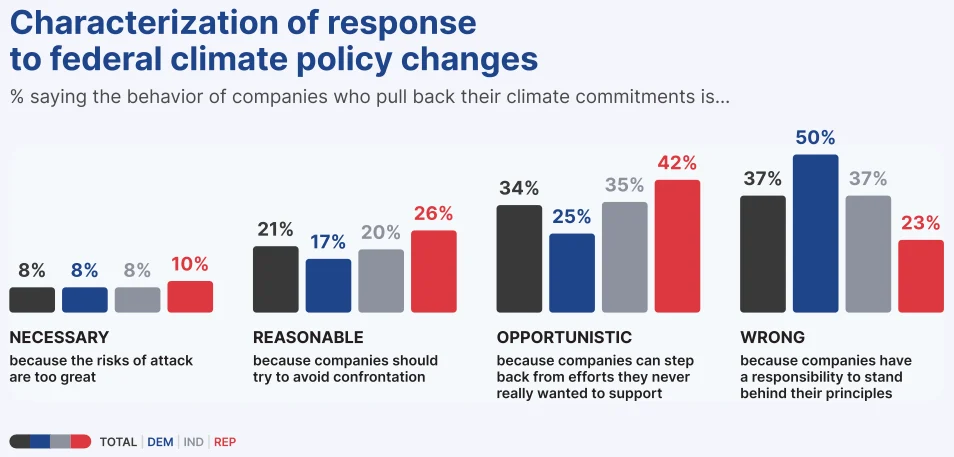
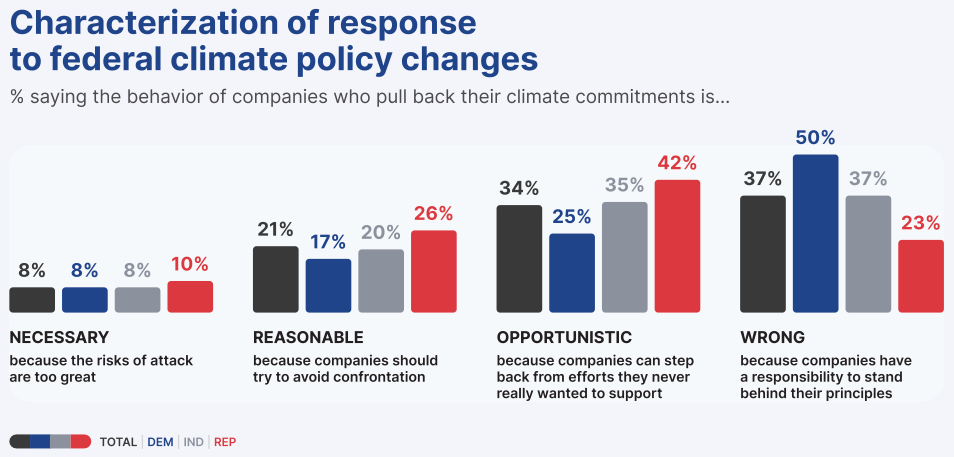
- The Backtracking Penalty: Consumers are increasingly sensitive to "green-hushing" or the rolling back of climate goals. 71% of all voters, and 65% of Republicans, characterized a company’s decision to backtrack on climate initiatives due to government pressure as "opportunistic" or "wrong."
- The Framing Effect: Support for climate action hinges on framing. When initiatives are presented as "smart business moves" that increase efficiency or competitiveness, Republican support spikes.
II. Chronology: From ESG Enthusiasm to the Current Backlash
To understand the significance of these findings, one must look at the trajectory of corporate climate action over the last half-decade.
2019–2021: The Era of Bold Commitments
Following the 2015 Paris Agreement and the subsequent rise of the "Net Zero" movement, major U.S. corporations entered a period of rapid goal-setting. Tech giants, retailers, and even oil and gas firms announced ambitious targets to reach carbon neutrality by 2040 or 2050. During this period, ESG investing became the dominant trend on Wall Street, with trillions of dollars flowing into funds that prioritized environmental metrics.
2022–2023: The Political Backlash Begins
As inflation rose and energy prices spiked following the invasion of Ukraine, the "anti-ESG" movement gained traction. Several U.S. states, led by Florida and Texas, passed legislation to prevent state pension funds from working with investment firms that "boycotted" fossil fuel companies. High-profile politicians began framing corporate climate action as "woke capitalism," leading some companies to scrub climate language from their annual reports—a phenomenon known as "green-hushing."
2024–2025: The Rise of the Pragmatic Consumer
The current survey, conducted as we move through 2024 and into 2025, represents a new phase. It suggests that while the political environment has become more hostile, the consumer environment has remained remarkably stable. The data indicates that voters are seeing through the political theater. The jump in politicization perception—where 55% of voters in 2025 view fossil fuel phase-outs as "taking a political stance" compared to 40% in 2024—shows that while consumers recognize the political nature of the debate, they still hold companies accountable for their environmental footprints.
III. Supporting Data: Analyzing the "Republican Shift"
The most nuanced part of the survey involves the specific attitudes of Republican voters. For years, the conventional wisdom has been that conservative voters are hostile to any mention of "climate change." The C2ES and maslansky + partners data paints a different picture.
Responsibility vs. Regulation
While Republicans generally oppose government-mandated carbon taxes or strict EPA regulations, they do not necessarily oppose private-sector innovation. The survey found that when climate action is framed as "reducing waste," "increasing energy independence," or "securing supply chains," Republican support is nearly indistinguishable from Democratic support.
The "Opportunism" Factor
One of the most striking pieces of data is the reaction to companies that retreat from their goals. The survey found that 65% of Republicans view backtracking as a sign of weak leadership or opportunism. This suggests that "green-hushing"—trying to hide climate goals to avoid conservative ire—might actually backfire. Conservative consumers, it seems, value consistency and integrity; they would rather a company stand by a "smart business" climate goal than see it fold under political pressure.
The Fossil Fuel Paradox
The survey highlighted a growing sensitivity toward the transition away from fossil fuels. In 2024, 40% of Democrats viewed a company’s decision to end fossil fuel use as a "political stance." By 2025, that number rose to 55%. Among Republicans, this perception is even higher. This suggests that while there is broad support for "clean energy," there is increasing skepticism about "fossil fuel elimination," which is often viewed as an ideological rather than a practical move.
IV. Official Responses: Insights from the Experts
Leadership from the participating organizations emphasized that the survey results should embolden corporate leaders who have recently been hesitant to speak about their environmental progress.
Nicholle Manners, Senior Vice President at maslansky + partners:
Manners expressed surprise at the intensity of the backlash against corporate backtracking. "I was surprised by that," she noted, referring to the 71% of voters who condemned companies for yielding to political pressure. Her analysis suggests that consumers have a high "BS detector" and that authenticity is the most valuable currency in corporate communications. "Voters are looking for companies to lead, not to follow the latest political winds," Manners suggested.
Verena Radulovic, Vice President for Business Engagement at C2ES:
Radulovic highlighted the strategic value of the findings for the business community. "I did not expect climate-skeptical Republicans to agree that this is smart business," she said. "That was really encouraging to see." Radulovic argues that the "business case" for climate action—focusing on resiliency, innovation, and long-term profitability—is the bridge that can unite a divided electorate. Her takeaway for CEOs is clear: Stop talking about climate as a moral crusade and start talking about it as a competitive necessity.
The Potential Energy Coalition:
The nonprofit marketing firm contributed to the survey by analyzing the linguistic nuances that drive public demand. Their internal analysis suggests that "clean energy" remains one of the most popular phrases across the entire political spectrum, whereas "decarbonization" and "ESG" are viewed with suspicion or confusion.
V. Implications: A New Framework for Corporate Strategy
The implications of this survey are profound for the future of corporate strategy in the United States. If companies can navigate the language of climate action correctly, they stand to gain market share and brand loyalty from a broad cross-section of the public.
1. The End of "Green-Hushing"?
The data suggests that hiding climate initiatives is a losing strategy. Since a majority of voters—including a majority of Republicans—view backtracking as "wrong," companies that have quietly shelved their environmental goals may be courting a reputation for being unreliable. Instead of "hushing," companies should "reframe."
2. The "Smart Business" Pivot
The most successful companies of the next decade will likely be those that frame their climate actions in terms of economic efficiency. This includes:
- Energy Efficiency: Framed as cost-saving and waste reduction.
- Renewable Energy: Framed as energy independence and price stability.
- Sustainable Sourcing: Framed as supply chain security and risk management.
3. Navigating the "Political" Label
As the survey showed, more people are starting to see climate actions as "political." To combat this, companies must ground their initiatives in tangible data. When a company can show that switching to electric delivery vans saves $2 million a year in maintenance and fuel, the "political" argument evaporates, replaced by a "fiduciary" argument that is much harder for critics to attack.
4. The 2025 and 2026 Outlook
As we head toward another major election cycle, the pressure on corporations to take sides will only increase. However, this survey provides a shield for executives. By pointing to the fact that 75% of voters want companies to take responsibility for their environmental impact, CEOs can justify their climate investments as being in the direct interest of their customers and shareholders.
Conclusion
The C2ES and maslansky + partners survey offers a rare glimmer of hope in a polarized landscape. It reveals that while the American public may disagree on the causes of climate change or the role of the federal government, there is a powerful, bipartisan consensus that the private sector has a duty to act. For companies, the message is clear: The public isn’t asking you to be a politician; they are asking you to be a responsible, forward-thinking business. By focusing on "smart business" and maintaining the courage of their convictions, corporations can lead the way toward a more sustainable future without leaving half of their customers behind.
About the Author