For the past twenty-five years, the domestic freight market has functioned as the circulatory system of the American economy, yet it has been anything but stable. Since the turn of the millennium, logistics professionals have been subjected to a relentless cycle of "boom and bust," defined by rapid expansions, agonizing contractions, and unpredictable anomalies. By analyzing the Cass Freight Shipments Index (CFIS) and the Cass Truckload Linehaul Index (CTLI), industry analysts have mapped a history that reveals one singular truth: the freight market is a hyper-reactive entity, and predicting the onset or conclusion of its cycles is a fool’s errand.
The Metrics of Market Health
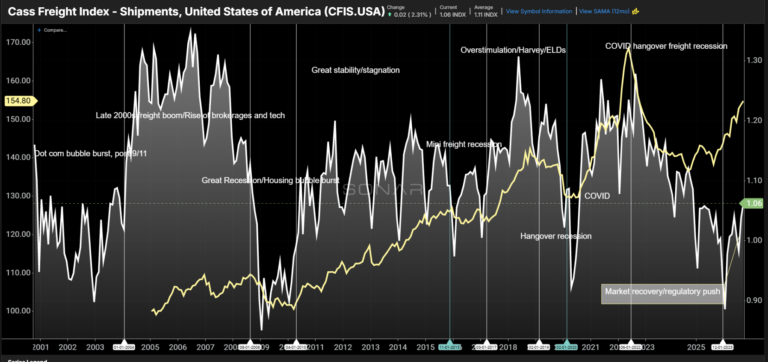
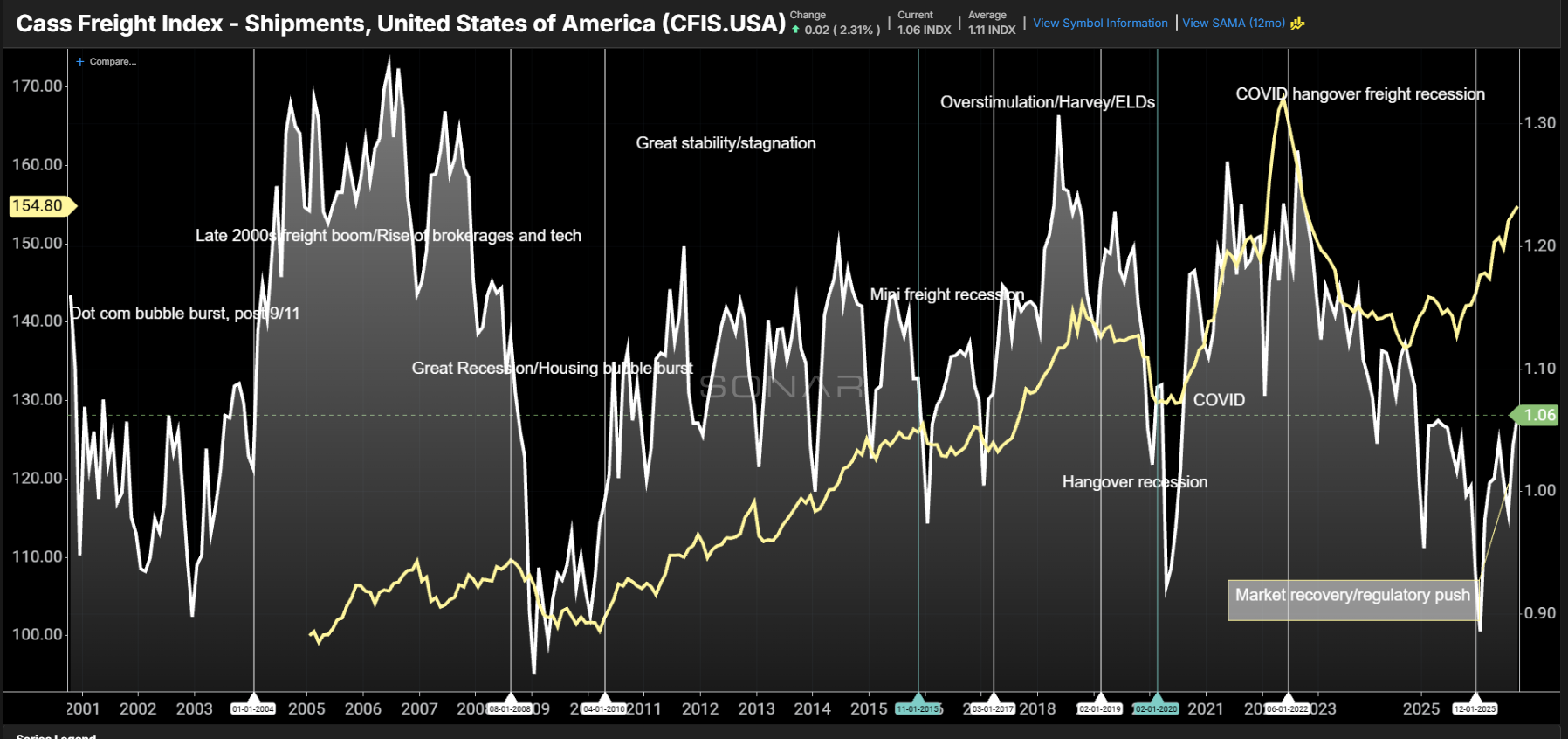
To understand the current state of freight, one must first understand the tools used to measure it. The CFIS serves as the industry’s pulse, tracking shipments across diverse modes including truckload, intermodal, and less-than-truckload (LTL). Because it is derived from actual invoice data, it provides a lagging but highly accurate reflection of total transportation demand.
Complementing this is the CTLI, which tracks the base cost of truckload moves while stripping away the noise of fuel surcharges and accessorial fees. By isolating base rates, the CTLI offers a transparent view of the fundamental supply-and-demand equilibrium. When these two indices are layered over the last two decades, they reveal a landscape marked by profound shifts in economic policy, consumer behavior, and technological integration.
Chronology: A History of Volatility
The Early Turbulence (2000–2010)
The new millennium began under a cloud of uncertainty. The bursting of the dot-com bubble, followed immediately by the economic fallout of the 9/11 attacks, sent the freight market into a tailspin. Demand for goods remained muted long after the broader economy began its recovery.
However, by 2004, the tide had turned. Fueled by low interest rates and a burgeoning subprime mortgage-backed housing boom, the economy surged, with real GDP growing at a robust 3.8%. This period marked a pivotal shift in the logistics landscape: the rise of the freight brokerage. As the internet matured, brokers leveraged new technology to connect smaller carriers with larger shippers, effectively democratizing capacity and setting the stage for the growth of the modern owner-operator. This era of relative prosperity was abruptly halted in 2008 by the collapse of the housing market, leading to the Great Recession—a period of prolonged, grinding weakness that did not fully abate until 2011.
The Great Stabilization (2011–2016)
The post-recession years are often remembered with nostalgia as the "Great Stabilization." From 2011 to 2015, the market experienced its most consistent performance in a quarter-century. The CFIS adhered to a predictable 12-month seasonal cadence, and base rates grew at a steady, manageable 3% annually. For many logistics managers, this period defined the "new normal." It was a time of equilibrium, where supply and demand moved in lockstep.
That stability was shattered in late 2015 when energy markets collapsed. The resulting "mini freight recession" of 2016 caught many participants off guard. Economic growth decelerated from 4% to 1.5%, and truckload base rates plummeted by approximately 2% as industrial demand faltered.
The Era of Black Swans (2017–2021)
By 2017, the pendulum swung back. Tightening capacity and the enactment of the Tax Cuts and Jobs Act in December of that year acted as a massive stimulus. The subsequent market conditions—exacerbated by the Electronic Logging Device (ELD) mandate and supply chain bottlenecks like Hurricane Harvey—produced one of the most aggressive spot-rate upswings in modern history.
This, however, was a "sugar high." The surge in rates invited a wave of new entrants, with active trucking authorities expanding by 15% between 2017 and 2019. This over-saturation led to the 2019 freight recession, which saw the collapse of industry titans like Celadon and New England Motor Freight. The market was already bleeding capacity when the COVID-19 pandemic struck, creating the perfect storm for the chaos that followed.
COVID-19: The Great Disruption
The COVID-19 era proved that "black swan" events are not outliers; they are a systemic risk. Unprecedented government stimulus, a shift to remote work, and a sudden, violent pivot in consumer spending toward goods rather than services broke the traditional supply chain model. The ensuing boom was followed by the longest freight recession of the century, stretching from early 2022 through the end of 2025.
Supporting Data and Current Realities
The current market cycle is defined by high-level complexity. We are now roughly a year into a new cycle, and the data paints a confounding picture. According to the CTLI, rates were up 10% in September, yet freight volumes grew by a mere 2%.
This disconnect between rates and volume is driven by a host of factors that differentiate this cycle from previous ones:
- Regulatory Pressure: The cost of compliance has created higher barriers to entry for smaller carriers.
- Interest Rates: Capital-intensive expansion is no longer cheap, forcing carriers to prioritize margin over volume.
- Energy Volatility: Persistent fluctuations in diesel prices continue to impact the viability of long-haul routes.
Implications for Corporate Strategy
The primary takeaway for CFOs and logistics planners is clear: the 2010–2015 "Great Stabilization" is a historical aberration, not a blueprint for the future. Businesses that plan their logistics strategy based on the assumption that a predictable, low-inflationary environment will return are likely to face significant operational disruptions.
History suggests that the current cycle will persist for at least another 12 months. Any unexpected positive economic surge could extend this period, while a rapid cooling of rates would likely signal a broader economic slowdown, impacting revenue across the entire supply chain.
Official Perspectives and Market Intelligence
Industry experts point to the necessity of real-time data to navigate this uncertainty. Tools like SONAR, which aggregates data from hundreds of sources, are no longer optional luxuries but fundamental necessities for modern supply chain management. By visualizing freight market trends in real-time, firms can transition from reactive, defensive postures to proactive, data-driven strategies.
As the freight industry moves forward, it must reconcile itself to a future of continued volatility. The lessons of the past 25 years are definitive: the market does not operate in a vacuum. It is a mirror of the global economy, sensitive to every policy shift, trade dispute, and technological advancement. For those in the driver’s seat of global logistics, the ability to anticipate change is the only competitive advantage that matters.
This report utilizes data derived from the FreightWaves SONAR platform, which aggregates thousands of indices to provide a real-time snapshot of the logistics landscape. For those looking to gain deeper insight into these cycles, demo requests for SONAR are available through the official portal.
About the Author