
The split-rail fence stands as one of history’s most enduring examples of vernacular engineering. A testament to the philosophy of "more work up front, less work later," it has defined the agrarian landscapes of the world for centuries. However, as modern architecture moves toward sustainable, modular, and low-maintenance solutions, this ancient design is finding a new life. By integrating contemporary materials like steel I-beams with the traditional mechanics of the through-mortise joint, designers are bridging the gap between historical heritage and industrial efficiency.
The Mechanics of the Split-Rail: An Architectural Philosophy
At its core, the split-rail fence is an exercise in functional simplicity. Unlike the ubiquitous nailed wooden fence—which relies on fasteners that inevitably rust, pull loose, or fail under the pressure of seasonal wood expansion—the split-rail fence operates on a system of mechanical interlocks.
In a traditional nailed fence, the structure is essentially a single, rigid unit. When a single rail sustains damage, the entire segment is compromised. Repairing it is a labor-intensive process: one must systematically de-nail the damaged board, source a replacement, and laboriously re-fasten the assembly. If a post requires replacement, the situation becomes even more dire, requiring the removal of every board connected to that structural anchor.
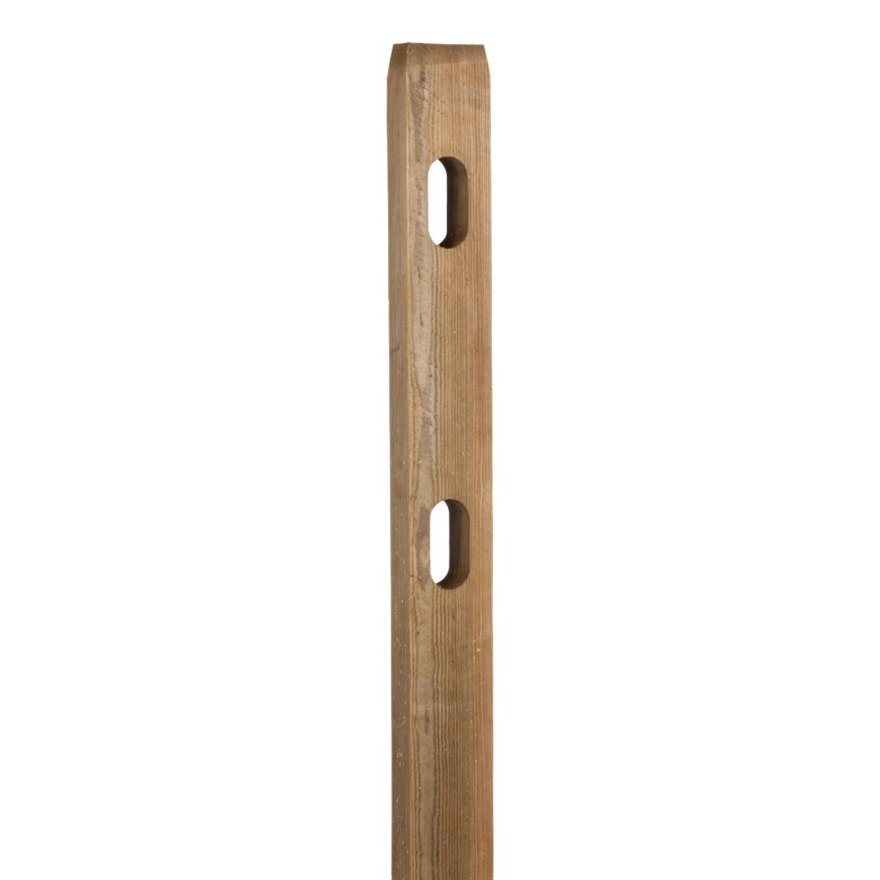
Conversely, the split-rail design utilizes rails that slide directly into through-mortises—precision-cut voids—within the support posts. This architecture requires significantly more effort during the initial construction phase. Crafting the rail ends to fit and boring out the mortises requires skill, time, and precision. Yet, this upfront investment yields immense long-term dividends. When a rail eventually decays or breaks, it can be slid out and replaced in minutes without the need for a single hammer, nail, or screw. It is a design that respects the inevitability of decay and plans for it through modularity.

A Contemporary Twist: The Farstadsanden Visitor Center
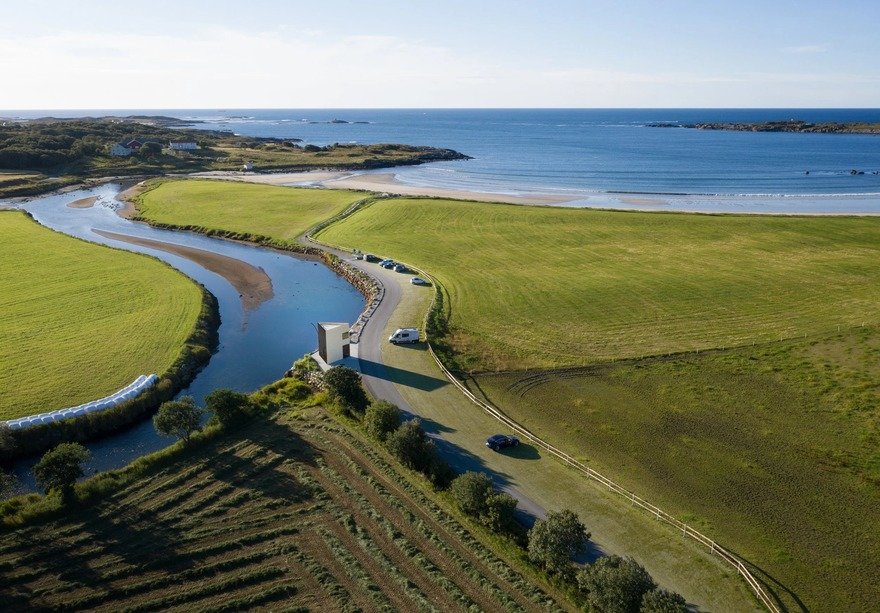
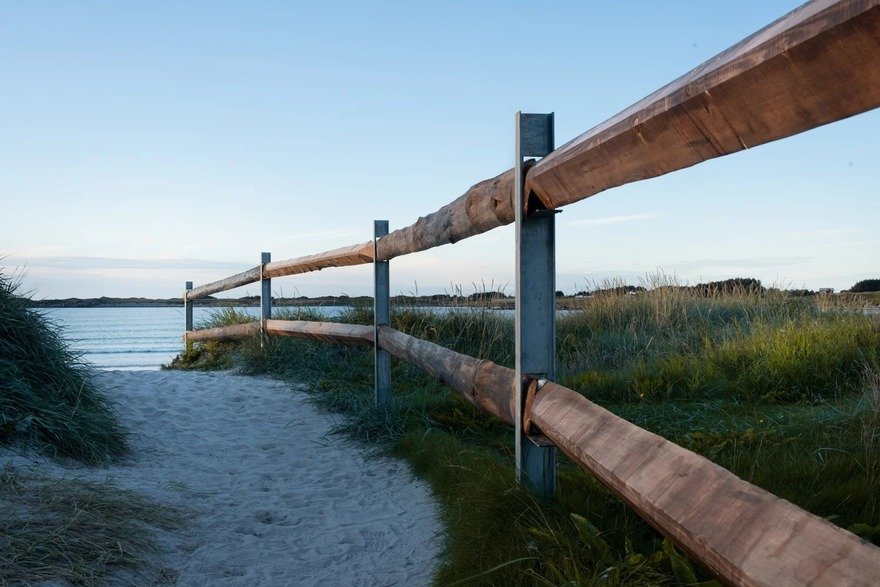
While the split-rail fence is a common sight in rural landscapes, its application in high-end, contemporary public architecture is rare. This changed when the Norwegian architecture firm Rever & Drage took on the project for a visitor’s center in Farstadsanden.
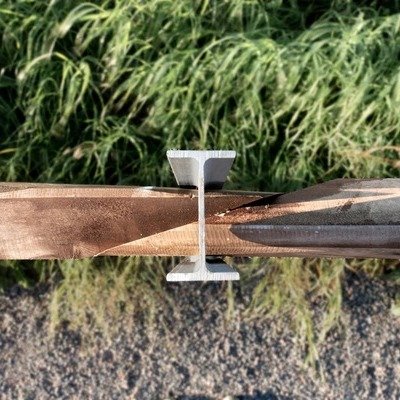
Known for their ability to blend rugged landscapes with precise, geometric interventions, Rever & Drage recognized the inherent genius in the split-rail mechanism. Rather than discarding the design as a relic of the past, they elevated it. At the Farstadsanden project, the firm employed the traditional through-mortise concept but swapped the traditional wooden posts for industrial steel I-beams.

This choice is both aesthetic and functional. The contrast between the organic texture of the wood rails and the cold, precise lines of the steel beams creates a visual dialogue between the past and the present. More importantly, it addresses the most vulnerable part of any fence: the post. By using steel, Rever & Drage has ensured that the primary structural supports will likely never need to be replaced, effectively future-proofing the installation against the rot and weathering that typically plague wooden posts.
Chronology of the Split-Rail Design
The history of the split-rail fence is closely tied to the history of land management and resource availability.
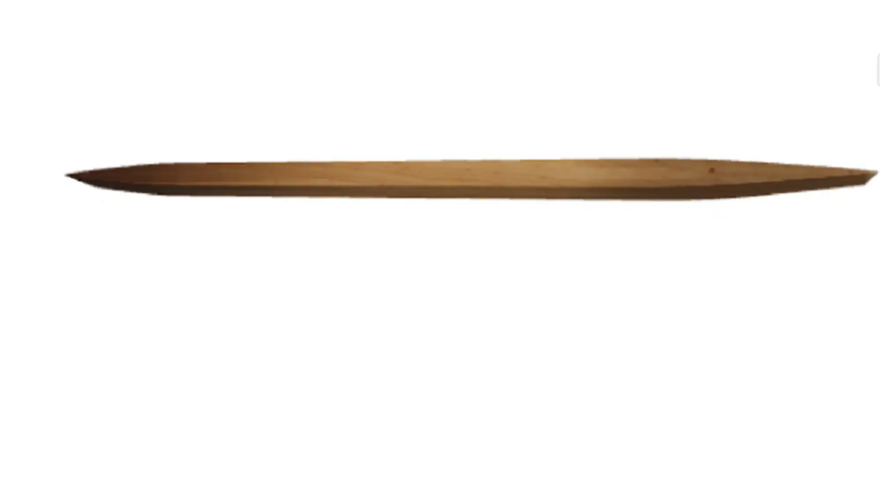
- Early Origins: Initially, split-rail fences were born of necessity in heavily forested regions. When land was cleared for agriculture, the felled trees provided a surplus of raw timber. Splitting these logs into rails was the most efficient way to utilize the wood, creating strong, defensive barriers that required no iron—a precious commodity in early frontier settlements.
- The Age of Fasteners: With the industrialization of the 19th and 20th centuries, the availability of mass-produced nails and wire led to the decline of the mortise-and-tenon fence. The focus shifted toward speed of assembly. The "nailed fence" became the standard for suburban and commercial properties, prioritizing low initial cost over long-term maintainability.
- The Sustainability Turn: In the 21st century, we are seeing a "re-valuation" of historical techniques. As architects grapple with the environmental impact of construction waste, the "design for disassembly" movement has gained traction. The split-rail system, by virtue of its nail-less assembly, is inherently designed for disassembly, aligning perfectly with modern circular economy principles.
Supporting Data: Efficiency and Life-Cycle Costs
To understand why a design like the one at Farstadsanden is significant, one must look at life-cycle costing. Traditional fence construction typically involves "hidden costs" that accumulate over a 20-to-30-year period.
Comparative Maintenance Analysis
| Feature | Nailed Wooden Fence | Steel-Mortise Split-Rail |
|---|---|---|
| Initial Labor | Low (Fast) | High (Precision required) |
| Tool Requirement | High (Power tools, hammers) | Minimal (None for repair) |
| Component Replacement | Destructive (Requires de-nailing) | Non-destructive (Sliding) |
| Material Longevity | Limited (Rot-prone) | High (Steel/treated wood) |
The initial capital expenditure for the Rever & Drage project is undoubtedly higher than a standard fence. Steel I-beams, while durable, are significantly more expensive than wooden posts. However, when viewed over a 50-year horizon, the cost-benefit analysis shifts. The ability to swap out rails as they weather, without requiring specialized labor or hardware, minimizes the total cost of ownership. The steel posts act as a permanent foundation, a "chassis" that can support infinite iterations of wooden rails.
Official Perspectives: The Philosophy of Rever & Drage
The firm Rever & Drage has long been vocal about their design philosophy, which often emphasizes the importance of site-specific intervention. Their work at Farstadsanden is not just about a fence; it is about managing the transition between the human environment and the natural one.
By choosing to use a traditional joinery technique, the architects are paying homage to the local Norwegian building traditions that have existed for centuries. Their decision to pair this with modern steel is a reflection of Norway’s modern industrial capacity. As the firm has noted in various project discussions, the goal is often to create structures that "age with grace." A structure that can be easily repaired is one that is more likely to be maintained, rather than abandoned or torn down, when the first sign of wear appears.
Implications for Future Architecture
The integration of the split-rail concept into modern architecture has profound implications for urban design, landscape architecture, and beyond.
1. Design for Disassembly (DfD)
The construction industry is one of the largest producers of waste globally. The "nail-less" philosophy demonstrated at Farstadsanden encourages architects to rethink how components connect. If we design structures that can be taken apart, we can reclaim and reuse materials at the end of a building’s life cycle.

2. Low-Tech, High-Efficiency
There is a prevailing myth that modern efficiency requires high-tech, complex solutions. The split-rail fence reminds us that some of our most efficient technologies are low-tech. By applying modern precision (such as CNC-cut mortises) to age-old joinery, we can achieve high-performance results without the need for complex, proprietary fastening systems.
3. Aesthetics of Maintenance
Finally, this project challenges the modern obsession with "maintenance-free" surfaces. Often, "maintenance-free" is just a euphemism for "disposable." By designing for repairability, architects like those at Rever & Drage are inviting the user to be a participant in the building’s life. When a rail breaks, it is not a sign of failure, but a scheduled part of the building’s ongoing lifecycle.
Conclusion
The modern take on the split-rail fence at Farstadsanden is more than just a functional barrier. It is a synthesis of historical wisdom and industrial innovation. By revisiting the through-mortise joint and reinforcing it with the durability of steel, Rever & Drage have provided a template for how we might approach the built environment in the coming decades.
As we continue to seek ways to make our structures more resilient, sustainable, and adaptable, we would do well to look backward. The answers to many of our contemporary design challenges—how to manage decay, how to reduce waste, and how to build for longevity—may not be found in a laboratory, but in the simple, elegant solutions of our ancestors, re-engineered for the modern world. The split-rail fence, in its new, steel-reinforced incarnation, proves that the best design is often the one that acknowledges time, wear, and the inevitable need for change.
About the Author