In the high-stakes environment of industrial manufacturing, the "Emergency Drill" is often treated as a box-ticking exercise. A facility triggers an alarm, staff files out to an assembly point, a supervisor marks a clipboard, and the site logs a "completed" status. However, safety experts are increasingly warning that this approach creates a dangerous illusion of readiness. The real value of an emergency drill lies not in the headcount, but in its ability to reveal performance data and expose the operational weak points that could prove fatal during a genuine crisis.
The Myth of Administrative Compliance
Many organizations fall into the trap of measuring drills through basic administrative indicators: the date, the time, the total number of participants, and the duration of the evacuation. While these metrics provide proof of compliance for regulatory bodies like the Occupational Health and Safety Administration (OSHA), they rarely provide insight into whether the workforce is truly prepared to act under duress.
An evacuation that takes four minutes might look "successful" on paper, but it fails to answer critical questions: Did the employees recognize the alarm immediately? Did they understand the specific nature of the threat? Were they able to navigate around a simulated hazard, or did they blindly follow a pre-planned route into danger? A drill that does not answer these questions provides a false sense of security, masking systemic failures that will only become apparent when the stakes are real.
Shifting Toward Readiness Metrics
To move from compliance to true operational resilience, plant leaders must shift their focus to "Readiness Metrics." These metrics assess observable behaviors and decision-making under simulated emergency conditions. Unlike administrative data, readiness metrics measure performance: the speed of recognition, the accuracy of route selection, the efficiency of communication, and the precision of accountability protocols.
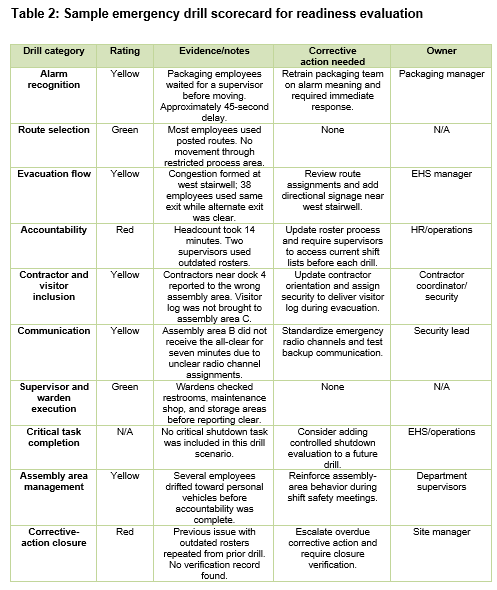
A useful drill metric must be actionable. It should follow a clear logic: Expected Action + Observation Point + Acceptable Standard + Correction Owner. For instance, rather than simply recording that a drill occurred, a facility might measure how quickly packaging employees begin evacuation upon alarm activation at Line 3 without waiting for supervisor confirmation. If delays occur due to noise or confusion, the accountability is assigned to the packaging manager, and the effectiveness of the correction is verified during the next spot check.
Chronology of an Effective Drill: From Planning to Verification
A high-impact emergency drill follows a rigorous lifecycle that ensures the lessons learned are translated into tangible improvements.
Phase 1: Pre-Drill Calibration
Preparation starts by defining what "good" looks like. Leaders must identify high-risk areas—such as maintenance shops where heavy machinery masks alarms, or outdoor tank farms where weather affects communication—and establish specific, time-bound performance goals for these zones.
Phase 2: Execution and Real-Time Observation
During the drill, observers should be stationed at critical junctions: stairwells, gates, and assembly areas. Their role is to record not just if people are moving, but how they are moving. Are they bypassing blocked routes? Are they adhering to the emergency communication protocols?
Phase 3: Immediate Debrief and Scoring
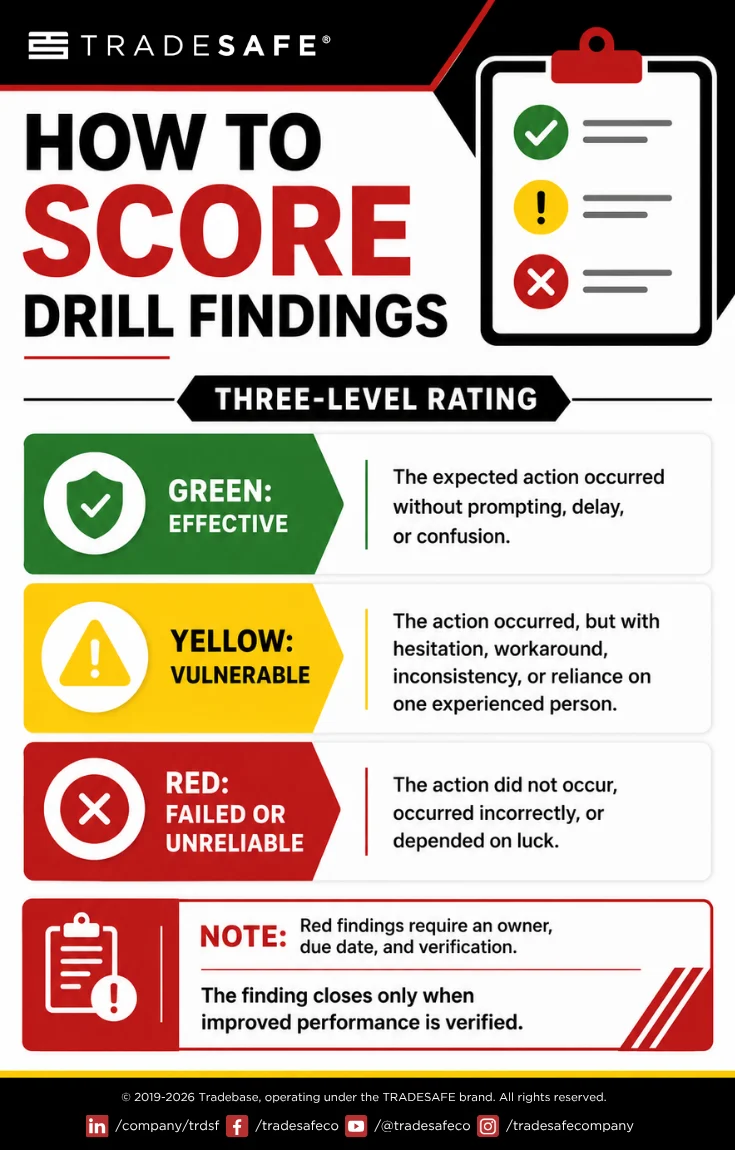
Immediately following the "all-clear," the performance data must be analyzed. Using a scorecard system—categorizing findings as "Effective," "Vulnerable," or "Failed"—leaders can pinpoint exactly where the process broke down.
Phase 4: Corrective Action and Verification
This is the most critical stage. A finding is not closed simply by saying the topic was "discussed with the team." A true corrective action involves updating the emergency action plan, providing additional training, or altering physical infrastructure, followed by a secondary test to ensure the failure point has been eliminated.
The Eight Pillars of Emergency Performance
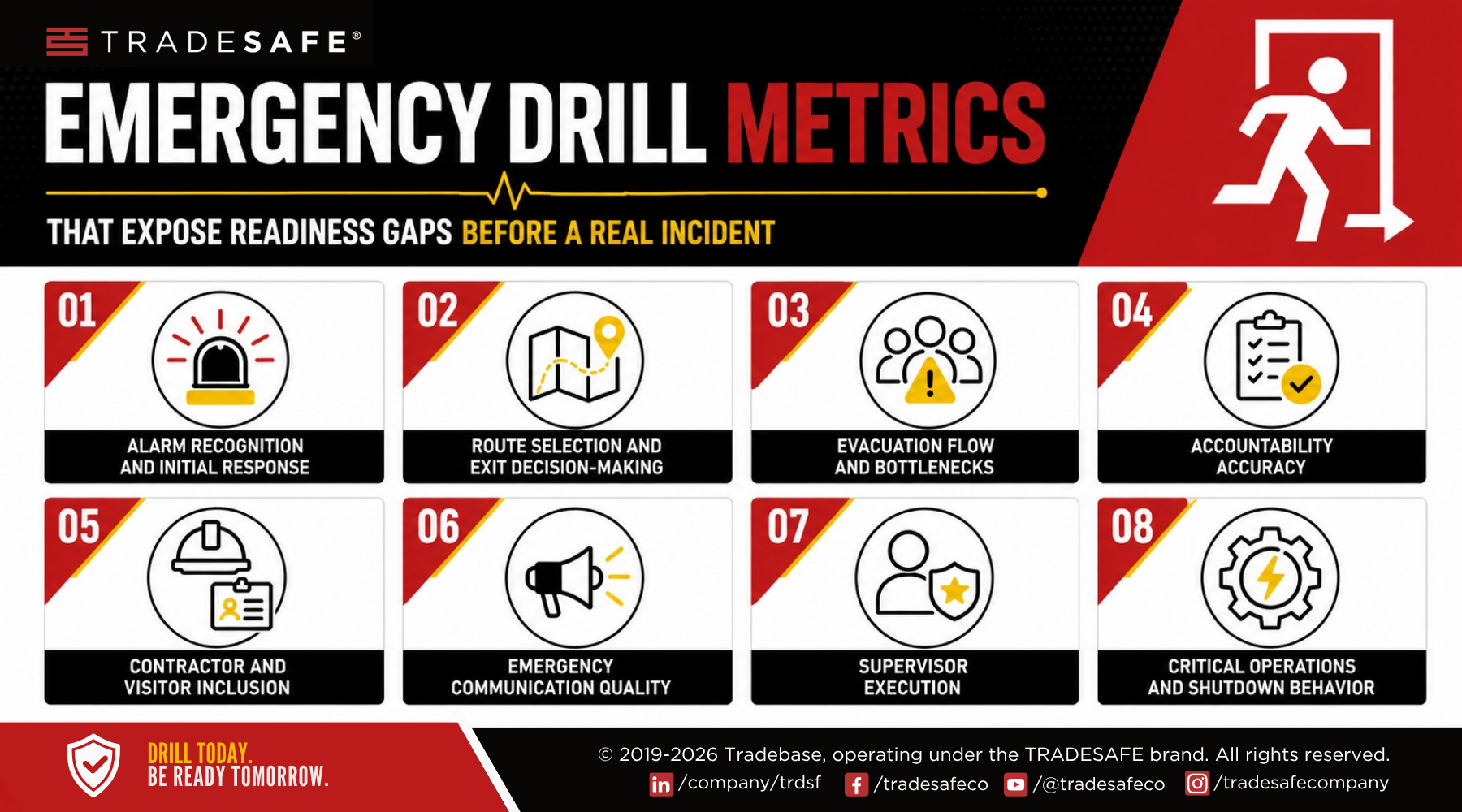
To build a robust drill program, safety managers should focus on eight specific metrics that target the most common points of failure in industrial emergency response.
1. Alarm Recognition and Initial Response
OSHA mandates that alarm systems must be perceivable above ambient noise. However, in an industrial plant, the "ambient noise" changes based on the shift, the equipment running, and the location. Does the alarm cut through the sound of grinders in the maintenance shop? Is it visible to workers wearing hearing protection? The acceptable standard should require an immediate, independent response without the need for supervisor prompting.

2. Route Selection and Decision-Making
A facility’s evacuation plan is only as good as its flexibility. Employees must be trained to recognize when a primary exit is compromised and have the confidence to select an alternate route. Observers should watch for "herd mentality," where employees follow the person in front of them even if that person is moving toward a simulated hazard.
3. Evacuation Flow and Bottlenecks
Congestion is a silent killer. Even if everyone is moving, if they are bottlenecked at a single turnstile or badge reader, the evacuation time will spike. Metrics should identify these chokepoints so that infrastructure—such as wider gates or additional exits—can be prioritized.
4. Accountability Accuracy
Accountability is not complete until every individual is physically accounted for. This includes reconciling visitors, contractors, and off-area personnel. If a facility relies on a manual headcount, they are likely failing; digital or systematic verification methods are required to prevent "lost soul" scenarios.
5. Contractor and Visitor Inclusion
Contractors often operate outside the normal employee roster. During shutdowns or major maintenance projects, the risk increases exponentially. The drill must test whether the host, the contractor’s crew lead, and the assembly-area coordinator are all in sync regarding the headcount.
6. Emergency Communication Quality
Communication is only successful if it is received, understood, and acted upon. In a noisy plant, a PA announcement might be unintelligible. Effective metrics measure whether instructions—such as "Do not use the south corridor"—were heard and followed by all teams, including those in high-noise areas.
7. Supervisor Execution
Supervisors are the linchpins of an emergency response. Their role involves sweeping zones, verifying that restrooms are clear, and ensuring that no one re-enters the building. If a supervisor shows uncertainty, the entire team will hesitate. Drills should specifically assess the performance of the leadership chain.
8. Critical Operations and Shutdown Behavior
Some roles require personnel to shut down machinery or secure energy sources before evacuating. This creates a risk of "heroism," where employees stay too long to finish a task. A successful drill defines the exact "abandon-and-evacuate" trigger for these workers, ensuring they prioritize their lives over the equipment.
Official Guidance and Industry Best Practices
The Federal Emergency Management Agency (FEMA) and OSHA emphasize that emergency action plans must be site-specific. This means the plan must reflect the reality of the facility’s unique architecture, staffing patterns, and environmental hazards.
When a facility treats these guidelines as a checklist, they often miss the mark. The goal of an emergency action plan should not be to demonstrate that a plan exists, but to demonstrate that it works under the chaotic conditions of a real incident. By applying the "Exercise Guidance" framework—where every deficiency is documented in an After-Action Report (AAR)—facilities can transform their safety culture from reactive to proactive.
Implications for Future Resilience
The implications of ignoring these metrics are severe. In a true emergency, the difference between a controlled evacuation and a chaotic, dangerous event is the muscle memory built during drills. When a facility adopts the mindset that every drill is an opportunity to find a failure, they effectively "stress-test" their defenses before they are truly needed.
Ultimately, the goal of a robust drill program is to reach a state of "controlled performance." It is about ensuring that when the alarm sounds, every employee—from the newest contractor to the most senior manager—knows their role, their route, and their accountability, without the need for hesitation. A drill that ends with a completed sign-in sheet is just a memory; a drill that ends with a list of verified improvements is a life-saving tool.
About the Author