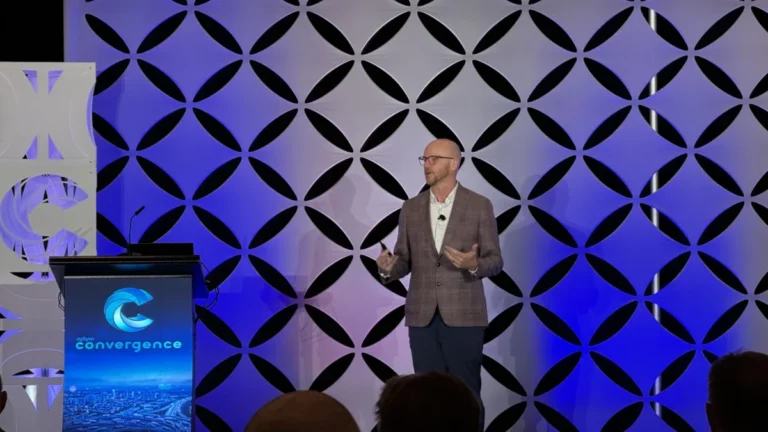
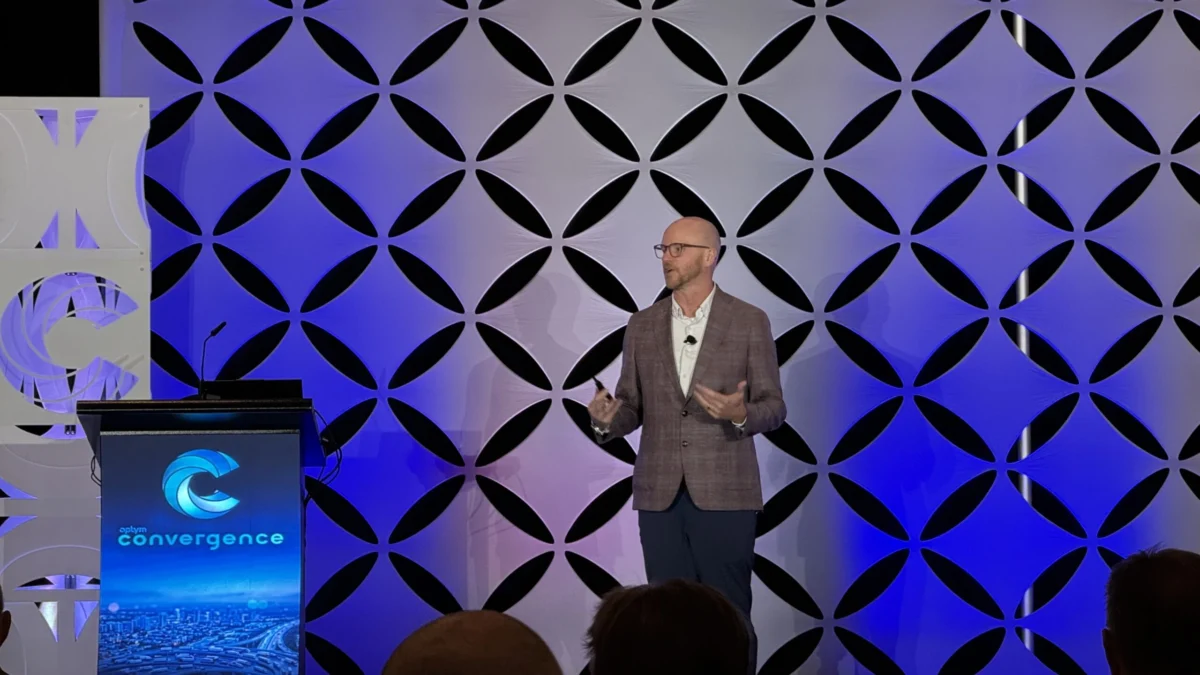
FRISCO, Texas — For small carriers and independent brokers holding out hope that a change in political winds will bring relief from a tightening regulatory environment, the forecast is bleak. FreightWaves founder and CEO Craig Fuller delivered a sobering message during his keynote address at the Optym Convergence 2026 conference: The "regulatory easing" that many in the industry are banking on is a mirage.
According to Fuller, the industry is currently weathering the most significant period of transformation since the Motor Carrier Act of 1980 effectively deregulated trucking. Far from being a government overreach that major industry players despise, the current crackdown on safety, licensing, and liability is being fueled by the very titans that once built their models on cheap, fragmented capacity.
The Convergence of Forces: Safety, Liability, and the End of the "Cheap Truck"
The current landscape is defined by three distinct but converging pressures: the federal government’s aggressive stance on non-domiciled commercial driver’s licenses (CDLs), a landmark Supreme Court ruling that stripped brokers of their primary legal shield against negligent-hiring lawsuits, and a $604 million nuclear verdict against industry giant C.H. Robinson.
For years, the industry operated under the assumption that federal preemption—specifically the Federal Aviation Administration Authorization Act (FAAAA)—would protect intermediaries from state-level liability. That era has ended. For brokers and small carriers, the writing is on the wall: the days of hiring low-cost, high-risk capacity are coming to a permanent close.
"I am frequently asked whether a change in administration will ease these restrictions, allow more new operators into the industry, or effectively kill the enforcement surge," Fuller told the audience. "And I will say no. Follow the money. The largest motor carriers, along with the American Trucking Associations (ATA) and the Truckload Carriers Association, have concluded that tighter standards for hiring are not just preferred—they are desperately needed for their own survival."
A Chronology of a Shifting Landscape
To understand why the industry is at a breaking point, one must look at how the structure of freight procurement has evolved over the last two decades.
The Era of Broker Dominance
In the early 2000s, brokers managed roughly 6% of the nation’s freight. Today, that figure has soared, likely exceeding 30%. This shift occurred as corporate procurement departments began viewing transportation as a commodity to be bid out to the lowest bidder. Brokers became the "day traders" of the industry, creating a hyper-efficient but ultimately fragile ecosystem.
The Pandemic Distortion
The COVID-19 freight boom saw a massive influx of new, small-scale carriers. While many experts predicted these carriers would vanish during the post-pandemic "Great Freight Recession," they proved surprisingly resilient. Fuller identifies the root cause of this market stagnation as the proliferation of non-domiciled CDL holders and operators working in the shadows of the regulatory system. These operators, often running at lower costs, kept the market saturated with cheap, albeit high-risk, capacity.
The Legal Turning Point
The turning point came in mid-2026. On May 14, the Supreme Court ruled in Montgomery v. Caribe Transport II that state negligent-hiring claims against brokers are not preempted by federal law. Shortly thereafter, the $604 million jury verdict in Lipe v. Lupus Superior signaled that juries are no longer viewing brokers as mere middlemen, but as active participants in the safety chain—especially when they utilize proprietary technology to manage driver behavior.
Supporting Data: The Safety and Economic Crisis
The industry is currently facing a triple threat: a security crisis (freight theft), a safety crisis (rising fatality rates), and an economic crisis (the inability to purge excess capacity).
The CDL Controversy
The Federal Motor Carrier Safety Administration (FMCSA) has been embroiled in a battle over non-domiciled CDLs. While the agency’s data suggests that these drivers represent only about 0.2% of fatal crashes, critics—including a dissenting federal judge—have argued that this figure is a gross undercount. The final rule, which took effect in March 2026, aims to restore integrity to the licensing process, effectively removing an estimated 5% to 7% of drivers from the market.
The Fatal Crash Trajectory
Despite the implementation of advanced driver-assistance systems (ADAS) and increased spending on training by large fleets, the statistics on heavy-truck safety remain stubborn. While the rate of fatal crashes involving large trucks declined from 1.76 per 100 million vehicle miles in 2022 to 1.58 in 2024, the absolute numbers remain tragic, with over 5,300 deaths recorded in 2024. The lack of granular, CDL-category-specific data from the FMCSA has only exacerbated the confusion, leaving carriers and brokers to fend for themselves in vetting the capacity they hire.
Official Responses and Corporate Shifts
The industry’s giants are already moving to insulate themselves from the newfound liability.
Following the Supreme Court’s decision, major brokerages began scrubbing their carrier lists, moving "non-certified" carriers to inactive status based on internal safety scores. This proactive approach is a direct response to the risk of being named in "nuclear" lawsuits.
C.H. Robinson, in the wake of the Lipe verdict, has consistently maintained that the carrier involved in the fatal crash held a "Satisfactory" FMCSA rating at the time of the incident. However, the legal precedent is shifting toward a "borrowed-employee" theory, where the use of a broker’s digital load board or mobile app can be interpreted as a form of employment or operational control.
Meanwhile, the liability is beginning to creep up the supply chain. In the case involving Dalilah Coleman, plaintiffs have named not just the broker, but the shipper (Unilever) and the warehouse operator (U.S. Cold Storage). The allegation? A failure to verify the identity and credentials of the carrier at the dock.
"I would bet that at least 20% to 30% of loads leave a warehouse without anyone checking that the truck at the dock belongs to the assigned carrier," Fuller noted. "It has been a security problem for years, but now it has become a catastrophic litigation problem."
Implications for the Future: The Asset-Based Resurgence
As the industry heads into 2027, the implications for all stakeholders are profound.
For Shippers
Shippers can no longer rely on a "hands-off" approach to transportation procurement. The days of simply selecting the lowest bid are over. Procurement teams must now account for the "liability premium"—the hidden cost of using high-risk, unvetted carriers. Expect to see a move toward more "direct-to-asset" relationships, where shippers prioritize stability and safety over pure cost-minimization.
For Brokers
The barrier to entry for the brokerage business has just become significantly higher. Small, under-capitalized brokers who lack the resources to perform rigorous safety audits or to defend against sophisticated litigation will likely find themselves squeezed out of the market. The industry is moving toward a model of "broker-as-guardian," where the value proposition is the mitigation of risk, not just the facilitation of a transaction.
For Small Carriers
For the small, compliant operator, this may actually represent an opportunity. As the market is purged of bad actors—those who have thrived on regulatory loopholes and cheap, under-the-radar labor—there will be a vacuum for high-quality, reliable capacity. However, the requirement for operational transparency, digital compliance, and rigorous safety reporting will be absolute.
The Final Verdict
Fuller’s prediction is clear: Asset-based carriers are poised to win this round. When a shipper tenders a load to a carrier that manages its own assets, employs its own drivers, and adheres to a singular, internal safety standard, that shipper is in the strongest possible position to defend itself against the rising tide of litigation.
The "Great Correction" is not just about clearing out excess trucks; it is about rewriting the rules of the road. In an environment where a single accident can lead to a $700 million verdict, safety is no longer a cost center—it is the core of the business model. For those who can adapt to this higher standard, the path forward is one of stability. For those who cannot, the road ahead is rapidly coming to an end.
About the Author