In the modern manufacturing landscape, the promise of Industry 4.0—characterized by predictive maintenance, real-time analytics, and hyper-connected asset management—often feels like an elusive goal. Despite substantial capital expenditure on sophisticated software and predictive technologies, a new industry report highlights a sobering reality: many maintenance departments are trapped in a cycle of reactive firefighting, hamstrung by organizational inefficiencies rather than a lack of hardware.
The State of Maintenance Report, released in September 2026, surveyed 686 maintenance and operations professionals across the United States. The findings paint a picture of a sector struggling to translate digital potential into tangible reliability. The core issue, according to the report, is not technological failure, but a profound breakdown in the fundamental processes of scheduling, documentation, and knowledge transfer.
The Reality Gap: Planned Maintenance vs. Operational Reality
At the heart of the reliability crisis is a significant gap between maintenance strategy and execution. While industry best practices dictate that the majority of maintenance should be preventive—planned, scheduled, and proactive—the survey reveals that leaders estimate their teams complete only 54% of scheduled preventive maintenance (PM) tasks.
This chronic failure to execute planned work has direct financial and operational consequences. Nearly half of the maintenance leaders surveyed reported at least 10 hours of unplanned downtime in a typical month, with 24% of organizations suffering through more than 20 hours of unexpected machine stoppages. The cost of this instability is mounting: four in 10 respondents estimate that annual downtime costs their organizations at least $100,000, a figure that often represents only the direct loss of production, excluding the hidden costs of wasted labor, emergency parts procurement, and delayed shipments.
The Administrative Burden: Why Technicians Aren’t on the Floor
Perhaps the most startling revelation of the 2026 report is the limited amount of time technicians actually spend performing maintenance. A staggering 62% of technicians report spending three hours or less of their shift performing actual hands-on work. The remainder of their time is eroded by a "death by a thousand cuts" of administrative and operational friction.
The primary culprits behind this lost productivity include:
- Approval Delays (51%): Red tape and bureaucratic hurdles that keep technicians waiting for authorization to proceed with critical repairs.
- Data Deficiencies (41%): Incomplete or outdated asset records that force technicians to hunt for information before they can begin a repair.
- Logistical Failures (40%): Inefficiency in parts procurement and inventory management, requiring technicians to spend valuable time tracking down components.
- Software Usability (35%): Digital tools that are perceived as cumbersome or counter-intuitive, leading technicians to favor inefficient manual workarounds.
For plant leadership, these figures provide a clear mandate: improving equipment reliability requires more than just purchasing new sensors or software. It requires a fundamental streamlining of the workflow. If a technician spends more time navigating an interface or waiting for an email approval than turning a wrench, the maintenance strategy is effectively dead on arrival.
The "Tribal Knowledge" Crisis and Workforce Attrition
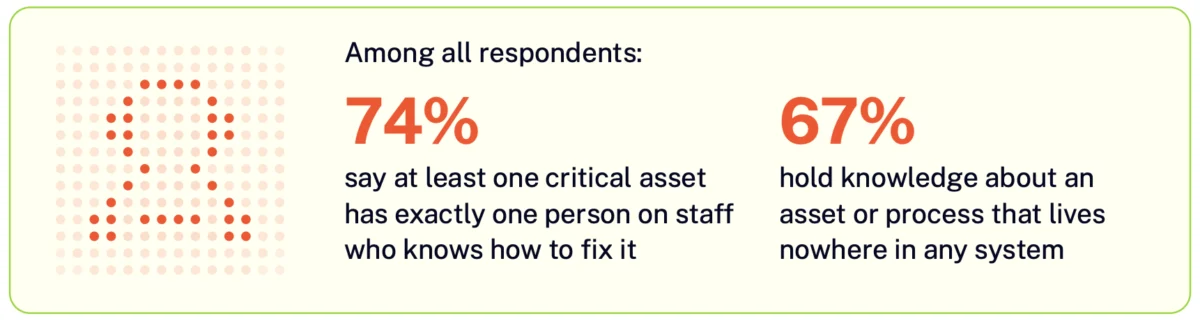
While administrative bottlenecks hinder current output, a more existential threat looms over the maintenance sector: the loss of human expertise. The report highlights a dangerous dependency on individual memory, with 74% of respondents noting that at least one critical asset relies on a single employee who holds the "secret" to its repair.
This creates a high-stakes scenario when that employee retires, takes a new job, or is simply unavailable. Compounding this risk is the fact that 67% of maintenance leaders report that asset or process knowledge is not formally captured in any system. Consequently, 47% of organizations have already experienced a permanent loss of maintenance knowledge due to employee turnover.
This "tribal knowledge" phenomenon acts as a hidden tax on operational efficiency. Without a structured approach to documenting troubleshooting steps, repair histories, and equipment quirks, every new technician is forced to "reinvent the wheel," leading to longer repair times and a higher likelihood of recurring failures.
Expert Insight: The Resource Dilemma
John Rimer, CFM, Vice President of Professional Services at Limble, underscores the difficulty of fixing these systemic issues while teams are already operating at maximum capacity.

"One of the biggest challenges is a lack of internal resources and expertise," Rimer notes. "Collecting accurate, comprehensive asset data takes significant time, and most maintenance teams are already stretched thin. When you are constantly responding to the next emergency, finding the time to properly document the last one feels like a luxury, even though it is actually the key to preventing the next one."
Rimer’s assessment highlights a vicious cycle: teams are too busy fixing machines to document their work, and because they don’t document their work, they remain stuck in a reactive state that prevents them from ever having the time to get ahead.
Technology Adoption: The CMMS and AI Mirage
The report also offers a cautionary tale regarding technology adoption. While 82% of organizations claim to use a Computerized Maintenance Management System (CMMS), the usage is far from universal. Only 39% of respondents report consistent, team-wide adoption of these platforms.
The reasons for this disparity are often tied to the "workaround culture." If a CMMS is poorly configured or lacks mobile accessibility, technicians will inevitably revert to pen and paper, whiteboards, or spreadsheet trackers. This creates a data silo that renders the software useless for management.
Furthermore, the industry’s fascination with Artificial Intelligence (AI) faces a reality check. While 55% of respondents claim to be using AI in some capacity, 92% of experts and practitioners alike agree that AI is only as good as the data it is fed. Without disciplined, consistent data entry from the field, AI models will likely produce inaccurate, misleading, or irrelevant insights. As the saying goes in data science, "Garbage in, garbage out"—a principle that is particularly dangerous in an industrial environment where poor decisions can lead to catastrophic equipment failure.
The Path Forward: A Three-Pillar Strategy
For manufacturing leaders looking to reverse these trends, the report suggests a transition away from "shiny object syndrome" and toward a strategy of disciplined execution. The path to improved asset performance can be summarized by three priorities:
1. Removing Operational Friction
Leadership must audit the maintenance workflow to identify and eliminate the barriers preventing technicians from doing their jobs. This includes automating approval processes for routine tasks, ensuring parts inventory is readily available at the point of need, and providing mobile-first software interfaces that function seamlessly in the field.
2. Formalizing Knowledge Capture
Organizations must move away from a reliance on individual memory. This involves incentivizing technicians to log their work-order findings, document unique troubleshooting steps, and update asset histories in real-time. By transforming tacit knowledge into explicit, searchable data, companies can protect themselves against the loss of key personnel and accelerate the onboarding of new hires.
3. Prioritizing Practicality over Complexity
Technology should be evaluated based on its usability, not just its feature list. A CMMS that is used consistently by the entire team is infinitely more valuable than a high-end predictive analytics suite that sits gathering dust because it is too complex for the frontline staff to navigate.
Conclusion: Reliability as a Discipline
The 2026 State of Maintenance Report serves as a vital reminder that the most sophisticated AI and predictive algorithms are merely tools, not solutions. Sustainable reliability in a manufacturing environment is not a product of software—it is a product of culture and discipline.
When organizations prioritize the basics—ensuring that planned work is completed, that data is captured accurately, and that the administrative burden on the technician is minimized—they create the conditions necessary for true operational excellence. In the race to digitize the plant floor, those who focus on the "human-in-the-loop" elements of maintenance will be the ones who truly achieve, and maintain, a competitive advantage.
About the Author