Introduction
In the wake of a pivotal midterm election cycle that saw the Democratic Party reclaim control of both the House and the Senate, the American political atmosphere has become increasingly volatile. As the dust settles on the 2026 midterms, the relationship between political figures, the news media, and the public is undergoing intense scrutiny. Central to this narrative is a public confrontation between former President Donald Trump and Fox News, a network long considered the definitive source of information for the Republican base. Simultaneously, new data from the Pew Research Center suggests a paradoxical trend: while political rhetoric against the media remains sharp, public trust in news institutions is actually on the rise.
Main Facts: The Trump-Fox Confrontation
Following the midterm results, President Donald Trump took to his platform, Truth Social, to launch a blistering critique of Fox News. Trump alleged that the network "bears responsibility" for the Republican electoral losses, specifically citing the platform it provided to Democratic candidates.
The grievances extended beyond social media. During the height of election night coverage, Trump made a surprise call-in appearance on the network, using the airtime to challenge the accuracy of the network’s own polling and reporting. This public airing of grievances coincides with a period of declining viewership for the network throughout October. While Trump attributes these numbers directly to the network’s editorial decisions, Fox CEO Lachlan Murdoch has characterized the slump as a byproduct of broad "viewer fatigue," a phenomenon noted across the cable news industry as the election cycle reaches its conclusion.
Historically, Fox News has held a near-monopoly on the attention of conservative audiences. Pew Research data from 2025 indicated that 57% of Republicans and GOP-leaning independents rely on the network for their news—a figure 30 percentage points higher than any other media outlet. In the lead-up to the 2024 presidential election, that reliance peaked at 69%, underscoring the massive influence the network wields over the Republican electorate and explaining why any perceived betrayal by the network is met with such immediate hostility from the party’s leadership.
Chronology of Events
- August 24–30, 2026: Pew Research Center conducts a survey on the role of the news media as a "watchdog" for political power.
- September 15, 2026: Release of the Pew-Knight Initiative survey revealing widespread public concern regarding the corporate and political influence over U.S. news organizations.
- October 2026: Fox News reports a consistent decline in viewership compared to the same period in the previous year.
- November 3, 2026: Midterm elections take place, resulting in a Democratic majority in both chambers of Congress.
- November 4, 2026: President Trump posts on Truth Social blaming Fox News for GOP losses; he calls into the network’s live broadcast to dispute polling data.
- November 5, 2026: Analysis of post-election sentiment begins, highlighting the tension between political leaders and media gatekeepers.
Supporting Data: The Trust Paradox
Despite the high-profile vitriol directed at media organizations, the American public is demonstrating an increased level of faith in news institutions. According to a new report from the Pew Research Center, trust in both national and local news organizations has risen over the past year.
Currently, 62% of U.S. adults report having at least "some trust" in information provided by national news organizations, a notable increase from the 56% recorded in 2025. Local news has fared even better, with 75% of Americans expressing trust in their local outlets, up from 70% in the previous year. While this increase is observed across the political spectrum, a partisan gap persists, with Democrats remaining significantly more trusting of legacy media than their Republican counterparts.
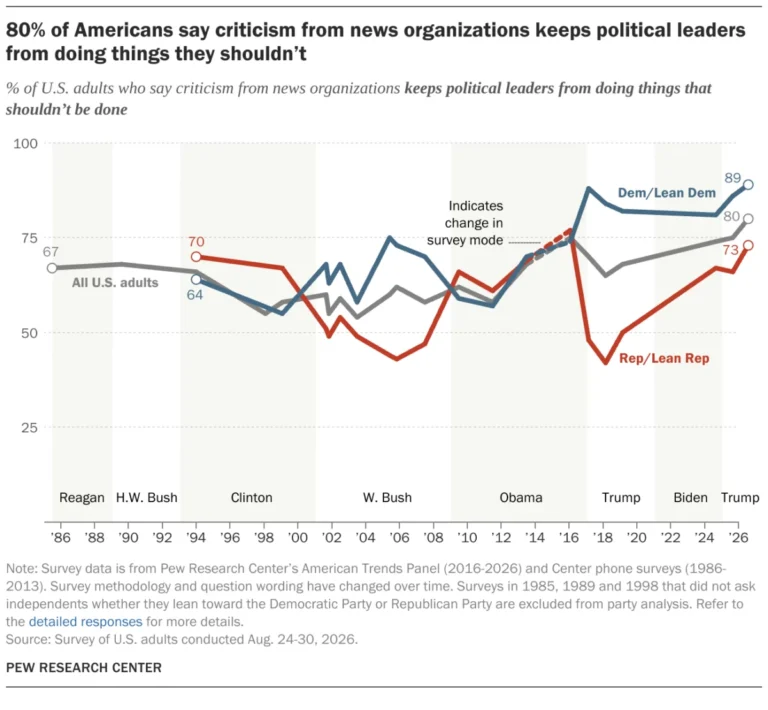
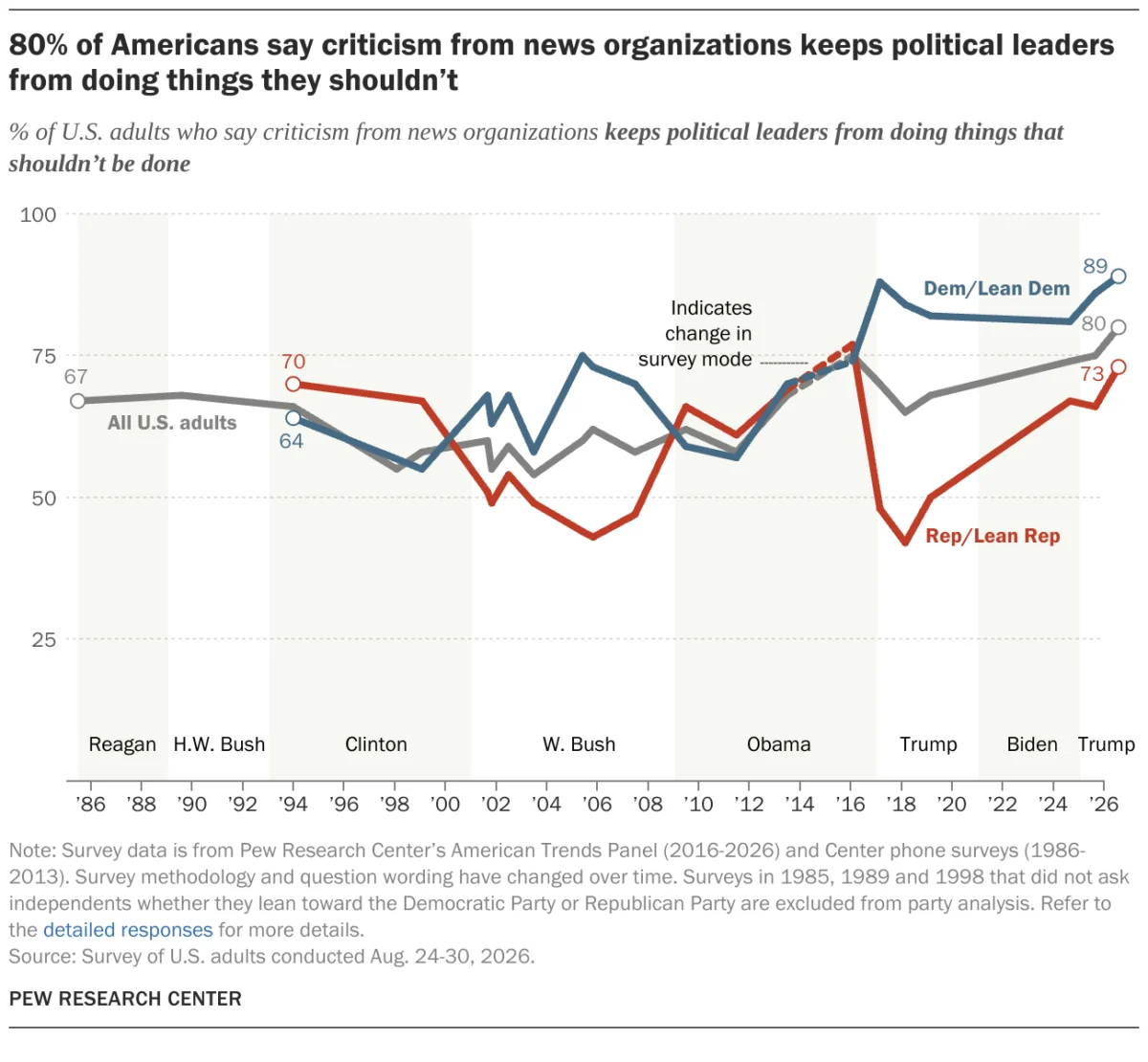
Perhaps most revealing is the data concerning the "watchdog" role of the press. Eight-in-ten Americans now believe that criticism from news organizations is a vital mechanism to prevent political leaders from overstepping their bounds. This represents a significant shift from 2025, where the figure stood at 75%. Even among Republicans, who have historically been more critical of mainstream media, there has been a notable uptick; 73% now agree that the media keeps politicians in check, up from 67% in 2024. This trend bucks the traditional pattern where supporters of the sitting party typically become more skeptical of the media’s watchdog function.
Official Responses and Corporate Stance
The tension between the Trump administration and media moguls is not occurring in a vacuum. Fox CEO Lachlan Murdoch has maintained that the decline in viewership is not an ideological protest by viewers, but a reflection of a broader market trend. "Viewer fatigue" is a term often used in media circles to describe the saturation of political advertising and news coverage that leads audiences to tune out as elections approach.
However, the political response to this media environment is shifting toward a more interventionist approach. Reports indicate that with the Democratic Party now in control of Congress, there is significant momentum for legislative investigations into the media landscape. Specifically, committees are looking to probe the relationship between the Trump administration and major media conglomerates. This includes a review of the government’s role in recent high-profile mergers involving companies like Paramount and TikTok, as well as the Federal Communications Commission’s (FCC) oversight of broadcast license renewals.
Implications: The Future of Media and Politics
The current climate suggests that the relationship between the government and the press is entering a new, more adversarial phase. The public’s wariness, documented by the Pew-Knight Initiative in June 2026, highlights that the skepticism is not limited to political figures alone. The survey found that a large majority of Americans believe news organizations are influenced by external forces: 54% feel that corporate and financial interests exert "a great deal" of influence on the news, while 49% say the same regarding government and political interests.
1. The Erosion of the "Safe Space"
For decades, Fox News served as an information "safe space" for conservative voters. The current friction between the former President and the network suggests that this alignment is no longer guaranteed. If political leaders continue to distance themselves from their traditional media allies, the Republican electorate may face further fragmentation in where they seek their information, potentially turning toward even more niche or partisan platforms.
2. The Regulatory Battleground
The prospect of Congressional investigations into media mergers signals that the "tech-media-politics" nexus will be a major battleground in the new Congress. If the legislative branch begins to use its subpoena power to investigate how media companies are managed, or how they interact with federal regulators like the FCC, it could lead to a fundamental restructuring of media ownership laws in the United States.
3. The Watchdog Dilemma
The most optimistic finding in the recent data is that the American public still values the watchdog role of the press. Despite the constant rhetoric about "fake news" and "media bias," the fact that 80% of citizens agree that journalists perform a necessary function in keeping politicians in check provides a mandate for the press to continue its investigative work. The challenge for the media will be to maintain this trust while operating in a polarized environment where every fact is treated as a political statement.
Conclusion
The intersection of the 2026 election results and the public’s evolving relationship with the news media highlights a nation in transition. While the political class continues to view the media through the lens of power and influence, the public is simultaneously demanding more accountability and expressing a renewed, albeit cautious, trust in the institutions that provide it. As the new Congress prepares to take office, the debates surrounding media regulation, corporate influence, and the accountability of political leaders will remain at the forefront of the national conversation, defining the media landscape for years to come.
The Briefing is compiled by Pew Research Center staff, including Naomi Forman-Katz, Christopher St. Aubin, Emily Tomasik, Joanne Haner, and Sawyer Reed. It is edited by Michael Lipka and copy-edited by David Kent. For inquiries, contact [email protected].
About the Author