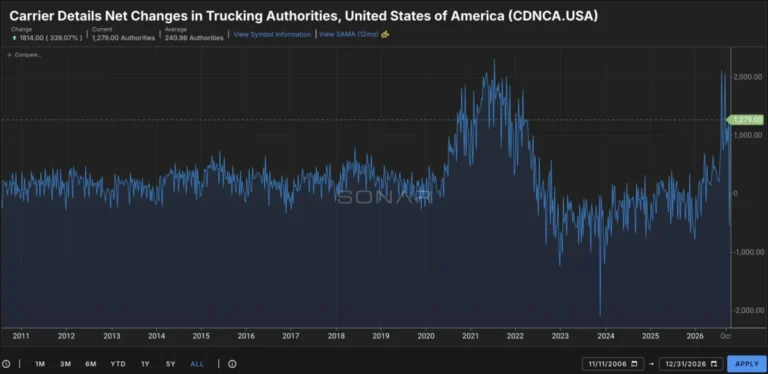
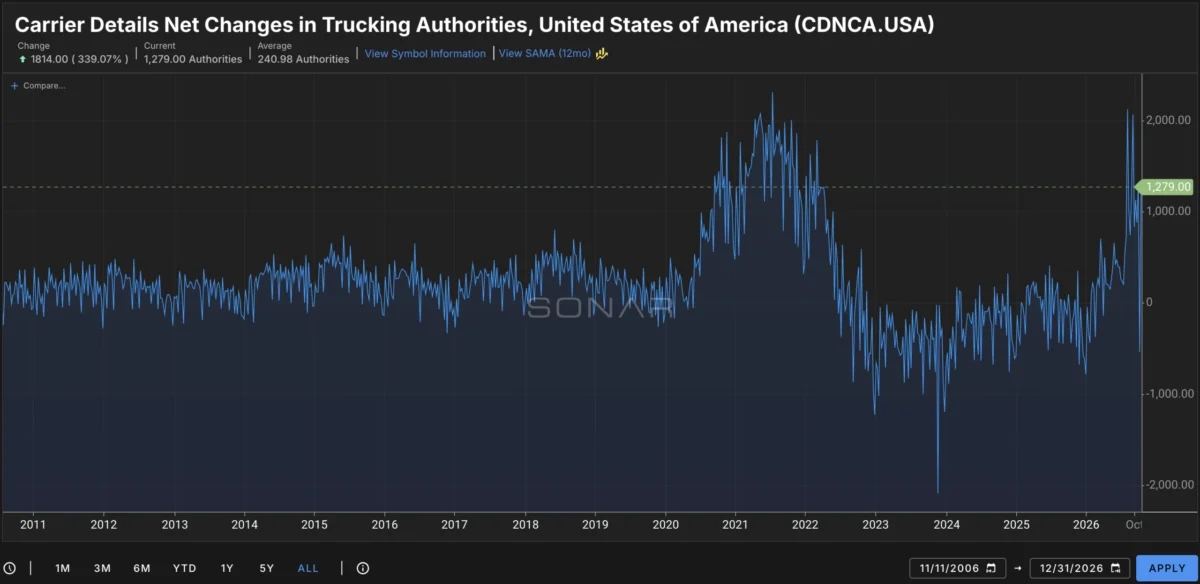
For three and a half years, a silent transformation has been reshaping the American logistics landscape. At the bottom of the trucking industry’s hierarchy—the “one-to-six-truck” tier—a steady exodus has been underway. From a 2023 peak of approximately 398,000 tractors, the population of these smallest carriers has dwindled to roughly 362,000.
To the casual observer, the narrative is simple: owner-operators are folding under the pressure of a difficult market. However, a deeper analysis of federal data reveals a more nuanced and fascinating reality. These trucks are not disappearing from the nation’s highways; they are merely changing the names on their doors. This is not a story of total industry collapse, but rather a structural migration—a redistribution of capacity from the fragile, hyper-fragmented periphery into the more resilient, mid-sized fleets.
The Anatomy of a Market Shift
The trucking industry’s bedrock remains its smallest operators. According to the most recent Federal Motor Carrier Safety Administration (FMCSA) census, there are more than 1.8 million active carrier registrations in the one-to-six-truck band. This segment represents the vast majority of all registered carriers in the United States, encompassing private fleets, intrastate haulers, and for-hire freight operators. When this broad base contracts, it signals a fundamental shift in how the nation’s freight is moved.
This contraction has been consistent, indifferent to the monthly ebbs and flows of freight volumes. While the headlines often focus on whether the market is “bullish” or “bearish,” the structural shift is being driven by a mathematical inevitability. The costs of doing business have reached a point where the traditional “lone wolf” model is increasingly difficult to sustain, forcing a mass migration toward larger, more stable fleet environments.
Chronology of the Squeeze: A Ledger-Driven Exodus
The current crisis for the small operator is defined by a pincer movement: record-shattering operational costs meeting a market that lacks the mechanisms to insulate the smallest players from volatility.
2025: The Foundation of Rising Costs
The year 2025 set the stage for this shift. The American Transportation Research Institute (ATRI) reported that the average marginal cost of operating a truck hit a record $2.336 per mile. Within this figure, labor costs—driver pay—accounted for 82 cents per mile, while fuel trailed at 48 cents. At the time, this was considered a challenging but manageable ceiling.
2026: The Fuel Crisis
The math changed drastically in 2026. Fuel, typically a fluctuating variable, transformed into a fixed, insurmountable barrier. Following a series of global refining constraints and a surge in crude oil prices—which breached the $100-per-barrel mark—diesel prices reached unprecedented heights. By the week of November 9, 2026, the Department of Energy’s national on-highway average hit $6.127 per gallon.
For a truck averaging six to seven miles per gallon, fuel costs effectively doubled to roughly $1.00 per mile. This increase arrived on top of an already record-high cost base, effectively cannibalizing the thin profit margins of the smallest operators.
The Invisible Barrier: Why Surcharges Favor the Large
The most significant disadvantage for the small operator is the lack of a “fuel surcharge” (FSC) mechanism. In the contract-freight world, mid-sized and large fleets utilize sophisticated FSC programs that adjust in real-time based on the weekly DOE diesel average. When fuel prices spike, these fleets recoup a substantial portion of their increased overhead.
Conversely, the owner-operator who relies on the spot market is largely defenseless. Spot rates are quoted “all-in,” meaning the rate is a flat, non-negotiable figure that includes the cost of fuel at the time of the quote. When diesel jumps overnight, the owner-operator cannot retroactively adjust their rate. They absorb the entirety of the fuel increase, effectively subsidizing the shipper’s logistics costs with their own dwindling net profit. While contract fleets capture rising rates and claw back fuel costs, the spot-dependent operator is left with a shrinking cushion that quickly evaporates.

Supporting Data: The Migration to Scale
The FMCSA census data provides a clear roadmap of where these trucks are landing. The pattern is defined by a striking correlation between fleet size and the use of leased equipment.
- 1-6 Trucks (Owner-Operators): Only 6.9% of tractors are leased. This group relies almost exclusively on owned assets.
- 7-19 Trucks: The leased share jumps to 18.2%.
- 20-100 Trucks (The Efficiency Sweet Spot): Nearly a third (31.6%) of all tractors are leased.
- 101-999 Trucks: The share climbs past 40%.
This data suggests that when an owner-operator reaches the end of their runway, they are not necessarily selling their truck for scrap. Instead, they are surrendering their own authority and “leasing on” to a larger carrier. In this scenario, the truck remains in service, but it now operates under the umbrella of a mid-sized fleet that possesses the purchasing power to secure fuel discounts, the legal resources to negotiate better insurance rates, and the administrative staff to manage back-office compliance.
The 20-to-100-truck tier has become the industry’s “absorbing” layer. These fleets are large enough to benefit from economies of scale—buying fuel in bulk, spreading insurance premiums, and optimizing maintenance cycles—yet small enough to remain regional and agile. With roughly 44,500 carriers in this segment operating 1.75 million power units, they have become the most durable tier in the modern trucking economy.
Official Industry Perspective and Implications
Industry experts note that the disappearance of small authorities is not necessarily a negative for the supply chain, though it represents a profound change for the entrepreneurial spirit of the industry.
"The consolidation we are seeing is a rational market response to an environment of permanent volatility," says one senior analyst at a national logistics firm. "The small operator who isn’t a specialist is finding that they are essentially paying a ‘small-business tax’ in the form of higher fuel and insurance costs that they cannot mitigate."
The insurance sector confirms this, with premiums rising by roughly 4% in 2025 to 10.6 cents per mile. Because small carriers lack the ability to self-insure or negotiate group rates, they bear the brunt of these increases. The result is a cycle where the most efficient, capitalized carriers eventually acquire the equipment of those who can no longer make the math work.
Long-term Implications for the Logistics Sector
The shift from independent ownership to leased-on capacity has several critical implications for the future:
- Supply Chain Stickiness: As capacity moves into larger, more stable fleets, the industry becomes more consolidated. These larger fleets are "stickier"—they have the financial durability to survive periods of flat volume or high fuel costs that would otherwise drive independent owner-operators out of business.
- Increased Professionalism in Fleet Management: The migration suggests that the future of trucking will be defined by larger, more professionalized mid-sized firms. This will likely lead to better-maintained equipment and a more standardized approach to driver management and safety.
- The End of the "Wild West" Spot Market: The reliance on the spot market, which defined the 2020-2021 surge, is becoming a liability. As more carriers move toward contract-based freight, the spot market may eventually shrink to a secondary role, reducing the volatility that defined the pandemic-era freight market.
Conclusion: The Choice Facing Today’s Operator
The data cannot dictate an individual operator’s path, but it clarifies the stakes. For the owner-operator, the current environment demands a level of fiscal discipline that was previously optional. The ones who survive are those who treat their operations like a business rather than a job: they know their cost-per-mile to the penny, they favor direct relationships over the volatility of load boards, and they operate with a clear understanding of their competitive disadvantages.
The story of the shrinking owner-operator is not one of a dying industry, but of a maturing one. It is a story of consolidation, driven by the inescapable math of modern operating costs. Whether an operator decides to double down on their independence or trade it for the safety of a larger fleet’s authority, the reality is clear: the era of the small, autonomous fleet is being replaced by the era of the integrated, efficient mid-sized operation. Trucking remains the heartbeat of the American economy, but the vessels that carry that heart are growing larger, stronger, and more consolidated by the day.
About the Author