For private companies, the "Golden Handcuffs" of equity incentives are intended to serve as the ultimate alignment tool. By granting senior executives a slice of the ownership pie, boards and owners aim to foster a long-term, "owner-mindset" that drives value creation. Yet, a new, comprehensive analysis from the Chief Executive Group suggests a jarring disconnect: many firms are offering these incentives without providing the one thing that makes them effective—tangible, understandable value.
In the public markets, an executive can check a stock ticker at any moment to see the real-time valuation of their portfolio. In the private sector, that transparency is often replaced by opacity, internal guesswork, or simply silence. This "valuation vacuum" is not just a bookkeeping issue; it is a critical failure in human capital strategy that risks rendering millions of dollars in compensation effectively invisible to the very people it is meant to motivate.
The Valuation Paradox: When Wealth Is Theoretical
The core objective of equity compensation is to bind an executive’s personal prosperity to the long-term health of the firm. When an executive holds equity, they are theoretically incentivized to forgo short-term gains in favor of building sustainable, compounding value.
However, the research highlights a systemic weakness in private-company compensation programs. While many businesses offer equity or "phantom equity" to their leadership teams, a surprisingly small fraction of these companies prioritize the regular measurement and communication of these gains.
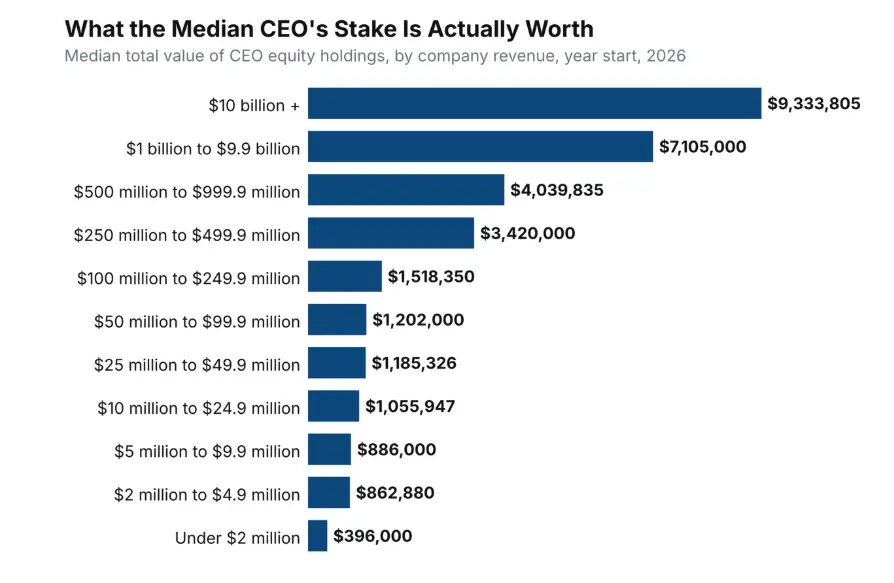
The stakes are immense. According to the 2026–2027 CEO & Senior Executive Compensation Report, the median equity stake for a CEO at a company with under $2 million in revenue sits at roughly $396,000. As companies scale, that figure grows exponentially, reaching a median of $7.1 million for CEOs at firms generating between $1 billion and $9.9 billion. When an executive is unaware of the growth—or the stagnation—of this multi-million-dollar asset, the motivational "carrot" loses its flavor.
A Chronology of Compensation Opacity
The evolution of executive compensation has long been dominated by the influence of public market standards, yet private firms have struggled to adapt those standards to their unique structural constraints.
- The Traditional Era: Historically, private firms viewed equity as a "set it and forget it" tool. Grants were often made at the time of hiring or during significant milestones, with little regard for ongoing valuation until a liquidity event (such as a sale or IPO) occurred.
- The Rise of Professionalism: As private equity (PE) and venture capital (VC) firms became more dominant in the landscape, they introduced rigorous reporting requirements. These firms began to mandate quarterly or annual valuations, shifting the baseline expectation for reporting.
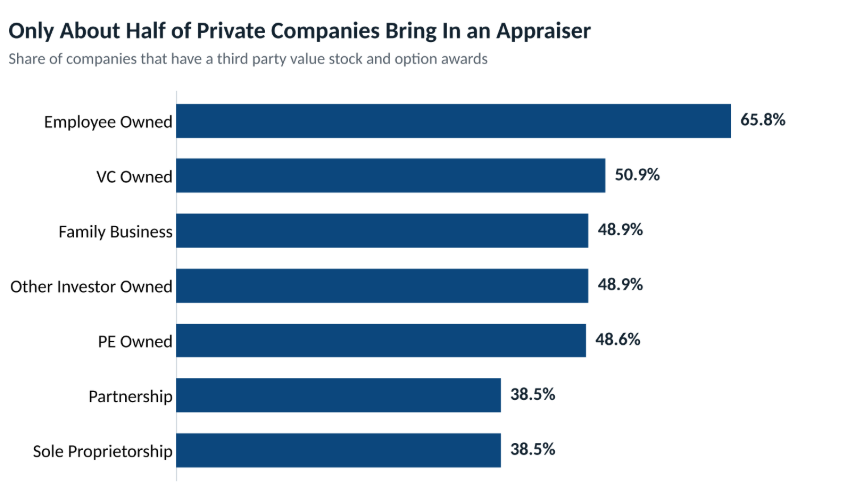
- The Current Crisis of Communication: Despite the influence of PE/VC, the broader private market remains fragmented. Today, only about 50% of private companies engage an independent third party to value their stock. The remaining half rely on internal estimates from CFOs, rudimentary formulas tied to trailing revenue, or simply nothing at all. This lack of a standardized, objective process creates a "black box" where executives are expected to work for a reward they cannot see, quantify, or verify.
Supporting Data: The Cost of Silence
The Chief Executive Group report provides a sobering look at how companies handle the valuation process, revealing a landscape defined by inconsistency:
- Third-Party Appraisals: Employee-owned companies are the most transparent, with 66% utilizing independent appraisals. In contrast, sole proprietorships and partnerships trail significantly, with only 39% employing external experts.
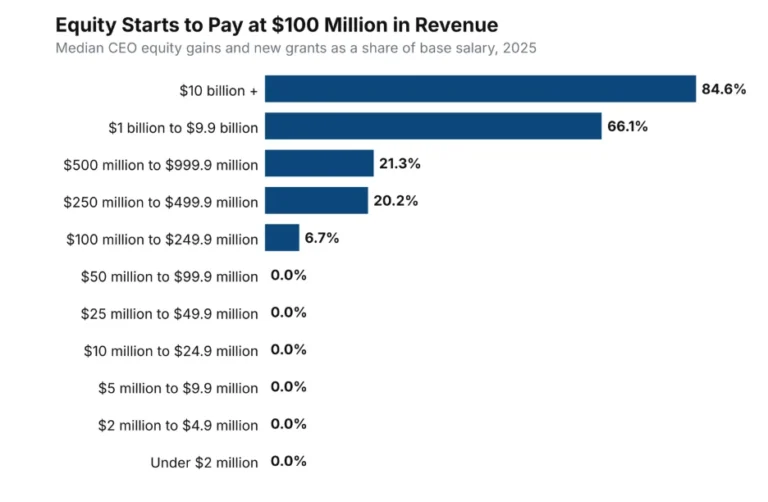
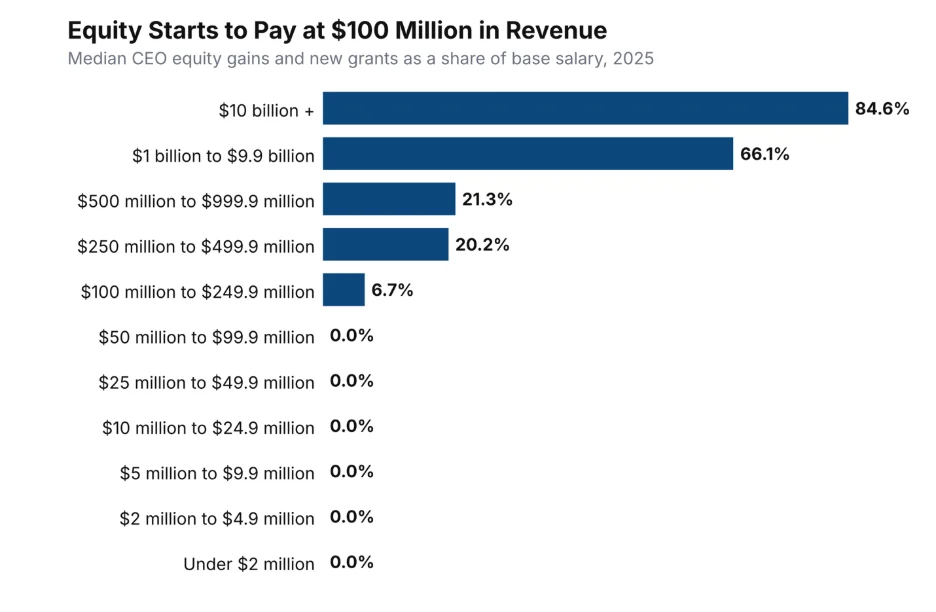
- The Size Threshold: Equity participation is essentially nonexistent below the $100 million revenue mark. However, as revenue crosses that threshold, equity becomes a significant component of the compensation package. For firms in the $1 billion to $9.9 billion range, equity grants and gains account for a staggering 66% of a CEO’s base salary.
- Vesting Trends: The reliance on time-based vesting remains the dominant strategy, with nearly 50% of companies ignoring performance metrics entirely. This approach further decouples the incentive from the actual, measurable impact of the executive’s decisions.
When companies fail to provide a clear, annually updated valuation, they inadvertently signal to their leadership that equity is a "gift" rather than a performance-based investment. This undermines the psychological contract between the employer and the executive.
Official Perspectives: Transparency as a Double-Edged Sword
For leaders who have embraced transparency, the experience is not always smooth, but it is undeniably more effective.
Pete Ensch, CEO of the private equity-backed manufacturing firm Sani-Matic, represents the "best practice" model. Under his guidance, the firm works with a sponsor to track value quarterly, commissioning a formal, independent valuation annually. More importantly, Sani-Matic now issues personalized statements to each equity holder, outlining the current value of their stake and providing a range of potential outcomes based on hypothetical sale scenarios.
"Everybody was doing the same thing, just doing their own math," Ensch explains. He is refreshingly candid about the risks of this transparency. "It comes down to the numbers." When the company is performing well, transparency creates enthusiasm and focus. During leaner years, however, the data can be a reality check. "At an earlier, more difficult business, valuations brought disappointment rather than enthusiasm," Ensch admits. Yet, he argues that the discomfort of transparency is preferable to the stagnation caused by ignorance.
On the other end of the spectrum is the Parr Instrument Company, a 127-year-old manufacturer based in Moline, Illinois. Their approach is structural: an independent appraiser values the business annually, and the company offers key employees shares at a 40% discount to that value. Because the IRS treats the discount as taxable income, the company is effectively forced into annual valuation. Both Sani-Matic and Parr share a rare, crucial trait: they require executives to put up their own capital to acquire equity. This "skin in the game" is present in only 22% of companies, yet it is arguably the most effective mechanism for ensuring that executives understand and respect the value of their holdings.
Implications: The Strategic Path Forward
The evidence suggests that many private company owners are leaving money on the table—not by underpaying their executives, but by failing to communicate the value they have already provided. If an executive cannot quantify the growth of their equity, they cannot be expected to make decisions that prioritize the long-term health of that equity.
To rectify this, private company boards and owners should consider three strategic shifts ahead of the next fiscal year:
1. Formalize the Valuation Cadence
Annual, independent valuations should be the gold standard. Relying on internal estimates is a recipe for skepticism, especially if the internal formula appears to shift to suit the needs of the board. An independent appraisal provides a layer of objectivity that is essential for trust.
2. Close the Communication Gap
A valuation is useless if it remains in a drawer. Companies must adopt a policy of radical transparency regarding equity. This means providing clear, personalized statements that explain the valuation methodology and, ideally, show how the company’s performance metrics directly influenced the change in share price.
3. Align Vesting with Performance
Moving away from purely time-based vesting toward performance-based metrics ensures that equity is truly "earned" rather than "accrued." When executives understand that their equity growth is tethered to specific, achievable KPIs, they are far more likely to focus their daily efforts on those specific levers of value creation.
Conclusion
Equity is one of the most expensive and potent tools in the compensation toolkit. When used correctly, it transforms an employee into a steward of the business. When left to languish in a state of valuation-blindness, it becomes a wasted asset—a promise of wealth that feels like a phantom.
As the private market continues to mature and compete with public firms for top-tier executive talent, the ability to clearly articulate the value of ownership will become a competitive advantage. For owners, the message is clear: if you want your executives to think like owners, you must first treat them like owners by showing them exactly what they own, what it is worth, and how they can make it worth more.
About the Author