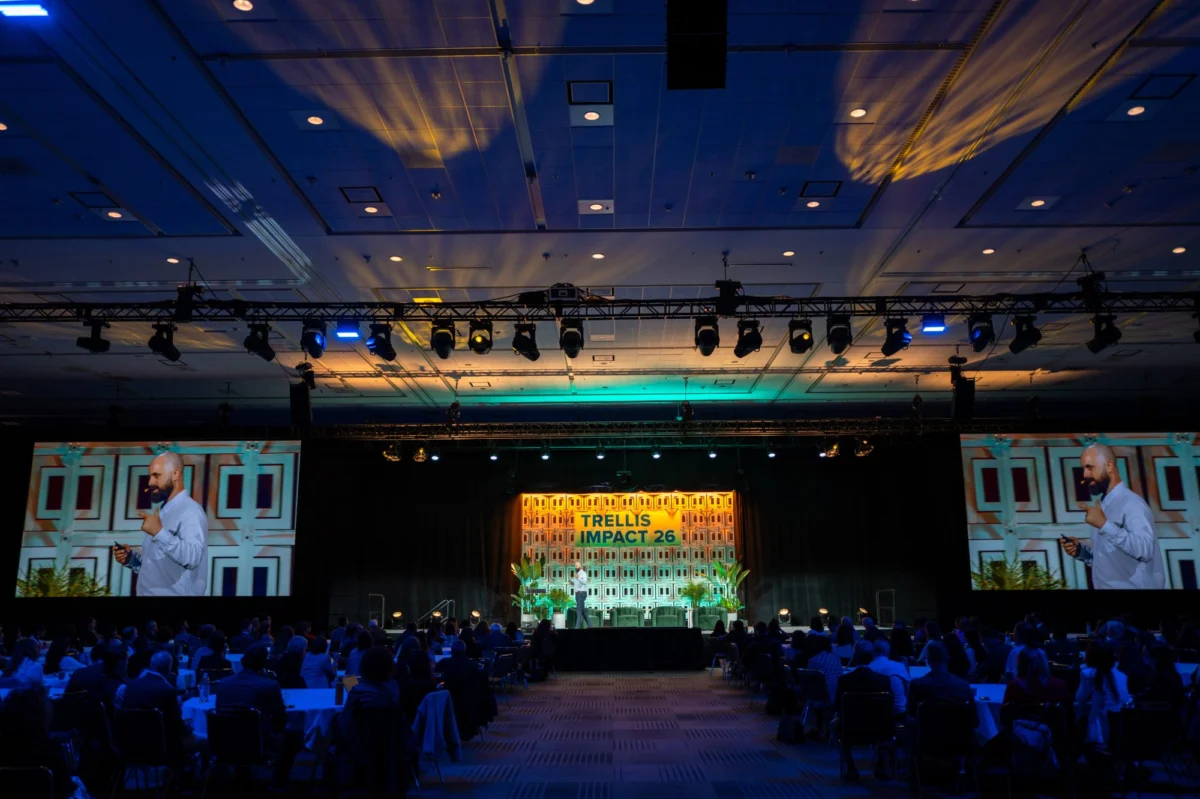
The landscape of corporate responsibility has undergone a tectonic shift. For over a decade, the primary currency of sustainability was the "commitment"—bold, often distant targets for carbon neutrality or net-zero emissions. However, as the dust settles on Trellis Impact 26, a premier gathering of sustainability leaders and innovators, the industry consensus has moved decisively. The era of visionary rhetoric is being replaced by the "Implementation Era," a period defined by operational grit, infrastructure scaling, and the hard engineering of a low-carbon economy.
In the weeks following the event, a post-mortem analysis of attendee reflections, LinkedIn discourse, and session takeaways reveals a striking change in vocabulary. Familiar buzzwords like "ESG" and "Net Zero" have been sidelined. In their place, a new lexicon has emerged: "infrastructure," "resilience," "grid capacity," and "social license." The following report explores the core themes of this transition, the data driving it, and the implications for the global business community.
I. Main Facts: From Ambition to Execution
Trellis Impact 26 served as a microcosm of the current state of climate action. While previous years focused on the why—the moral and economic imperatives for sustainability—this year’s event was dominated by the how. Attendees from Fortune 500 companies, tech startups, and policy think tanks converged on a single realization: the frameworks have been built, the targets have been set, and now the actual work of rebuilding the industrial world must begin.
The Death of the "Commitment" Phase
The most significant takeaway from the event was the collective admission that corporate sustainability has matured beyond its infancy. We are no longer in the "Commitment Phase" (2015–2023), where a well-crafted press release about a 2050 goal was sufficient to satisfy stakeholders. Instead, the "Implementation Era" demands immediate, measurable progress.
The Convergence of AI and Infrastructure
Artificial Intelligence (AI) was not discussed as a mere software tool, but as a massive physical infrastructure challenge. The narrative shifted from the capabilities of Large Language Models (LLMs) to the physical requirements of the data centers that house them—specifically their insatiable demand for power, water, and cooling.
The Rise of Business Resilience
A recurring theme across nearly every session was the rebranding of sustainability as "business resilience." Rather than viewing environmental initiatives as a cost center or a compliance burden, leaders are now framing them as essential strategies for long-term survival in a volatile climate and a shifting regulatory landscape.
II. Chronology: The Evolution of the Sustainability Narrative
To understand why Trellis Impact 26 felt like a turning point, it is necessary to trace the trajectory of corporate sustainability over the last ten years.
- The Era of Awareness (2010–2015): Sustainability was often siloed in "Corporate Social Responsibility" (CSR) departments. It was largely a marketing function, focused on small-scale philanthropy and basic energy efficiency.
- The Era of Frameworks (2015–2020): Following the Paris Agreement, the industry focused on standardization. This period saw the rise of the Science Based Targets initiative (SBTi), the Task Force on Climate-related Financial Disclosures (TCFD), and the explosion of ESG (Environmental, Social, and Governance) investing.
- The Era of Ambition (2020–2023): Driven by the pandemic and a surge in climate-related disasters, companies raced to announce "Net Zero by 2040/2050" goals. This was the peak of the "pledge" culture.
- The Implementation Era (2024–Present): As highlighted at Trellis Impact 26, the deadline for 2030 interim targets is looming. The focus has shifted to the "plumbing" of sustainability: supply chain decarbonization, grid modernization, and circular economy logistics.
III. Supporting Data: The New Lexicon of Success
The shift in focus is not merely anecdotal; it is reflected in the language used by professionals in the field. An analysis of post-event reflections from over two dozen high-level LinkedIn responses showed a marked divergence from traditional sustainability terminology.
The Vocabulary Shift
The frequency of terms like "Net Zero" and "ESG" decreased by nearly 40% compared to previous event cycles. Conversely, terms related to operational execution saw a dramatic spike:
- "Implementation": Mentioned in 85% of attendee takeaways.
- "Infrastructure": Mentioned in 70% of reflections.
- "Resilience": Mentioned in 65% of posts.
- "Data/Credibility": Mentioned in 60% of responses.
The AI Infrastructure Bottleneck
Data presented during the event underscored the physical constraints of the AI boom. Estimates suggest that data centers could consume up to 9% of total U.S. electricity generation by 2030, up from 4% today. Attendees consistently linked this to the broader climate challenge, noting that the "Implementation Era" of AI is inherently tied to the "Implementation Era" of renewable energy.
The "Social License" Metric
While technical data dominated, a new qualitative metric emerged: the "Social License to Operate." Research shared by attendees suggested that up to 30% of large-scale renewable energy and infrastructure projects are delayed or canceled due to community opposition. This data has forced a shift in strategy toward early-stage community engagement and "human-to-human" trust-building.
IV. Official Responses: Voices from the Front Lines
The sentiment of Trellis Impact 26 was best captured by the attendees themselves. Their reflections provide a "boots-on-the-ground" perspective of the challenges facing modern corporations.
On the Shift to Execution
One attendee, a senior sustainability director for a global manufacturing firm, noted: "We’re no longer debating why circularity matters. We’re wrestling with how to make it work. The theoretical phase is over; the engineering phase has begun." This sentiment was echoed across sectors, from fashion to heavy industry, indicating that the "how" is now the primary source of competitive advantage.
On AI and Systems Thinking
A technology executive remarked on the interconnectedness of modern challenges: "The scale and speed of AI deployment are creating a new industrial ecosystem. We cannot talk about AI without talking about grid capacity, water cooling, and the supply chain for critical minerals. It is all one system."
On the Mandate for Hard Data
The "Implementation Era" has no patience for vague promises. One attendee summarized the new standard for credibility in five words: "Promises are cheap. Data is the new credibility." There is a growing demand for real-time, granular data to prove that carbon reductions are actually happening, rather than being "offset" through questionable accounting.
On Cross-Sector Collaboration
The complexity of these tasks has led to a new humility among corporate giants. As one participant put it: "No one solves this alone. Circularity is a team sport." This has led to unprecedented partnerships between utilities, tech firms, and local governments to solve shared infrastructure bottlenecks.
V. Implications: The Future of Sustainability Leadership
The insights gathered from Trellis Impact 26 have profound implications for the next decade of business strategy.
1. The CFO as a Sustainability Partner
As sustainability becomes a matter of "infrastructure" and "resilience," the role of the Chief Financial Officer (CFO) will become central. Decarbonization is no longer a line item in a CSR report; it is a capital expenditure (CAPEX) challenge that requires sophisticated financial modeling and risk management.
2. The Return of the "Physical" Economy
For years, the digital economy was seen as decoupled from the physical world. The AI infrastructure challenge has shattered that illusion. Companies must now become experts in the "physicality" of their operations—where their power comes from, how much water they consume, and the stability of the communities where they build.
3. Radical Transparency and Regulatory Compliance
With the advent of the EU’s Corporate Sustainability Reporting Directive (CSRD) and similar regulations in California and elsewhere, the demand for "data over promises" will move from a voluntary best practice to a legal requirement. Companies that have not invested in robust data collection systems will find themselves at a significant disadvantage, both legally and in the eyes of investors.
4. Resilience as a Competitive Moat
In an era of increasing climate volatility, "resilience" is becoming the ultimate business case. Organizations that can maintain operational continuity during extreme weather events or energy shortages will outperform their less-prepared peers. Sustainability is being absorbed into the broader umbrella of "Risk Management," making it a core component of fiduciary duty.
5. The Necessity of the "Social License"
Technical excellence is no longer enough. The projects that define the Implementation Era—giant wind farms, massive data centers, and circular recycling hubs—require the consent of local populations. Companies will need to develop new competencies in sociology, community organizing, and transparent communication to ensure their physical infrastructure projects can actually break ground.
Conclusion: The Next Decade of Delivery
Trellis Impact 26 was more than a conference; it was a clear signal that the "honeymoon phase" of corporate sustainability is over. The transition from the "Ambition Era" to the "Implementation Era" will be difficult. It involves wrestling with aging power grids, complex global supply chains, and skeptical local communities.
However, the prevailing mood remains one of optimism. The focus on execution suggests that the industry is finally taking the climate challenge seriously enough to move beyond the boardroom and into the field. If the last decade was defined by what we hoped to achieve, the next will be defined by what we actually build. As the attendees of Trellis Impact 26 made clear: the goals are set—now it’s time to deliver.
About the Author