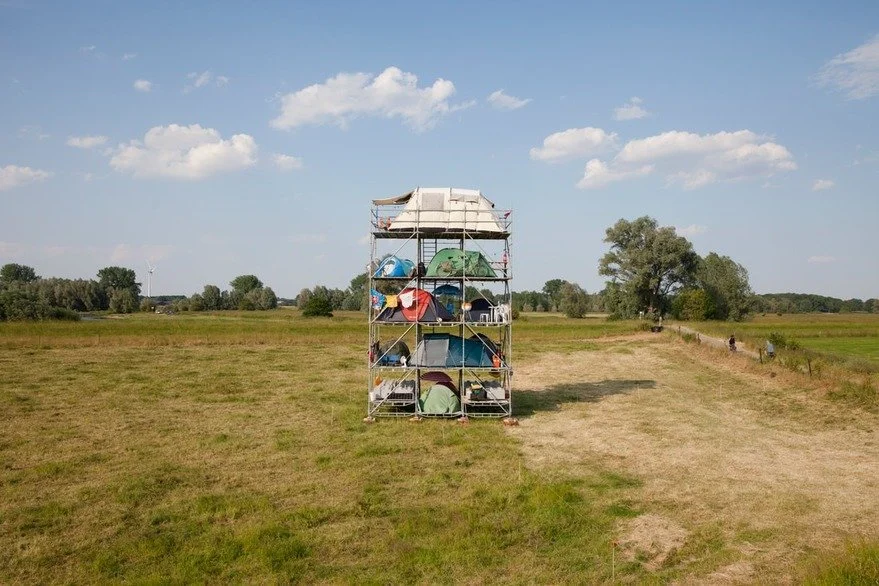
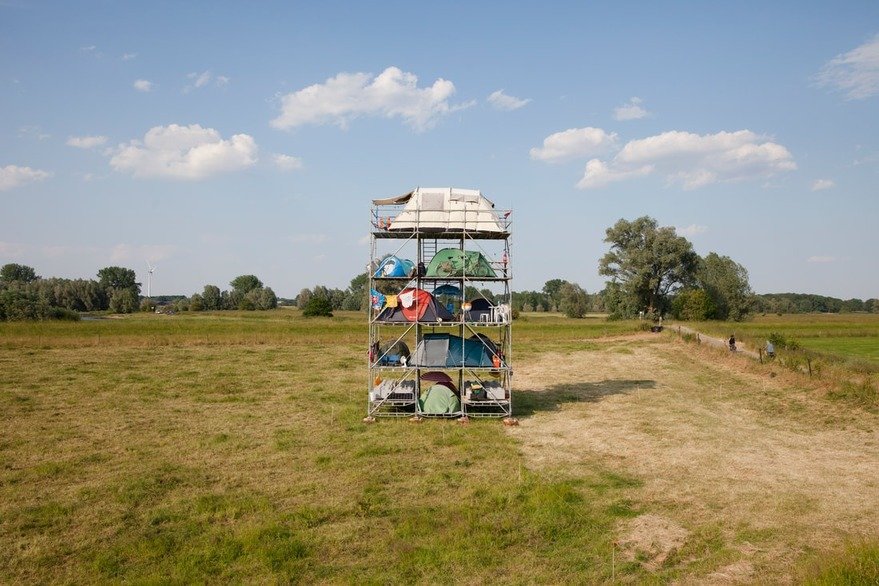
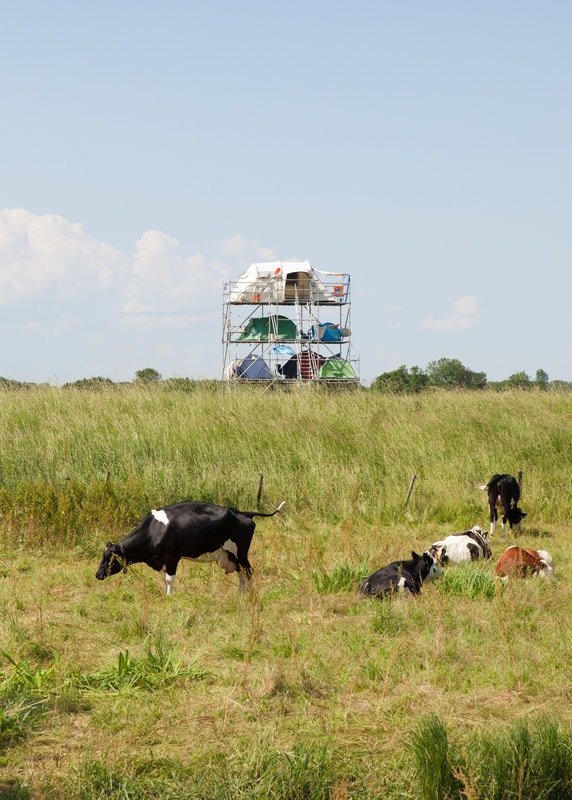
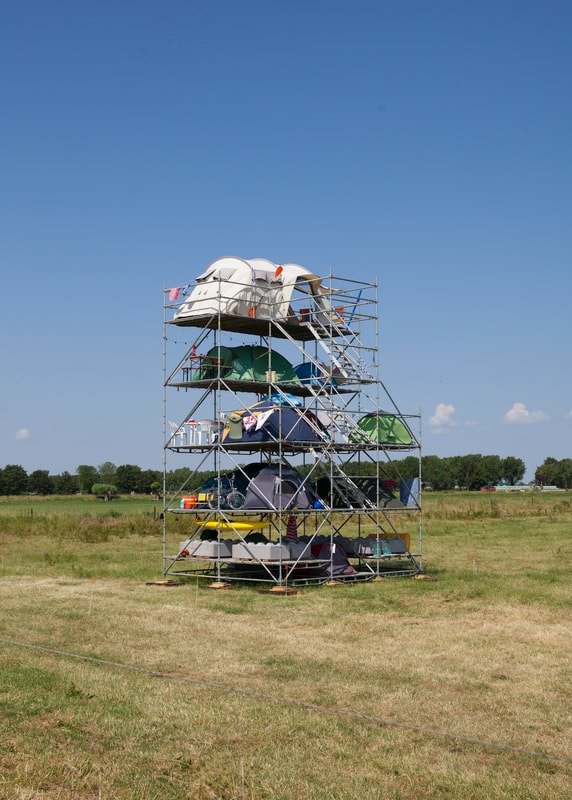
In the serene, sprawling landscapes of the Dutch countryside, where the IJssel River winds its way through pastures and historic villages, a jarring, industrial anomaly has emerged. Standing 11 meters (approximately 36 feet) tall, the "Highrise Campsite"—an art installation by Dutch artist Willem de Haan—challenges the traditional notion of rural leisure. Constructed from utilitarian industrial scaffolding, nylon tents, and festive string lights, the structure is more than an aesthetic intervention; it is a provocative commentary on the global crisis of urban density and the encroaching scarcity of living space.
The Genesis of the Highrise Campsite: Main Facts
The installation is a masterclass in juxtaposition. By taking the quintessential camping experience—traditionally defined by horizontal sprawl, connection to the earth, and personal privacy—and forcing it into a vertical, high-density configuration, de Haan has created a "vertical village" that feels inherently uncomfortable.
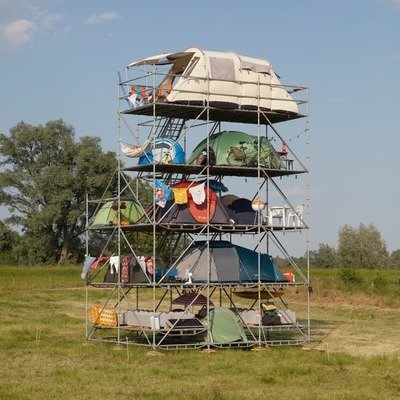
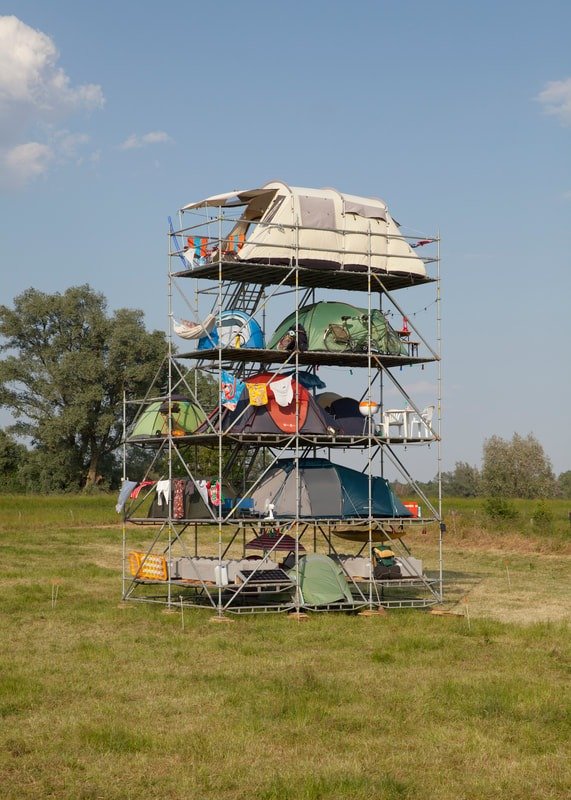
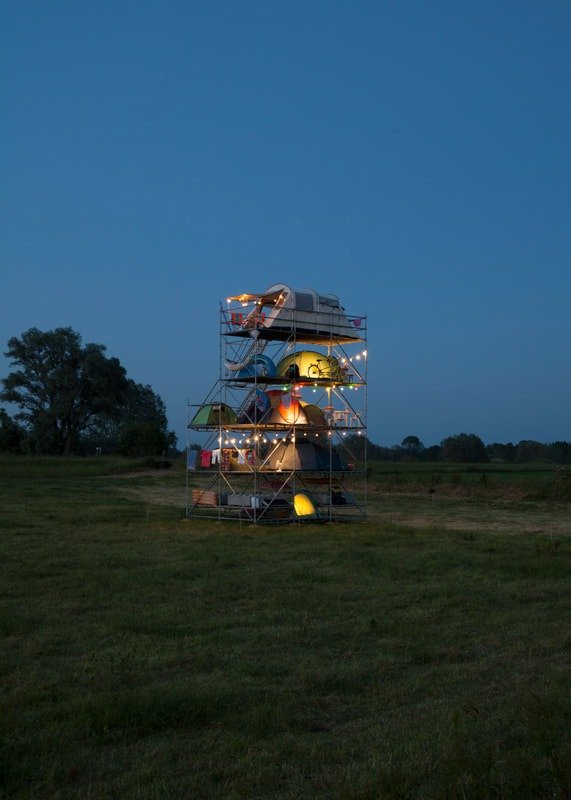
The structure houses 12 individual tents, stacked precariously atop one another within a framework of steel construction scaffolding. Despite its impressive height, the footprint of the installation is remarkably minimal, occupying only a fraction of the land that a traditional campground of the same capacity would require. By night, the structure glows with string lights, mimicking the bustling, neon-lit density of a metropolitan skyscraper, yet it sits in a landscape defined by emptiness and natural silence. It is a structure that is purposefully impractical, designed not for habitation, but for contemplation.
A Chronological Evolution of the Project
The realization of the Highrise Campsite was a process that bridged the gap between fine art and civil engineering.
Phase 1: Conceptualization and Site Selection
De Haan’s initial focus was the IJssel River region, a setting chosen for its peaceful, pastoral qualities. By placing an architectural nightmare—a towering, industrial eyesore—against the backdrop of the Dutch countryside, he aimed to highlight the absurdity of modern spatial competition.
Phase 2: Structural Assembly
Construction involved the deployment of standard industrial scaffolding, the same material used to build the modern cities that the installation critiques. The process of mounting the 12 tents required precise coordination to ensure both the safety of the installation and its visual alignment. The integration of string lights was a strategic choice, adding a layer of domestic "coziness" that clashes with the cold, rigid steel of the scaffolding.
Phase 3: Public Unveiling and Reception
Upon completion, the campsite served as a beacon for passersby. The contrast between the slow, natural flow of the river and the rigid, verticality of the campsite became the focal point of local media attention. It has since become a viral touchstone, frequently compared to the dystopian "Stacks" described in Ernest Cline’s Ready Player One, where humanity is forced to live in literal towers of discarded shipping containers and trailers.
Supporting Data and Spatial Analysis
The Highrise Campsite serves as a physical manifestation of urban planning data regarding density and land usage.
The Metrics of Density
To understand the impact of the installation, one must look at the standard requirements for a recreational campsite. A typical tent site requires approximately 80 to 100 square meters of land to ensure privacy and safety. A 12-tent campsite would normally occupy over 1,000 square meters. De Haan’s installation, by contrast, occupies less than 20 square meters of ground space.
This reduction in footprint is a 98% efficiency gain in land usage, yet it comes at the cost of the "human experience." The data points to a recurring dilemma in architecture: the trade-off between sustainability (density) and quality of life (space).
The Aesthetic of Industrialism
The materials chosen—steel, nylon, and electric cabling—are symbols of the Anthropocene. By utilizing "temporary" construction materials, de Haan emphasizes the impermanence of current urban solutions. The scaffolding acts as a skeleton, revealing that our urban environments are often just hollow frames meant to keep the populace in a state of managed containment.
Official and Artistic Perspectives
While the Highrise Campsite is an art project rather than a municipal development, it has sparked significant dialogue among architectural critics and urban planners.
Willem de Haan himself has been vocal about the installation’s purpose. In his own words, the structure is a direct response to the "battle for scarce space." He argues that even in the most remote, tranquil environments, the human impulse to claim territory and the economic necessity of density are beginning to override our natural desire for openness.
Critics have noted that the piece acts as a "mirror to the metropolis." By transplanting the high-density living conditions of a city like Hong Kong or New York into a field in the Netherlands, de Haan forces the viewer to confront the fact that our current trajectory is moving toward a world where the "great outdoors" is no longer a horizontal expanse, but a series of vertical lockers.
Implications for Future Urbanism
The Highrise Campsite is not a blueprint for the future of housing, but it is a cautionary tale. As global populations continue to shift toward urban centers, the pressure on land will only intensify.
The "Stacking" Phenomenon
The comparison to Ready Player One is particularly apt. The "Stacks" in literature represented the final stage of economic collapse, where the poor were forced to live in the air because the ground had become too expensive or too polluted. De Haan’s installation asks: At what point does density become a form of imprisonment?
Environmental and Social Consequences
If we continue to compress human life into smaller, more vertical footprints, we must account for the psychological impact. The "Highrise Campsite" is intentionally disorienting. It removes the inhabitant from the ground, creating a sense of precariousness. If this becomes the standard for living—or even for leisure—the connection between the individual and the natural environment will be permanently severed.
Furthermore, the installation highlights the "minimal footprint" paradox. While high-density living is often touted as the most sustainable way to house a growing population, it often results in high energy costs, issues with waste management, and the erosion of communal living. De Haan’s use of string lights—a symbol of community and celebration—placed on a structure that inherently lacks privacy, suggests that our attempts to mimic "community" in high-density environments are often superficial, flickering, and fragile.
Conclusion: The Horizon of the Future
Willem de Haan’s Highrise Campsite is a haunting, evocative, and deeply necessary piece of art. It forces us to step outside the comfort of our homes and look at the landscape with a critical eye. It reminds us that every square meter of land is subject to the forces of capital, demand, and survival.
As we look toward the future of architecture and urban development, the questions raised by this installation remain pertinent. Can we create high-density environments that respect the human need for dignity and connection to the earth? Or are we destined to stack our lives higher and higher until we are all living in the clouds, looking down at a landscape we can no longer reach?
The Highrise Campsite may be made of nothing more than scaffolding and nylon, but it stands as a monument to the most pressing challenge of our time: how we choose to live together in a world where space is running out. Whether viewed as a sculpture or a warning, it serves its purpose perfectly—it stops us in our tracks, makes us look up, and forces us to wonder what lies just beyond the horizon of our current reality.
About the Author