July 23, 2026 — The American media landscape is currently navigating a period of unprecedented turbulence, defined by both massive corporate consolidation and a fundamental transformation in how citizens engage with the world around them. This week, the industry reached a critical flashpoint when a federal judge issued a temporary restraining order halting Paramount’s proposed acquisition of Warner Bros. Discovery. This judicial intervention follows a sweeping antitrust lawsuit filed by a coalition of 12 states, signaling a potential shift in the regulatory environment for media conglomerates.
Beyond the courtroom, new research from the Pew-Knight Initiative reveals that the way Americans connect with news, politics, and civic life is increasingly fragmented by age and platform preference. As newsrooms scramble to pivot toward video-first strategies, the industry finds itself caught between the pressures of market survival and the shifting demands of an audience that prefers watching over reading.
Main Facts: The Merger Under Scrutiny
The proposed merger between Paramount and Warner Bros. Discovery, which has dominated industry headlines for months, has been brought to a sudden halt. The federal judge’s temporary restraining order is a direct response to a legal challenge launched by a 12-state coalition. The plaintiffs argue that the consolidation would create an insurmountable market dominance, effectively stifling competition in both the cable television sector and the theatrical distribution market.
If permitted to proceed, the deal would unify two of the most significant pillars of the American media establishment. The combined entity would command an extensive portfolio of cable networks and hold an outsized influence over film distribution. Perhaps more controversially, the merger would place two of the nation’s most prominent news organizations—CNN, currently a crown jewel of Warner Bros. Discovery, and CBS News, a staple of the Paramount ecosystem—under a single corporate umbrella.
According to 2025 data from the Pew Research Center, the implications of this consolidation are significant for public discourse: roughly one-third of U.S. adults regularly consume news from CNN, while three-in-ten rely on CBS News. Consolidating these two outlets under one parent company raises profound questions regarding editorial independence, the diversity of information sources, and the potential for market monopolization in the news ecosystem.
Chronology of the Conflict
The path to this week’s injunction was marked by escalating tension between media giants and federal regulators.
- Early 2026: Paramount and Warner Bros. Discovery formally announce their intention to merge, citing the need for scale in an increasingly fragmented streaming-dominated economy.
- Spring 2026: Industry analysts and consumer advocacy groups begin raising alarms regarding the impact on cable carriage fees and the reduced bargaining power of independent content creators.
- June 2026: A coalition of 12 states, concerned over the erosion of market competition and the potential for a "media duopoly," files a multi-district antitrust lawsuit.
- July 2026: Federal investigators present evidence suggesting that the merger would lead to price hikes for cable providers and, subsequently, consumers.
- July 20, 2026: A federal judge grants the requested temporary restraining order, citing the "irreparable harm" that could be caused to the competitive landscape if the merger were to close while the litigation proceeds.
Supporting Data: The Shifting Media Consumption Landscape
The legal battle over corporate ownership comes at a time when the very nature of news consumption is undergoing a radical transition. As news organizations navigate the legal complexities of mergers, they are simultaneously grappling with the "pivot to video," a trend that has gained momentum as audiences shift their preferences toward visual platforms.
The Rise of Visual Media
Recent findings from the Pew Research Center indicate that 44% of Americans now prefer to watch their news, a significant margin over the 37% who prefer reading and the 19% who prefer listening. This preference has remained relatively stable since 2016, but the delivery mechanisms have changed drastically.
The reliance on social media platforms for news has exploded. In 2025, 35% of U.S. adults reported regularly obtaining news from YouTube, a dramatic increase from the 23% who reported the same in 2020. This shift is driving major legacy news organizations—including The New York Times and The Wall Street Journal—to reallocate significant resources toward video-first content strategies. While skeptics point to the failed "pivot to video" of the mid-2010s, modern publishers argue that the ubiquity of high-speed mobile data and the dominance of platforms like TikTok, Instagram, and YouTube make this transition essential for future-proofing their brands.
Engagement Groups and Demographic Divides
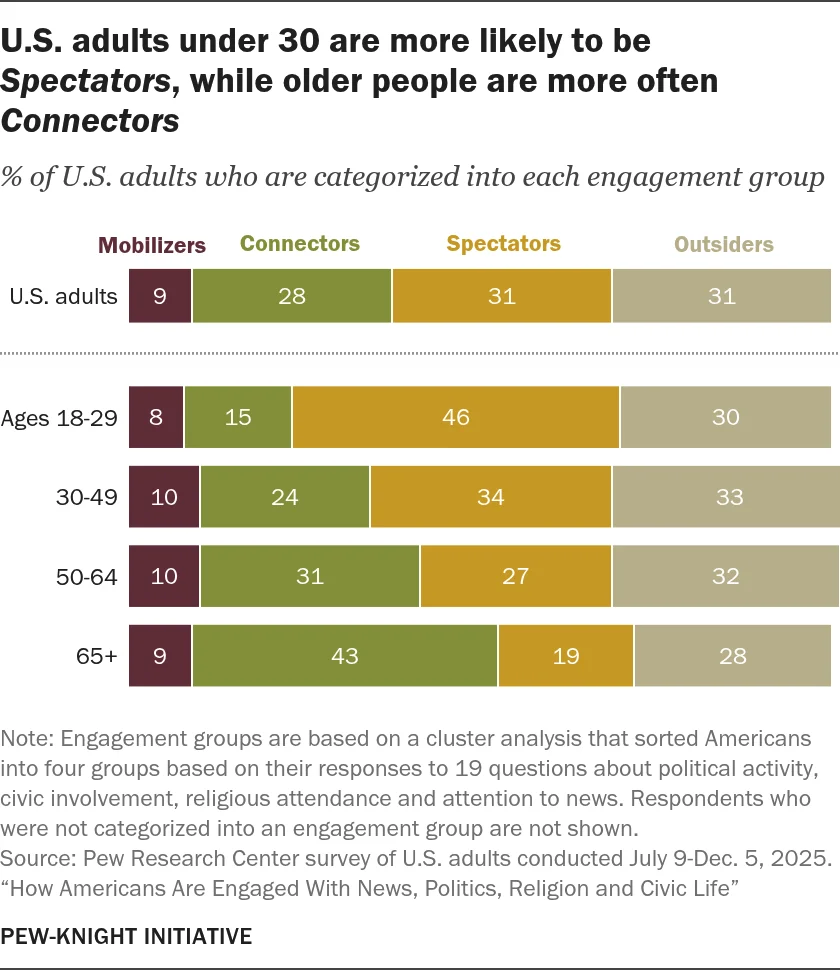
The Pew-Knight Initiative’s latest report on civic engagement provides a nuanced look at how these consumption habits map onto broader participation in public life. Researchers categorized the U.S. public into four distinct "engagement groups" based on a cluster analysis of 19 variables, including political activity, religious attendance, and news consumption.

- Mobilizers: Highly active in both politics and civic life.
- Connectors: Deeply involved in community and civic activities but less focused on national political volatility.
- Spectators: Heavy news consumers who interact with content online but participate less in local civic or community life.
- Outsiders: Individuals who show low levels of engagement across the board.
The data reveals a stark generational divide. Younger Americans (ages 18-29) are significantly more likely to be "Spectators," with 46% falling into this category. In contrast, older Americans (ages 65+) are much more likely to be "Connectors," with 43% falling into that group. This disparity suggests that while younger generations are well-informed through digital channels, the traditional, face-to-face community engagement that characterizes older demographics is waning.
Official Responses and Industry Outlook
The legal community and industry observers remain divided on the long-term viability of the Paramount-Warner Bros. deal. Proponents of the merger argue that in an era where tech giants like Amazon, Apple, and Google are dominating the media space, scale is the only way for traditional studios to survive. They argue that the injunction is a reactionary measure that ignores the reality of modern global competition.
Conversely, the attorneys general representing the 12-state coalition argue that market consolidation at this level is inherently anti-competitive. Their official statements emphasize the "public interest" mandate, noting that news diversity is a cornerstone of American democracy and that reducing the number of independent newsrooms is a risk the public cannot afford.
In the newsrooms themselves, the pressure is palpable. Editors are tasked with managing the transition to video while maintaining the rigorous standards of print and long-form reporting. The concern is that in the pursuit of viral, video-friendly content, the nuanced analysis required to keep a "Spectator" audience informed may be sacrificed for engagement metrics.
Implications for the Future
The implications of the current legal and social landscape are far-reaching.
First, the court’s decision will likely set a precedent for future media mergers. If the judge ultimately sides with the states, it may signal the end of the "mega-merger" era in Hollywood, forcing studios to find organic growth strategies rather than relying on acquisitions to dominate the market.
Second, the findings on civic engagement suggest that news organizations have a challenging path ahead. If the largest segment of the younger population remains "Spectators"—consuming news but not engaging in the broader civic structures of society—the health of the democratic process may be at risk. News organizations must navigate the delicate balance of meeting the audience where they are (on video-first social platforms) while simultaneously encouraging the deeper, community-level involvement that keeps a society functioning.
As the legal proceedings continue, the industry remains in a state of suspended animation. With the future of major news brands and entertainment studios hanging in the balance, one thing is certain: the way Americans receive, process, and engage with the news is fundamentally transforming, and the institutions designed to serve them are struggling to keep pace with the change.
The Briefing is compiled by Pew Research Center staff, including Naomi Forman-Katz, Christopher St. Aubin, Emily Tomasik, Joanne Haner, and Sawyer Reed. It is edited by Michael Lipka and copy edited by David Kent. For inquiries, contact [email protected].
About the Author