August 6, 2026
The American media landscape is undergoing a profound and often painful transformation. This week, the E.W. Scripps Company, a titan of local broadcasting with dozens of affiliates across the United States, announced a sweeping organizational restructuring that will result in the layoffs of 268 employees. This move, framed by the company as a necessary evolution, signals a decisive shift toward a “digital-first” business model. As traditional linear television audiences continue to erode, the industry is racing to capture viewers in a fragmented digital ecosystem, prioritizing 24/7 streaming, automated production, and centralized newsroom operations.
The Main Facts: Scripps’ Strategic Realignment
The layoffs at E.W. Scripps represent more than just a reduction in headcount; they mark a fundamental change in how local news is produced and delivered. By centralizing core newsroom functions—such as editing, graphics, and national reporting—Scripps is attempting to maximize efficiency in an era of tightening advertising budgets.
The company’s roadmap for the coming year includes the launch of 24/7 local news streams tailored for connected TVs and mobile devices. This pivot is designed to meet audiences where they now reside: on apps, social media, and dedicated streaming platforms rather than the traditional evening news broadcast. For the 268 employees affected, the news is a stark reminder of the volatility inherent in modern media, where technological advancements and changing consumption habits frequently outpace legacy business models.
Chronology of an Industry Shift
To understand the current crisis at Scripps, one must look back at the trajectory of local news over the past decade.
- 2018: The tipping point of the transition. Pew Research Center data from this era indicated that 76% of Americans primarily accessed local news via traditional television broadcasts. Only 22% relied on digital platforms as their primary source.
- 2020-2022: The COVID-19 pandemic accelerated the adoption of streaming services. As households “cut the cord,” the reach of traditional cable and broadcast television began to decline more rapidly than analysts had initially projected.
- 2025: A pivotal year for industry research. Pew Research Center studies confirmed that the shift was no longer a trend but a new reality. Digital access to local news had nearly doubled, rising to 43%, while the primacy of television broadcasts plummeted to 56%.
- August 2026: E.W. Scripps formalizes its “digital-first” strategy. The company initiates the 268-person layoff, consolidating its local newsrooms into a more streamlined, automated, and centralized network to survive the transition to streaming.
Supporting Data: The Collapse of Traditional Viewing
The data behind this transition is compelling and illustrates why broadcasters like Scripps are making such drastic maneuvers. According to the 2025 Pew-Knight Initiative survey, the preference for television as a primary source for local news has dropped significantly. In 2018, 41% of U.S. adults identified television as their preferred platform for local information. By 2026, that figure has dipped to 34%.
This decline is not merely a result of older demographics aging out; it represents a behavioral change across all age groups. As newsroom functions become more automated, the quality and character of local news are evolving. The challenge for broadcasters is maintaining the "local" feel—the sense of community connection that originally made local television successful—while utilizing the cold, efficient tools of digital automation.
Official Responses and Corporate Strategy
The decision by E.W. Scripps is symptomatic of a wider trend in media consolidation and adaptation. In the broader industry, eyes are currently fixed on the potential merger between Paramount and Warner Bros. Discovery. While the merger is currently stalled due to antitrust concerns—with a high-stakes trial set for March 2027—the rhetoric surrounding the deal highlights the tension between corporate control and journalistic integrity.

Paramount CEO David Ellison recently addressed these concerns in a guest essay for The New York Times. Ellison defended the merger, arguing that the pushback is largely motivated by anxieties over the future of CNN, a Warner Bros. Discovery asset. Ellison stated, "News should be based on facts and truth," vowing to protect the editorial independence of the network should the acquisition proceed.
However, his assurances have been met with skepticism. Critics point to his stewardship of CBS News and his perceived political leanings as evidence that a merger could lead to increased corporate and political influence over newsrooms. This skepticism is reflective of a wider national sentiment. A 2025 Pew Research Center survey found that the vast majority of Americans are wary of corporate influence; 55% of adults believe there is a “great deal” of corporate influence on news organizations, while 57% express the same concern regarding political influence.
Implications: The Future of the Journalist
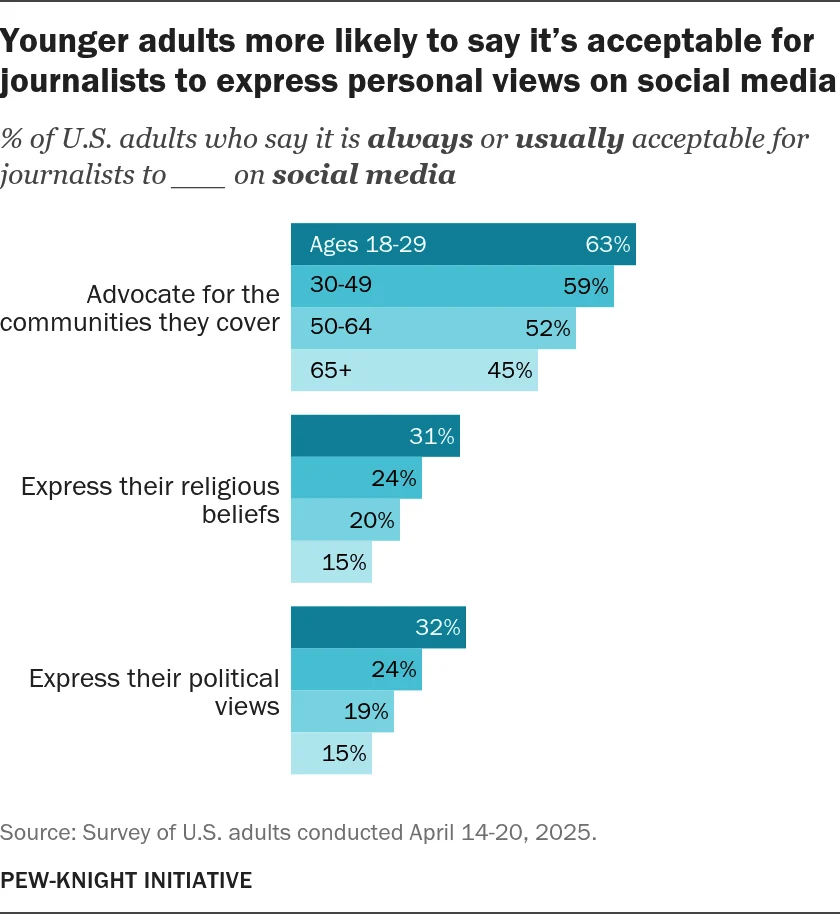
Perhaps the most significant takeaway from the current climate is the widening divide between generations regarding the role of a journalist. The 2025 Pew-Knight Initiative study on young adults highlights a changing set of expectations for those in the newsroom.
Younger adults (ages 18–29) are significantly more comfortable with journalists who take an active role in their communities. According to the study, 63% of adults in this age bracket find it acceptable for journalists to advocate for the communities they cover, compared to just 45% of those aged 65 and older.
Furthermore, the lines between personal identity and professional reporting are blurring in the eyes of the public. While older generations tend to demand strict neutrality, younger adults are increasingly comfortable with journalists expressing their religious or political views on social media. Thirty-two percent of young adults find it acceptable for journalists to express political views online, a figure that drops to 15% among those 65 and older.
The Road Ahead
The restructuring at E.W. Scripps is a microcosm of a larger, systemic shift. As media companies struggle to maintain profitability in a digital-first world, they are forced to weigh the cost of human labor against the efficiency of algorithms.
The implications are twofold:
- Economic: The move toward centralization and automation will likely continue to put downward pressure on newsroom employment. As local stations become smaller, the "local" aspect of their reporting—the boots-on-the-ground presence that holds local governments accountable—is at risk of being replaced by generalized, syndicated content.
- Societal: The public’s increasing skepticism regarding media ownership and the shifting expectations of younger generations suggest that the future of journalism will not just be digital in platform, but perhaps more activist in nature.
As the industry looks toward 2027 and beyond, the central question remains: can the institutions that once anchored the American information landscape successfully migrate to a digital-first model without losing the public trust they have spent decades building? For E.W. Scripps and its peers, the answer will define the next chapter of American journalism. The transition is not merely about surviving the streaming wars; it is about redefining what "local news" means in a world where the broadcast tower is becoming a relic of the past.
About the Author