For centuries, humanity has looked toward the stars and the depths of the ocean in search of a fountain of youth. From the mythical tales of alchemy to the modern-day obsession of Silicon Valley billionaires—who inject themselves with "young blood" and bankroll cryopreservation—the pursuit of immortality has been a defining, albeit macabre, human ambition. Yet, while we struggle with the inevitable decay of our cells, a tiny, thimble-sized creature drifting through the world’s oceans has quietly solved the riddle of existence.
Turritopsis dohrnii, known colloquially as the "immortal jellyfish," does not merely survive; it resets the clock. When faced with the ultimate existential threat—whether it be physical trauma, starvation, or environmental toxicity—this translucent marvel does not perish. Instead, it hits a biological "reset button," effectively reverting its life cycle to a state of infancy.
Main Facts: The Anatomy of Reincarnation
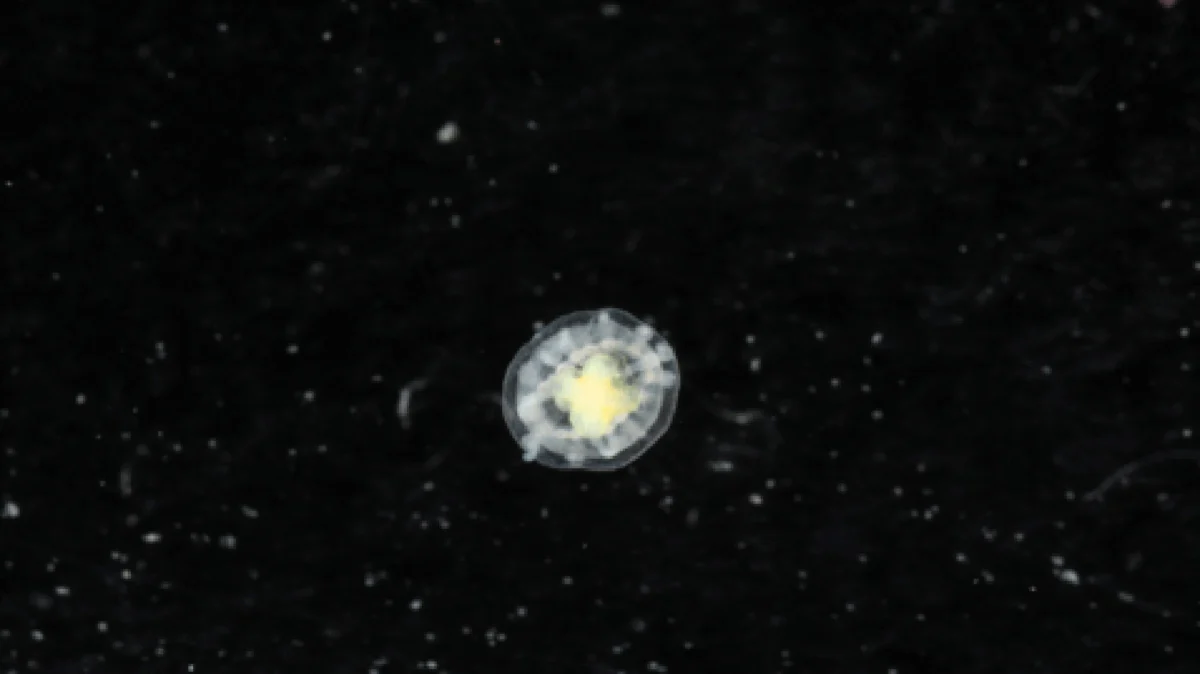
At a glance, Turritopsis dohrnii appears unremarkable. Measuring only a few millimeters in diameter, it is a delicate, bell-shaped creature adorned with a gossamer veil of tentacles. Despite its unassuming appearance, its internal mechanism is a biological masterpiece.
Most jellyfish follow a rigid life trajectory: they begin as larvae, develop into stationary polyps, bud off into free-swimming medusae, and eventually reach sexual maturity. Once they have reproduced, their biological function is considered fulfilled, leading to senescence and death. Turritopsis dohrnii bypasses this finality through a process known as "cellular transdifferentiation."
When the jellyfish encounters extreme stress, it does not simply succumb. It sinks to the ocean floor, retracts its tentacles, and begins to shed its adult identity. Its body collapses into a ball, and within 24 to 48 hours, it transforms back into a juvenile polyp. Because this new iteration shares the exact same genome as its predecessor, it is not just a descendant; it is the same individual, reborn and ready to mature once more.
A Chronology of Discovery and Understanding
The scientific journey to understand Turritopsis dohrnii has been a slow unraveling of nature’s best-kept secret.
- 1883: The species was first described by German zoologist Christian Hartlaub in the Mediterranean Sea. At the time, its unique life-cycle reversal remained undetected, as the animal was studied primarily in static, isolated environments.
- 1990s: Marine biologists, most notably Christian Sommer, began observing the creature’s strange habit of "reverting" in laboratory conditions. This sparked a flurry of interest in the biological mechanisms that could allow an adult cell to turn back into a stem-like state.
- 2000s–Present: As genetic sequencing technology advanced, researchers began to isolate the specific genes involved in transdifferentiation. It was confirmed that the jellyfish does not simply "shrink," but actually reprograms its gene expression, effectively turning back its biological clock.
- 2026: The species gained renewed public interest through initiatives like the "Invertebrate of the Year" contest, bringing its unique evolutionary trick to the forefront of environmental science and public imagination.
Supporting Data: Nature’s Hardwired Resilience
While the term "immortal" is often used in headlines, biologists provide an important caveat: the creature is biologically immortal, not invulnerable.
"In the lab, these jellies can theoretically live forever," says Dr. Maria Pia Miglietta, an associate professor of marine biology at Texas A&M University. "However, in the wild, they are still part of a complex food web."
The data suggests that while Turritopsis dohrnii can survive environmental stressors that would kill any other organism, it remains susceptible to predation. A jellyfish that successfully reverts to its polyp stage is still a soft-bodied target for fish, sea turtles, and other marine carnivores. Its immortality is a defense against the entropy of time, not against the physical reality of being eaten.
Despite this, the sheer ubiquity of the species is a testament to its success. Turritopsis species have been identified across the globe, from the temperate waters of the Mediterranean and the Atlantic to the coastal regions of Japan, Panama, and Brazil. Their ability to survive in diverse, often changing ecosystems—environments where temperature fluctuations and chemical pollution are increasingly common—suggests that their "reset" mechanism is a highly evolved evolutionary strategy for survival in an unpredictable world.
Official Responses and Scientific Perspective
The scientific community views Turritopsis dohrnii not as a miracle, but as a window into the limits of cellular biology.
"When you try to kill the jellyfish, it doesn’t die," Dr. Miglietta explains. "It is unique because it handles unfavorable conditions—high temperature, physical cutting, starvation, or chemical exposure—by fundamentally altering its own biology."
Dr. Lisa-ann Gershwin, a renowned biologist specializing in cnidarians, describes the creature as "exquisite" and a profound subject of study. For Gershwin, the allure of the jellyfish lies in the stark contrast between its simple physiology and the profound human desire it represents.
"It’s so hardwired in humans to not want to die," Gershwin observes. "And I think the drive that we have to survive, and the absurdity of that being in a jellyfish—the juxtaposition of those two things—just entertains me to no end. We spend billions of dollars on anti-aging research, and here is this little creature that does it for free, simply by existing."
The Implications of Eternal Life
The existence of Turritopsis dohrnii poses uncomfortable and exciting questions for the future of regenerative medicine. If we can map the exact genetic pathways that allow a jellyfish to undergo cellular transdifferentiation, could we potentially apply similar principles to human tissue?
1. Regenerative Medicine
The ability to turn back a cell’s clock is the "Holy Grail" of modern medicine. If scientists could trigger transdifferentiation in human cells, it could revolutionize the treatment of degenerative diseases like Alzheimer’s, Parkinson’s, or heart failure. By "resetting" damaged cells to a younger, healthier state, medicine could shift from managing symptoms to true biological restoration.
2. Ecological Impact
While the idea of immortality is tempting, the ecological implications of such a life cycle are vast. Turritopsis dohrnii is a prime example of how evolution can favor longevity in ways that seem alien to our own vertebrate experience. Understanding how they thrive could offer insights into how marine ecosystems might adapt to the rapid climate shifts currently threatening global biodiversity.
3. Philosophical Reflection
Beyond the lab, the immortal jellyfish serves as a mirror for human anxiety. The fascination with this creature is ultimately a reflection of our own mortality. As one observer noted, the jellyfish does "exactly what it says on the tin." It hits the reset button whenever life becomes untenable—a capacity that many humans would find enviable.
Conclusion: A Lesson from the Depths
The story of Turritopsis dohrnii is a reminder that nature often holds the answers to our most persistent questions long before we have the tools to understand them. While we remain tethered to the linear march of time, this "exquisite" creature drifts through the oceans, a living embodiment of the possibility of beginning again.
Whether or not the secrets of the immortal jellyfish will ever unlock human longevity remains to be seen. However, as long as these tiny, bell-shaped survivors continue their endless cycle of birth and rebirth, they will stand as a testament to the resilience of life and the infinite, often strange, creativity of evolution. We may never truly conquer death, but in the depths of the Mediterranean and beyond, the Turritopsis dohrnii has already shown us that, under the right conditions, the end is merely the beginning of another chapter.
About the Author