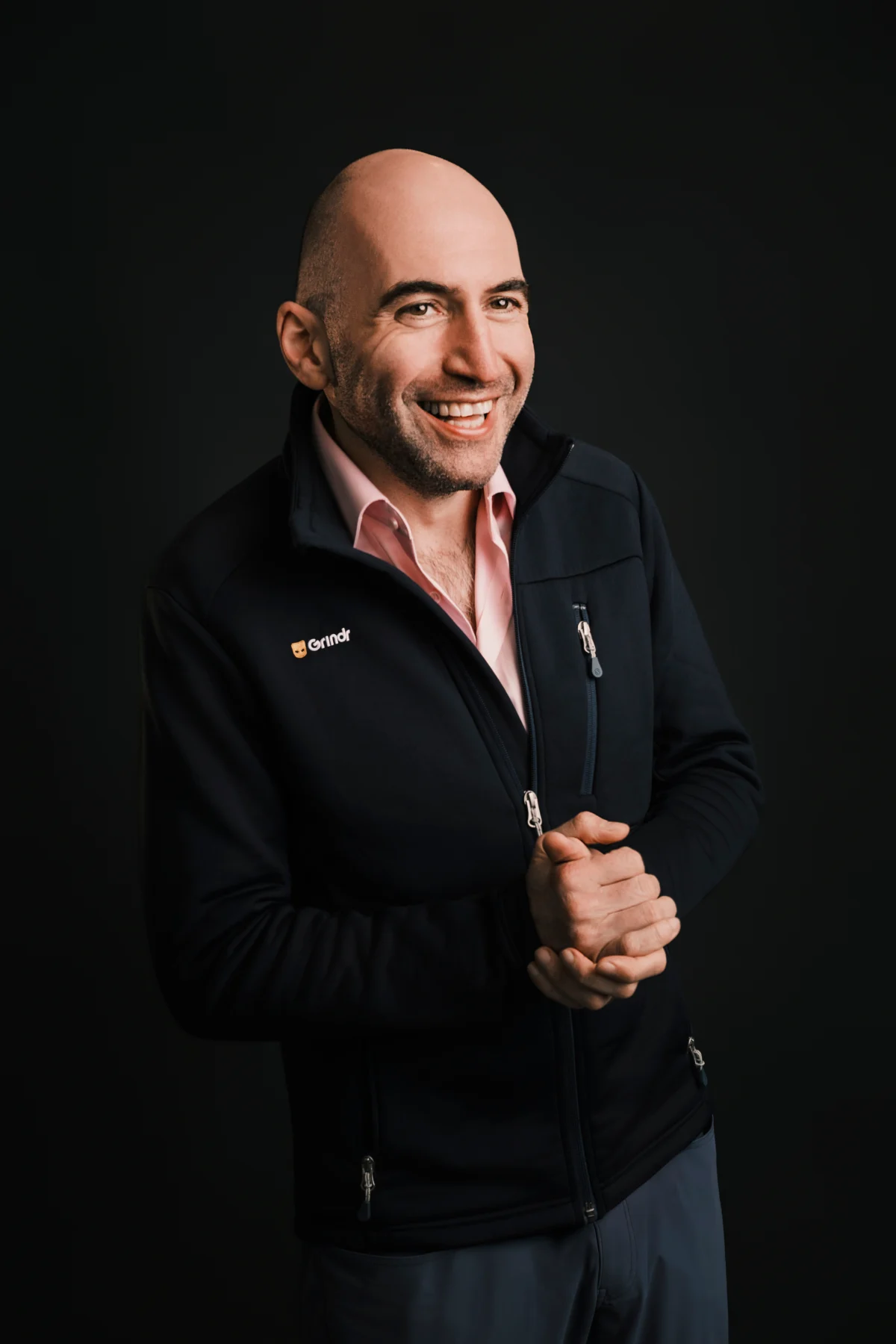
When George Arison assumed the helm of Grindr in 2022, he inherited a corporate entity that was less a cohesive business and more a historical anomaly. The company had spent years in a state of suspended animation, having been shuffled from Chinese ownership to a forced divestiture by the U.S. Committee on Foreign Investment (CFIUS), followed by a private-equity intervention. It was a digital powerhouse that generated significant cash but lacked a coherent product roadmap, a long-term business strategy, or a stable identity.
Four years later, following a SPAC (Special Purpose Acquisition Company) listing and a polarizing, headline-grabbing return-to-office mandate, the narrative has shifted. Under Arison’s leadership, Grindr has evolved into a formidable growth story. Revenue is currently on track to nearly triple—climbing from $195 million in 2022 to a guided projection of $540 million-plus for the current fiscal year—all while maintaining adjusted EBITDA margins consistently above 40%.
A Chronology of Corporate Metamorphosis
The journey from a "distressed asset" to a high-growth tech stock was not a passive evolution. Arison’s first order of business upon taking the CEO role was a radical restructuring of the company’s internal culture.
"A lot of people had been hired during the peak-COVID era when expectations for in-office productivity were low," Arison explains. "Average output was maybe three to four hours of real work a day."
In the summer of 2023, the company enforced a strict return-to-office mandate, requiring employees to work on-site two days a week. The policy ignited immediate internal friction and intense media scrutiny, resulting in a significant attrition rate. Today, the company operates with a leaner, more focused team of approximately 175 U.S. employees and a satellite team in Colombia. Notably, only about 25 staff members remain from the pre-Arison era, a testament to the magnitude of the organizational overhaul.
The Financial Engine: Driving Monetization
Grindr’s recent growth has been driven primarily by increasing the "average revenue per user" (ARPU) rather than a radical expansion of its total user base. While the platform boasts 1.4 million paying users—representing roughly 9% of its total audience—Arison has successfully pivoted the business model to extract more value from existing customers.
The company’s reliance on subscriptions remains high, accounting for 83% of total revenue. However, Arison is intent on diversifying this income stream. His vision is to transform Grindr into a "gayborhood in your pocket"—an "everything app" that integrates dating, healthcare, and travel.
The "EDGE" Controversy
Part of this expansion includes the upcoming launch of "EDGE," a premium subscription tier that has already drawn sharp criticism from online communities. Early testing of the tier, which reportedly carried a price point equivalent to $350–$375 USD per month in some markets, sparked backlash on forums like Reddit, with users clamoring for a return to the platform’s simpler 2012 iteration.
Arison defends the pricing as a function of market testing rather than a final product cost. "We’re not selling AI itself; we’re selling features derived from it," he notes. By leveraging behavioral data and user intent, the company aims to facilitate higher-quality matches than traditional, static profiles allow. He likens the strategy to a luxury vehicle roll-out: EDGE is the "Tesla Model X or S"—a premium flagship offering—while the underlying technological capabilities are intended to trickle down to the broader user base over time.
Data-Driven Growth and AI Integration
One of the most surprising facets of the "New Grindr" is its engineering efficiency. Despite its massive global footprint, the company manages its technical operations with a team of only 94 to 95 people.
Arison attributes this productivity to an aggressive adoption of generative AI. "Something like 80% of our code is now AI-written," Arison states, noting that the team has achieved a 2.5x increase in engineering productivity over the past year. He credits this lean, AI-first approach with allowing the company to accomplish with 100 people what would traditionally require a staff of 350.
Solving the "Small Pool" Problem
The application of AI extends beyond code to the core user experience. Arison highlights the limitations of geography in gay dating: even in a dense urban hub like San Francisco, the total population of gay men is roughly 50,000 to 60,000.
"That’s not a big pool to be fishing in if you’re trying to find a partner," Arison argues. His proposed solution involves using AI to break down geographic constraints, matching users based on deep behavioral data rather than superficial profile descriptions. While the company does not track long-term relationship success—a step Arison deems an overreach—he points to shifting demographics as a justification for the innovation. "About 50% of gay men under 35 say they want a long-term monogamous relationship, and 25% say they want children. It’s worth trying something new."
The "Grindr Discount" and Institutional Perception
Despite the company’s financial performance, Arison remains vocal about a persistent obstacle: the "Grindr discount." He argues that institutional investors continue to undervalue the stock due to lingering stigma surrounding gay dating apps. He recounts a specific instance where an investor presented a financial model featuring a literal line item labeled "Grindr discount," which slashed 25% off the company’s fair-value estimate.
"The stigma conversation is a real one," Arison admits. "We’ve had a consulting firm decline to work with us over reputational concerns, and a bank refuse our money during the Silicon Valley Bank crisis." He notes the irony, pointing out that mainstream competitors like Tinder—which prominently features a "free tonight" function—do not appear to face the same level of institutional skepticism.
However, the market’s perspective appears to be thawing. Morgan Stanley, Goldman Sachs, and Raymond James have all raised their price targets for the stock this year. Morgan Stanley upgraded the company to "overweight" in July, specifically citing the potential of the EDGE tier and the company’s push into telehealth. While the stock still trades at a roughly 35% discount to its industry peers, the valuation gap is undeniably closing.
Future Implications: Healthcare and Beyond
Looking toward the next decade, Arison envisions a broader ecosystem. The company has already begun its foray into healthcare with "Woodwork," a line of cash-pay products including ED medications, GLP-1s, and peptides. The long-term goal is to integrate these services into an in-app health center, eventually connecting users with gay-friendly doctors and clinical care.
"I do think there’s a world, a decade out, where healthcare is a bigger revenue stream for Grindr than what we do today," Arison says.
While the healthcare and travel verticals are currently in their infancy, they represent the pillars of Arison’s long-term vision. He is building a company that functions as a comprehensive digital utility for the LGBTQ+ community, rather than merely a transient hookup app.
Whether the market will fully shed the "Grindr discount" depends on the company’s ability to prove that its "everything app" model can scale effectively. For now, Arison has successfully navigated the company from a state of post-divestiture drift to a position of aggressive, albeit controversial, growth. As the company prepares to roll out its premium EDGE tier and expand its clinical offerings, the tech world will be watching to see if Grindr can truly translate its massive user engagement into a sustainable, multi-dimensional business empire.
About the Author