For decades, the standard rhythm of the technology industry has been dictated by the sprawling, cavernous halls of global trade shows. IFA Berlin, much like CES in Las Vegas, is a gargantuan ecosystem—a labyrinth of showrooms, booth babes, and sensory overload. However, for a company with the scale and ambition of Lenovo, the traditional trade show format has become increasingly inadequate.
While the general public will flock to the Messe Berlin show floor to catch a glimpse of the latest consumer electronics, the real story of Lenovo’s 2026 roadmap is being written in the more intimate, controlled, and highly orchestrated environment of "Lenovo Innovation World." Having spent time at this year’s pre-IFA event, it is clear that Lenovo is moving away from iterative annual updates and toward a strategy defined by radical experimentation.
The Shift Toward Curated Innovation
The fundamental problem with massive conventions like IFA is the lack of context. When a company launches dozens of products simultaneously in a crowded hall, the nuance of their engineering and the strategic intent behind their design are often lost in the noise. Lenovo, recognizing this, has adopted a "pre-conference" model that mirrors the success it found earlier this year at CES 2026.
By hosting Innovation World in a dedicated hotel-turned-event-space, Lenovo creates a sanctuary for deep dives. Here, journalists, analysts, and industry partners—including heavyweights like Intel, AMD, and Nvidia—are given more than just a walkthrough. They are given access. This environment facilitates the kind of one-to-one dialogue with executives that is impossible in the chaotic atmosphere of a public trade show floor.
It is here that the true ethos of the company emerges: Lenovo is no longer content to play it safe. They are actively embracing a culture of "brave failure."
A Snapshot of the 2026 Lineup
The product demonstrations at Innovation World were a testament to this departure from "business as usual." The showcase spanned the spectrum of the company’s massive portfolio, highlighting a desire to cater to niche segments with high-precision engineering.
The IdeaPad Vibe: Aesthetics Meet Function
The IdeaPad Vibe is perhaps the most visible indicator of Lenovo’s current design philosophy. While its vibrant, near-aggressive color palette might initially be dismissed as a cosmetic choice, it houses a surprisingly robust set of features. Lenovo is clearly attempting to bridge the gap between "lifestyle tech" and "power user hardware," proving that portable devices don’t have to look like dull, grey slabs to be taken seriously in a corporate environment.
ThinkCentre X Ultra: The Developer’s Dream
On the professional side, the ThinkCentre X Ultra aims to reclaim the desktop space for the modern AI developer. In an era where cloud computing dominates, Lenovo is betting on the necessity of local, "small but mighty" compute power. By cramming desktop-grade performance into a chassis that occupies a fraction of the traditional footprint, Lenovo is positioning itself as the primary hardware partner for the AI-native workforce.
The Yoga Tab Pro: Rethinking Input
Even the humble stylus has been reimagined. The Yoga Tab Pro’s stylus isn’t just a writing implement; it incorporates proprietary controls that challenge the current market standard. It is a prime example of Lenovo’s willingness to tweak the fundamental interaction points between human and machine, regardless of whether that specific feature becomes a long-term industry standard.
Proof of Concept: The "Swan" and the "Blade"
The highlight of any Lenovo Innovation World is, inevitably, the "Proof of Concept" gallery. These are not necessarily products you can buy today, but they are the blueprints for the next decade of computing.
Project Swan: The Evolution of Expandability
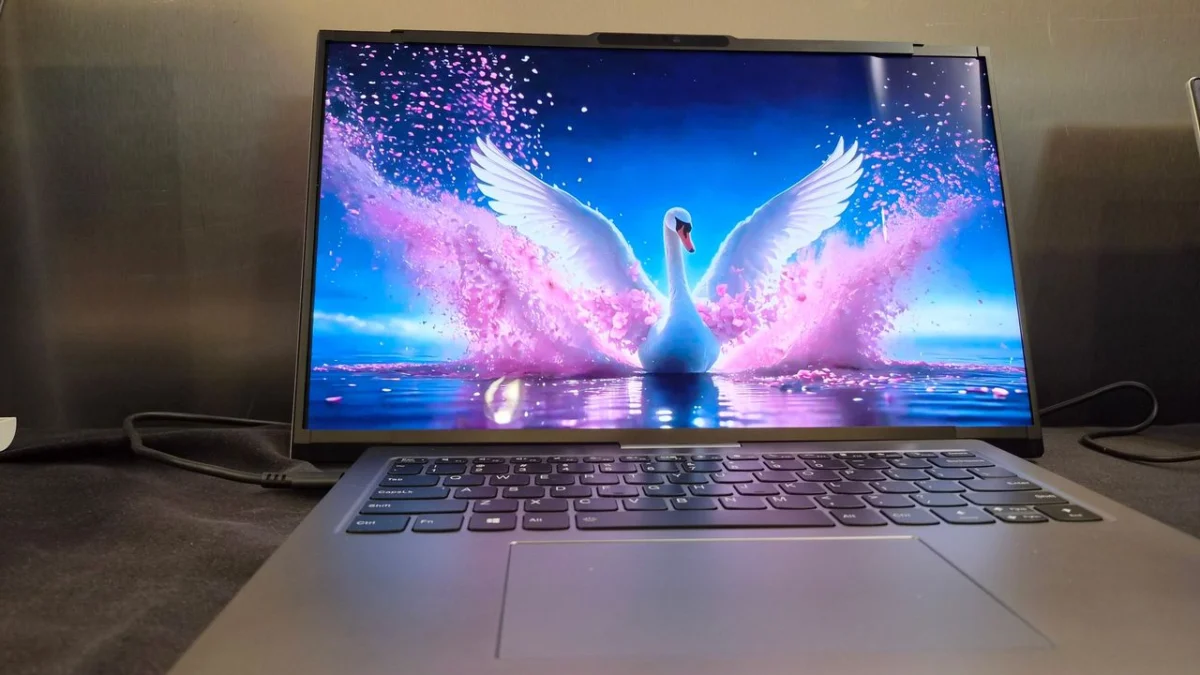
Project Swan represents the next logical step in the "foldable and rollable" trend. Taking lessons from the rollable screen concepts showcased at CES 2026, Swan is a laptop that physically expands its display real estate. Users can transition from a 14-inch portable workhorse to a 17-inch canvas by sliding the display outward. While Lenovo is currently exercising caution regarding its commercial launch—citing the need for rigorous durability and portability testing—the ambition is clear: the physical boundaries of the laptop screen are becoming fluid.
Project AeroBlade: The Thermal Revolution
Perhaps the most groundbreaking innovation at the event was Project AeroBlade. For years, the "fanless" laptop has been the holy grail of mobile computing. The challenges are obvious: heat management. Traditional spinning fans are bulky, noisy, and energy-hungry.
Lenovo’s solution? The "Active Flow Thermal Solution." Developed in partnership with AirJet, this system replaces mechanical fans with a 2.65mm chip that utilizes a vibrating ultrasonic membrane. By oscillating at high frequencies, the membrane pulls air into the chassis and ejects it through micro-slits. The result is a device under 10mm thick that remains cool under load without the hum of a cooling fan. This is not just a tweak; it is a fundamental re-engineering of how portable computing heat is handled.
Official Responses and Strategic Outlook
The contrast between these projects was highlighted by Eric Yu, Lenovo’s SVP and GM of its Commercial Product Center and WW SMB Segment. In an exclusive interview with ITPro, Yu provided clarity on the company’s production timelines.
"Project Blade is moving toward production very soon," Yu confirmed, signaling that the Active Flow Thermal Solution is ready to transition from a laboratory concept to a consumer reality. This is a significant milestone for the industry, as it could usher in a new generation of ultra-thin, silent, high-performance notebooks.
Conversely, Project Swan remains in the "exploration" phase. Yu’s comments reflect a pragmatic approach: Lenovo is willing to innovate, but they are wary of releasing "gimmick" hardware that fails in the real world. By keeping Swan in the testing phase, they are ensuring that if and when it hits the market, it will meet the rigorous standards of their professional user base.
The Implications: Why "Brave" Matters
Lenovo’s strategy carries profound implications for the wider technology sector. In a market saturated with iterative hardware—where the annual upgrade cycle often feels like a treadmill of minor processor bumps and chassis color changes—Lenovo is choosing to experiment.
Embracing the "Good and the Bad"
Not every experiment will succeed. Some, like the unique controls on the Yoga Tab Pro or specific aspects of the Project Swan design, may never see a second generation. However, the willingness to put these ideas in front of the public is an act of transparency and bravery. It forces the industry to ask questions: What is a laptop? How thin can we go before performance is sacrificed? Is the physical size of a screen a static constant?
The Impact on the Supply Chain
By pushing concepts like the AirJet-powered AeroBlade, Lenovo is also driving the supply chain to evolve. They are effectively forcing component manufacturers to rethink thermal design, which will inevitably lower the barrier for other OEMs to adopt similar technologies. This, in turn, accelerates the pace of innovation across the entire laptop market.
The Human-Centric Shift
Ultimately, the shift from the noisy, impersonal floors of IFA to the focused, tech-heavy atmosphere of Innovation World signifies a deeper shift in Lenovo’s corporate identity. They are no longer just a hardware manufacturer; they are a solutions provider that understands that for a product to be "innovative," it must solve a problem that the user didn’t even know they had yet—or solve an existing problem in a way that feels like magic.
Conclusion: A Barometer for the Future
IFA 2026 will undoubtedly be a success for Lenovo, filled with thousands of visitors marveling at their latest gadgets. But those who want to understand the future of the company—and perhaps the future of computing as a whole—must look at the lessons of Innovation World.
Lenovo is entering a period where its success will be defined not by the volume of its sales, but by the boldness of its engineering. Whether it is the thin, silent, fanless future of the AeroBlade or the expandable, fluid nature of Project Swan, Lenovo is betting that the market is ready for a change. They are betting that users are tired of "business as usual." If these concepts are any indication, the future of personal computing is going to be a lot more experimental, a lot more daring, and, quite frankly, a lot more exciting.
About the Author