In an era of intense political polarization, the American public’s relationship with its federal government remains a complex tapestry of high-level approval and deepening partisan distrust. According to a comprehensive survey conducted by the Pew Research Center between September 28 and October 4, 2026, Americans generally maintain favorable views of most major federal agencies. However, this broad consensus masks a significant "partisan chasm" that has turned previously non-partisan institutions into lightning rods for ideological disagreement.
The survey of 5,062 U.S. adults, drawn from the Center’s American Trends Panel, provides a rare, granular look at how the machinery of the federal government is perceived by a populace that is increasingly divided along party lines. While agencies providing direct public services—such as the National Park Service and the National Weather Service—retain overwhelming bipartisan support, those tasked with regulation, law enforcement, and immigration enforcement are seeing their favorability ratings pulled in starkly different directions by Republican and Democratic voters.

The Popularity Paradox: Service Agencies vs. The Enforcement State
The data presents a clear hierarchy of public perception. The agencies that garner the most "favorable" marks from the public are those that provide tangible, non-coercive services to the average citizen.
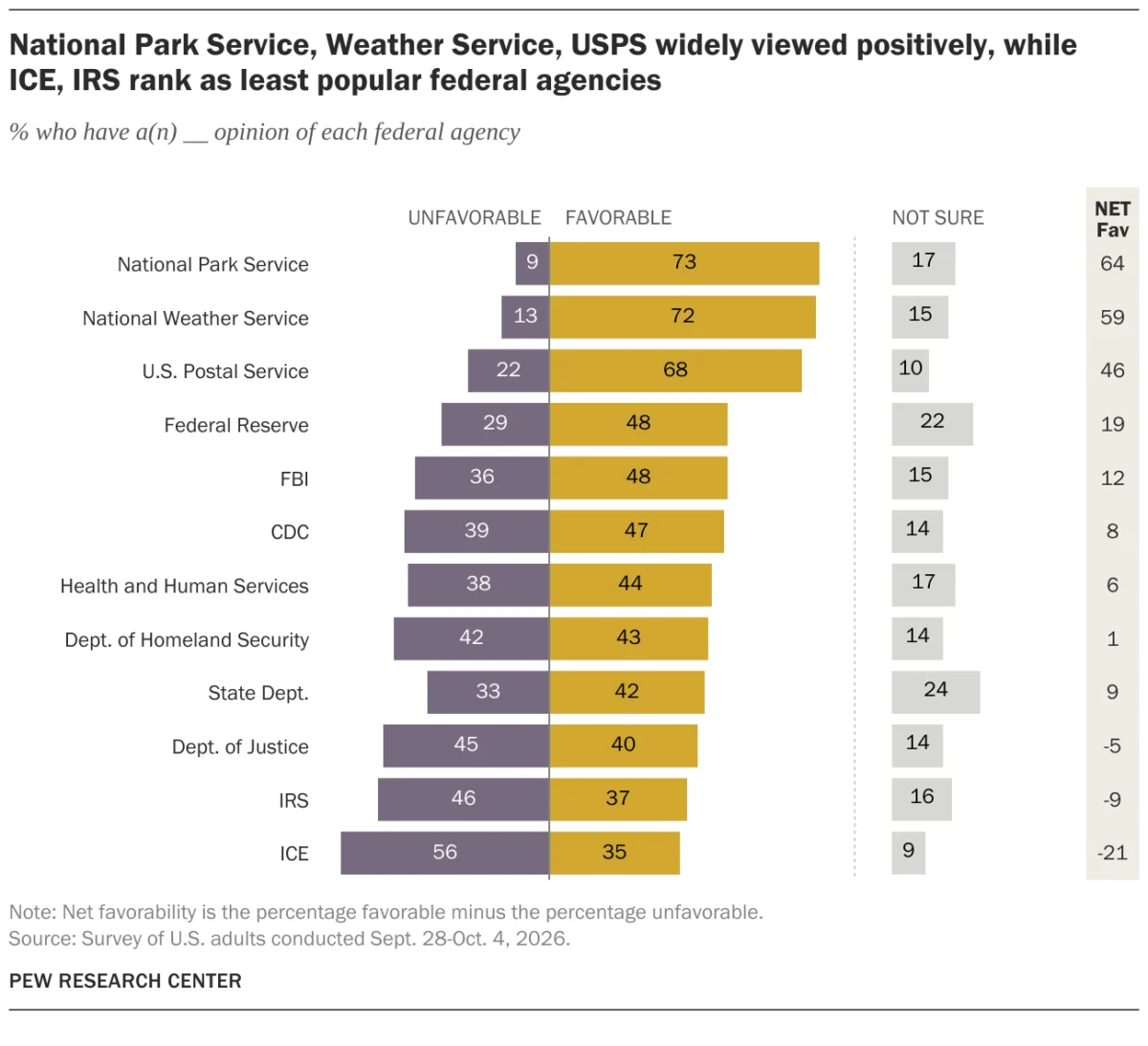
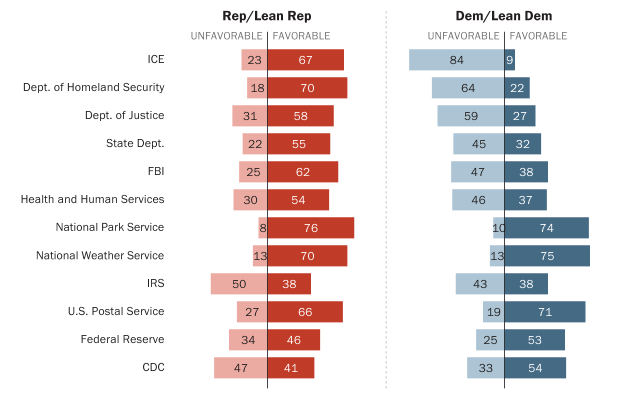
The National Park Service (NPS) leads the pack, with 73% of Americans holding a favorable view of the agency. The National Weather Service (NWS) follows closely at 72%, and the U.S. Postal Service (USPS) retains a strong 68% favorability rating. These agencies, which touch the daily lives of Americans in ways that are perceived as helpful and benign, enjoy broad support across the political spectrum.

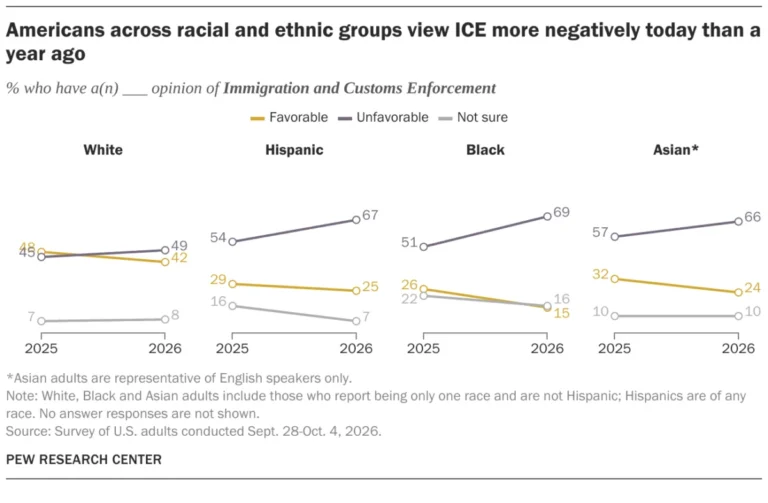
At the other end of the spectrum, the federal government’s enforcement and regulatory arms face a steeper climb. Immigration and Customs Enforcement (ICE) ranks as the least popular among the 12 agencies studied, with 56% of the public viewing it unfavorably. The Internal Revenue Service (IRS) and the Department of Justice (DOJ) also struggle, with net negative or low-positive favorability scores.
A Chronology of Shifting Sentiments (2023–2026)
To understand the current climate, one must look at the trends over the past several years. The 2026 data confirms that while total public opinion for many agencies appears stable on the surface, the underlying partisan trends have been shifting dramatically since 2023.
2023–2024: The Initial Divergence
In the early stages of this tracking period, the political divide was already evident, but many agencies still enjoyed a "cushion" of support from both sides of the aisle. For instance, in 2023, the FBI was viewed favorably by 65% of Democrats and 38% of Republicans. While a gap existed, both sides still recognized the agency as a central pillar of the state.
2025: The Year of Hardening Views
By 2025, the trajectory began to accelerate. As national discourse intensified around the Department of Justice and the FBI, we saw a "partisan swap" in some areas. Republicans’ views of the DOJ and FBI saw a notable rebound, while Democrats grew increasingly critical of these same institutions.

2026: The Current Reality
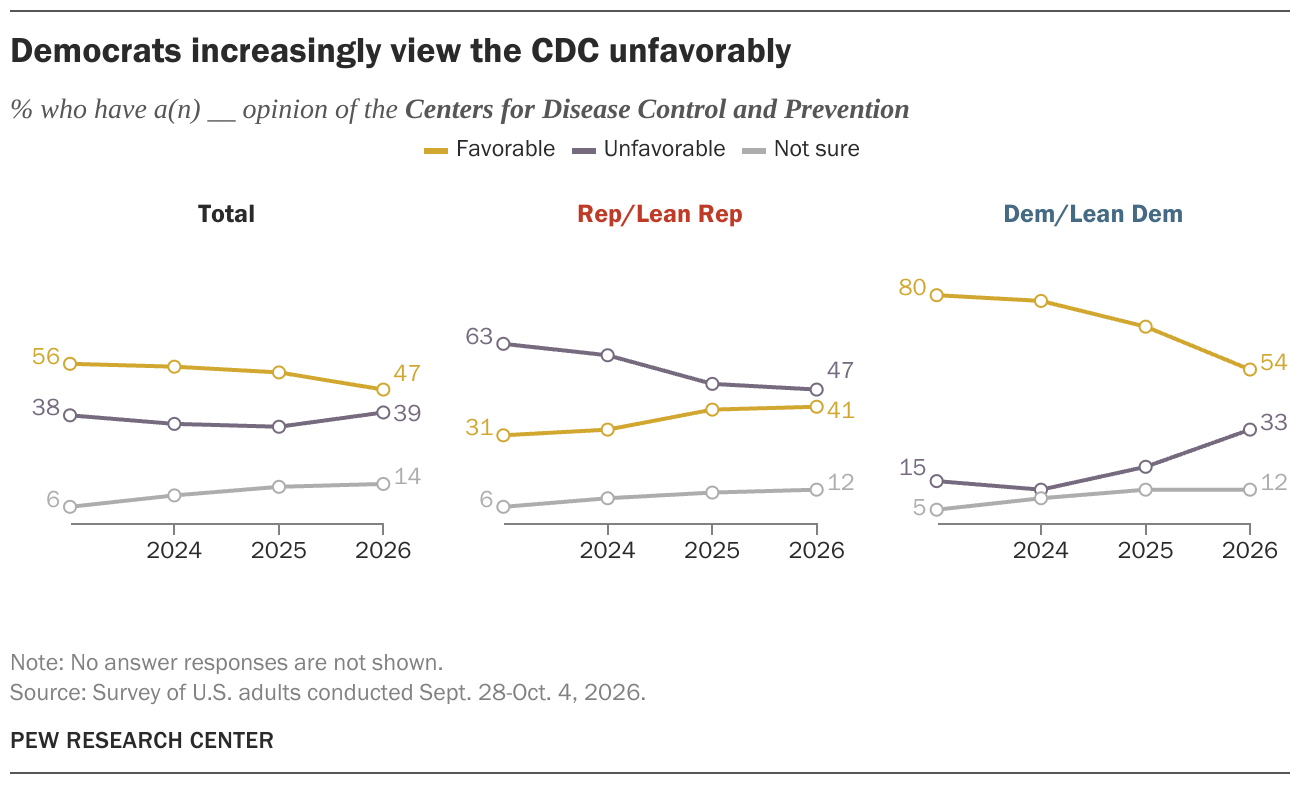
The latest 2026 data shows that this trend has not only continued but solidified. The "partisan gap" for the FBI is now essentially inverted compared to 2023, with Republicans expressing significantly higher levels of trust than their Democratic counterparts. Similarly, views on the CDC have shifted significantly, with Democratic favorability dropping from 69% in 2025 to 54% today, a change driven largely by a decline in confidence among the agency’s traditional base of support.
Supporting Data: The Anatomy of the Partisan Gap
The survey data provides the raw evidence of how deep this divide has become. When comparing the net favorability (favorable minus unfavorable) of agencies, the differences between Republicans and Democrats are startling.

- Immigration and Customs Enforcement (ICE): The divide is widest here. Republicans maintain a net favorability of +44, while Democrats report a staggering -75.
- Department of Homeland Security (DHS): A similar, albeit slightly less extreme, trend is visible. Republicans view the agency with a +52 net favorability, compared to -42 among Democrats.
- The Federal Reserve: Interestingly, the Fed—traditionally seen as a technocratic, non-political entity—is now also subject to the partisan lens. Democrats maintain a +28 net favorability, while Republicans are much more skeptical, holding a +12 rating.
- The IRS: Perhaps most surprisingly, the IRS has seen a shift in Republican opinion. Despite the traditional GOP rhetoric against the tax agency, Republicans’ views of the IRS have actually improved since 2025, rising to a 38% favorability rating, while Democrats’ views have drifted toward the negative.
Official Responses and Bureaucratic Implications
While federal agencies rarely issue direct responses to public opinion polling, the implications for the civil service are profound. When an agency like the CDC or the Department of Justice loses the confidence of a significant portion of the electorate, its ability to carry out its mission becomes fraught with political obstacles.
For the Department of Justice and the FBI, the fluctuation in support presents a strategic challenge. When these agencies are viewed through a partisan lens, their investigative actions are inevitably interpreted as political maneuvers by one side or the other. This creates a feedback loop: an agency’s perceived "bias" leads to lower support among one party, which leads to calls for reform or defunding, which further alienates the agency’s professional staff.

The decline in Democratic support for the CDC and HHS is particularly notable. During the early years of the current decade, these agencies were viewed as central to public health and were heavily supported by the Democratic base. The current decline suggests that public health messaging, in a post-pandemic or post-crisis environment, is struggling to maintain its previous high levels of bipartisan legitimacy.
Implications: The Future of Federal Legitimacy
The data from the 2026 Pew survey suggests that we are moving toward a period where "federal government" is no longer a monolithic concept in the minds of voters. Instead, the government is being fractured into "service providers" (which remain trusted) and "enforcers/regulators" (which are increasingly distrusted).

1. The Erosion of Institutional Neutrality
The most significant implication is the erosion of institutional neutrality. When the Department of Justice, the FBI, and the State Department become partisan wedge issues, their capacity to function as impartial arbiters of the law is diminished. This poses a long-term risk to the stability of federal operations, as the agencies become vulnerable to the shifting tides of electoral cycles.
2. Service as a Stabilizer
On a more positive note, the continued high favorability of the National Park Service and the Postal Service demonstrates that when the government provides clear, tangible value, the public is capable of putting aside partisan labels. These agencies serve as the "glue" of federal legitimacy. Any efforts to streamline or "modernize" these agencies must be handled with extreme care, as they remain the few remaining touchpoints where Americans from both parties find common ground.
3. The Challenge of Governance
For policymakers, the data provides a sobering roadmap. Any legislative attempt to reform the IRS, the FBI, or the Department of Homeland Security will be met with intense scrutiny. Because these agencies are now heavily associated with partisan identity, the debate over their funding and oversight will be dictated by the political leanings of the voter base rather than the operational efficiency of the agencies themselves.
Conclusion
The 2026 survey of federal agencies serves as a diagnostic tool for the health of American democracy. While the "service state" remains robust and well-regarded, the "enforcement state" is undergoing a period of deep turbulence. The data reveals that Americans have not necessarily turned against their government in totality; rather, they have become highly selective in their trust.

As we look toward the future, the primary challenge for federal agencies will be to bridge the gap between their operational reality and the polarized perceptions of the public. If the current trends continue, the bureaucracy may find itself in a permanent state of political tug-of-war, where every action taken is viewed not as a matter of public duty, but as an act of partisan loyalty. Restoring a shared sense of purpose and trust in these institutions will likely require not just administrative reform, but a broader national conversation about the role and nature of the state in a deeply divided society.
About the Author