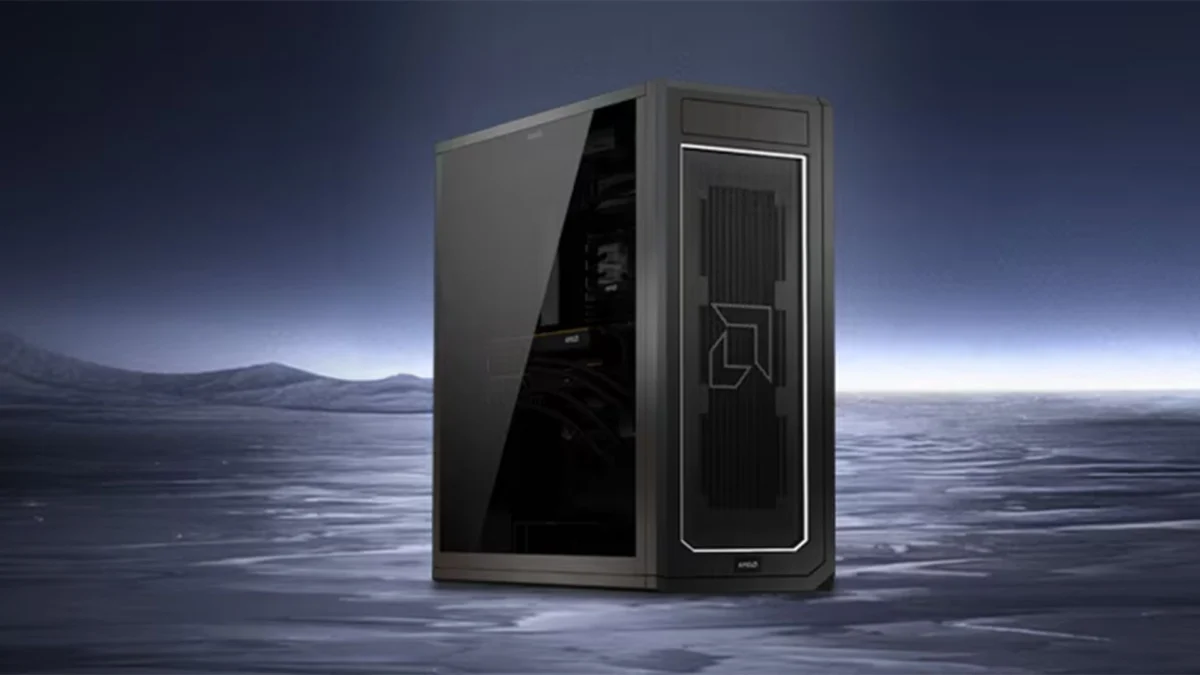
In a bold move that signals a tectonic shift in how enterprises approach artificial intelligence development, AMD has officially unveiled the Threadripper Halo—a high-density workstation specifically engineered to bring enterprise-grade AI inference and agent orchestration to the local desktop. Announced at IFA 2026, the device is being positioned not merely as a high-performance computer, but as a "personal supercomputer" capable of handling the most demanding frontier models without reliance on cloud infrastructure.
The Architecture of Power: Breaking Through Hardware Barriers
At the core of the Threadripper Halo lies an architectural powerhouse designed to alleviate the bottlenecks currently facing AI researchers and developers. The system is anchored by the 96-core Threadripper Pro 9995WX CPU, a processor that represents the current pinnacle of x86 computing density. However, the true innovation lies in the system’s modular AI-accelerated backbone.
Out of the box, the Halo ships with two MI350P GPUs, with an architecture that allows for rapid scaling to four units. This configuration is supported by a staggering 576 GB of HBM3e (High Bandwidth Memory), which provides the massive throughput necessary for real-time model interaction. When combined with a total system memory capacity of 2.6TB and an unprecedented 16.4TB/s of bandwidth, the Halo stands in a league of its own.
By AMD’s own metrics, this configuration is designed to provide 3.4 times the total system memory of the competing Nvidia DGX Station. This massive memory headroom is not just a spec-sheet flex; it is a functional requirement for researchers working with trillion-parameter models, which have historically been too large to fit within the memory constraints of standard high-end workstations.
Chronology: From Concept to the "Sidetop" Era
The trajectory toward this release began to crystallize in early 2026, as the industry grappled with the explosion of "agentic AI." As generative AI transitioned from simple chatbots to autonomous agents, the computational load shifted dramatically.
- Early 2026: IDC analysts began identifying a new hardware category known as the "sidetop"—a high-density, near-user system that bridges the gap between traditional workstations and server-rack infrastructure.
- March 2026: Following Nvidia’s GTC event, industry discourse pivoted toward the hidden costs of AI. Reports from Gartner and Signal65 revealed that agentic workflows were consuming up to 15 times more tokens than standard LLM interactions, rendering cloud-based API models prohibitively expensive for many firms.
- September 2026 (IFA): AMD officially unveiled the Threadripper Halo, aiming to solve the "cloud-lock" dilemma for AI developers.
- 2027 (Projected): The expected market launch of the Threadripper Halo, signaling the start of a broader migration toward on-premise AI sovereignty for small-to-medium enterprises (SMEs).
Supporting Data: The Economics of the "Agentic" Shift
The business case for the Threadripper Halo is rooted in the harsh economic realities of the modern AI development landscape. As organizations move from proof-of-concept to production-level agentic AI, the cost of cloud-based inference is ballooning.
According to research from Gartner, token consumption costs are currently on a trajectory that could see AI expenses exceed developer salaries by 2028. This trend has created a "Context Engineering" crisis, where developers are forced to sacrifice the quality of AI responses simply to manage costs.
Signal65’s analysis further underscores this, noting that agentic AI, which requires multiple reasoning loops and iterative prompt cycles, is fundamentally incompatible with the pay-per-token model of public cloud providers. By moving these workloads to a local, persistent workstation like the Threadripper Halo, developers can run continuous, iterative training and inference cycles without accruing additional costs. The capital expenditure of a one-time workstation purchase is, for many, beginning to look like a bargain compared to the compounding operational expenditure of cloud-based API bills.
Official Responses and Strategic Vision
Speaking at the IFA event, Jack Huynh, SVP and general manager of AMD’s computing and graphics group, framed the release as a pivotal moment for digital autonomy. "This is the most powerful workstation in the world, designed and engineered for a complete new era of computing," Huynh stated. "We are providing the tools for individuals and small teams who are currently constrained by the limitations of cloud access or shared infrastructure to operate with the power of a data center."
Huynh’s emphasis on "personal AI" is a deliberate pushback against the centralized, cloud-first ethos that has dominated the AI boom since 2022. By shifting the locus of compute back to the edge—or, in this case, the desk—AMD is effectively arguing that innovation is currently being throttled by the latency and financial costs of remote servers.
Implications for the Industry: The End of Cloud Exclusivity?
The release of the Threadripper Halo has profound implications for the hardware and software ecosystems.
1. The Decentralization of AI Development
For years, the training and deployment of large models have been the exclusive domain of companies with massive server farms. The Halo democratizes this capability. If a small team of researchers can run trillion-parameter models locally, the barrier to entry for developing specialized, industry-specific AI agents drops significantly.
2. Privacy and Data Sovereignty
Enterprises in regulated industries—such as legal, healthcare, and finance—have been hesitant to embrace AI due to the risks of transmitting sensitive data to cloud-based model providers. A local "supercomputer" workstation allows these firms to utilize powerful LLMs while keeping all training and inference data air-gapped from the public internet. This shift addresses the primary security concerns that have held back enterprise-wide AI adoption.
3. Challenging the Nvidia Dominance
For nearly three years, Nvidia’s DGX Station has been the de facto standard for high-end AI workstations. AMD’s explicit comparison—boasting 3.4x the memory capacity of the Nvidia offering—suggests a direct, aggressive challenge. By focusing on memory bandwidth and density, AMD is targeting the specific pain points of developers who find current "AI PCs" to be underpowered for modern, massive-scale model orchestration.
4. The Rise of the "Sidetop"
The industry is witnessing the death of the "generic" workstation. As IDC noted, the "sidetop" is not a luxury; it is a necessity for the modern engineer. Whether it is the Dell Pro Max range or the AMD Threadripper Halo, the market is rapidly segmenting into devices that are "AI-ready" and those that are "AI-capable." The former—which includes the Halo—is designed to handle the heavy lifting of training and fine-tuning, whereas standard AI-capable laptops are limited to inference-only tasks.
Conclusion: A New Frontier
As the industry looks toward 2027, the Threadripper Halo stands as a testament to the maturation of the AI hardware market. The initial "hype" phase of AI has given way to a "utility" phase, where enterprises are less concerned with simply having access to an AI model and more concerned with the efficiency, cost-effectiveness, and security of that access.
While pricing and specific release dates remain under wraps, the message from AMD is clear: the era of the personal supercomputer has arrived. By empowering the individual researcher with the hardware of a supercomputer, AMD is betting that the next great breakthrough in AI will not come from a massive, centralized data center, but from a developer’s desk, fueled by local compute and the freedom to experiment without constraints.
As enterprises continue to navigate the rising costs of token consumption and the complexities of agent orchestration, the Threadripper Halo may well be the piece of the puzzle that turns the promise of agentic AI into a sustainable, scalable reality.
About the Author