In a high-stakes legal collision between state-level environmental activism and federal preemption, a federal judge has effectively dismantled New York’s ambitious attempt to hold the fossil fuel industry financially accountable for climate change. On Monday, Chief Judge Brenda Sannes of the U.S. District Court for the Northern District of New York ruled that the state’s 2024 Climate Change Superfund Act is unconstitutional, marking a significant victory for energy giants and the Trump administration’s deregulatory agenda.
The ruling strikes a blow to a growing national movement that sought to establish a "polluter pays" framework, forcing multinational oil and gas corporations to subsidize the infrastructure upgrades necessary to survive a warming world. As the legal dust settles, the decision casts a long shadow over similar legislative efforts currently percolating in at least 13 other states.
The Core of the Conflict: The 2024 Climate Superfund Act
Passed in 2024, New York’s Climate Change Superfund Act was designed as a proactive financial tool for climate adaptation. The legislation sought to levy $75 billion in assessments on fossil fuel companies over a 25-year period. These funds were specifically earmarked for "climate-resilient" infrastructure: retrofitting stormwater drainage systems, hardening the electric grid against extreme weather, elevating roads, and constructing seawalls to protect against rising tides.
The fundamental premise was simple: the corporations that profited from the extraction and sale of fossil fuels, while knowing the risks of their products for decades, should bear the cost of the damage they helped create. However, the legislation was immediately met with a fierce legal offensive from industry titans—including the American Petroleum Institute, the U.S. Chamber of Commerce, and the National Mining Association—who argued that the state was overstepping its constitutional bounds.
A Chronology of a Legal Battle
The invalidation of the law is the culmination of a multi-year effort by industry groups to block state-level climate litigation.
- May 2024: Vermont passes the nation’s first state-level Climate Superfund Act, setting a precedent that New York and other states quickly sought to emulate.
- Late 2024: The U.S. Chamber of Commerce and the American Petroleum Institute file a lawsuit against Vermont, setting the stage for a national legal battle.
- Early 2025: The Trump administration shifts the focus of the Department of Justice, with the newly rebranded Energy and Natural Resources Division taking an active role in supporting industry plaintiffs.
- July 2026: Chief Judge Brenda Sannes holds a pivotal hearing, signaling skepticism regarding the state’s jurisdiction and expressing concerns about the potential conflict with federal law.
- August 31, 2026: Judge Sannes issues her 63-page opinion, officially ruling the New York law preempted by the federal Clean Air Act and outside the scope of state authority.
The Judicial Rationale: Beyond the Limits of State Law
In her comprehensive 63-page opinion, Judge Sannes adopted a restrictive view of state authority, arguing that climate change is an issue that transcends state lines. By framing climate change as a "uniquely international problem of national concern," Sannes concluded that New York had entered a federal domain.
"The Climate Act is an unusual and sweeping statute," Sannes wrote. "Thus, the Court finds the Climate Act is simply beyond the limits of state law."
Her ruling relied heavily on a 2021 Second Circuit decision involving New York City’s attempt to sue oil companies for damages related to sea-level rise. While the industry championed this precedent as a "shield," climate legal experts have long argued that the 2021 case is not binding in this context. Patrick Parenteau, a law professor and Climate Policy Fellow at Vermont Law School, was among those who criticized the reliance on the earlier case.
"The Second Circuit NYC decision is not binding precedent in this case," Parenteau noted. "It has been severely criticized by other federal and state courts. Judge Sannes should not feel bound by it."
Official Responses and the "Energy Dominance" Agenda
The ruling was met with immediate, triumphant praise from the White House. Under the current administration’s "energy dominance" platform, the Department of Justice has been aggressive in dismantling environmental regulations that it views as hostile to the oil and gas industry.
Principal Deputy Assistant Attorney General Adam Gustafson, who leads the Department of Justice’s Energy and Natural Resources Division, issued a statement framing the victory as a protection of national interest. "The Department of Justice is delivering on President Trump’s order to protect American energy from state overreach," Gustafson stated. "New York’s law would have expropriated $75 billion from energy companies around the world during an energy emergency and in direct defiance of American foreign policy and federal law."
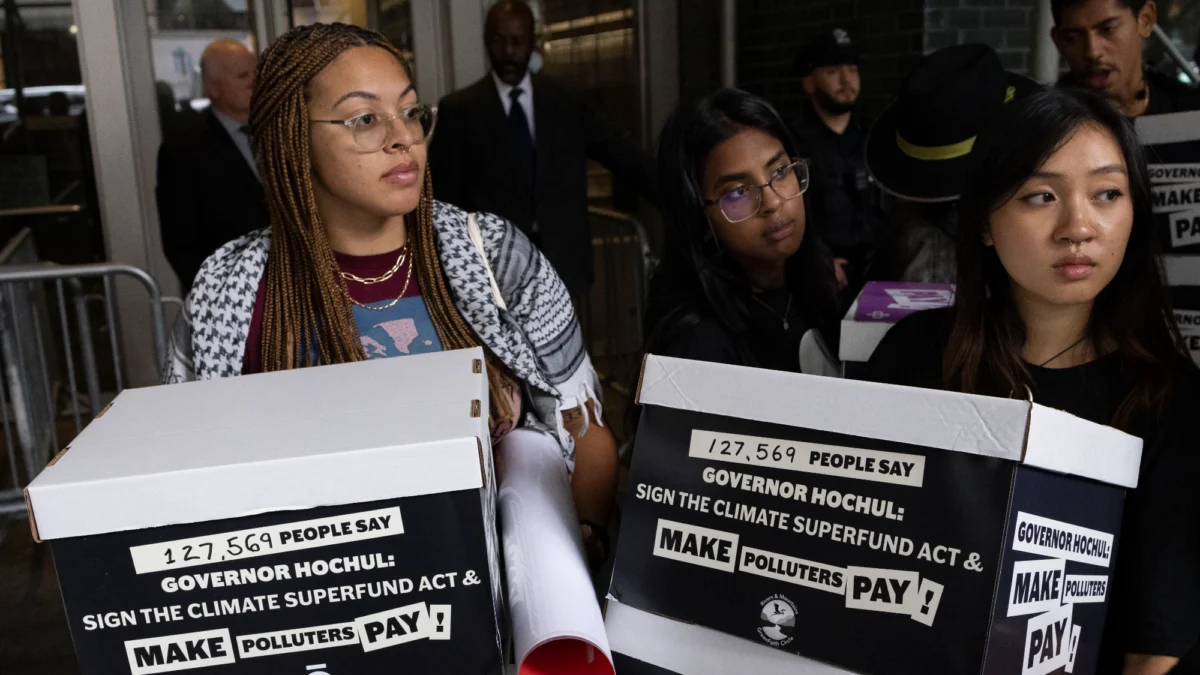
Conversely, environmental groups and state officials expressed deep frustration. Advocates argue that the ruling ignores the mounting costs of the climate crisis, which do not wait for legal clarity. Cassidy DiPaola, communications director for the advocacy group Make Polluters Pay, emphasized the disconnect between the court’s decision and the physical reality of a changing climate.
"The floods will still come, roads will still wash out, and communities will still need billions to protect themselves," DiPaola said in an email. "Those costs don’t disappear just because fossil fuel companies don’t want to pay them."
Implications for a Divided Nation
The ruling has created a chilling effect on similar legislation across the country. In states like New Jersey, where lawmakers were considering their own versions of a "polluter pays" bill, the mood has shifted toward caution. New Jersey Senator Michael Testa, a vocal opponent of such measures, urged his colleagues to halt their efforts, characterizing the bill as a "waste of time and resources."
The legal landscape now hinges on two major unknowns:
- The New York Appeal: While Attorney General Letitia James has yet to file an appeal, legal analysts expect that if she does, the case could reach the Second Circuit Court of Appeals, where the arguments over the 2021 precedent will be litigated once more.
- The Vermont Case: As the original pioneer of the Climate Superfund Act, Vermont remains in the crosshairs of the U.S. Chamber of Commerce. The outcome of that litigation, which is still pending, will likely serve as the ultimate litmus test for the viability of these state-level laws.
The "Polluter Pays" Future
The struggle over these laws is not merely about $75 billion; it is about the broader question of who is responsible for the transition to a low-carbon economy. For states, the Climate Superfund Acts were a way to bridge the massive funding gap for infrastructure adaptation. For the fossil fuel industry, they represented an existential threat—a shift from the courtroom defense of "negligence" to the legislative reality of "taxation."
As the federal judiciary continues to favor a interpretation of law that restricts state-level environmental regulation, climate activists are being forced to rethink their strategy. While the "polluter pays" movement remains popular with the public, the path forward appears increasingly narrow.
The decision serves as a stark reminder that while local governments are on the front lines of climate change, the legal architecture of the United States—under the current administration—is prioritizing the stability of the energy sector over the immediate fiscal needs of climate-vulnerable communities. Whether this ruling will be overturned by a higher court or stand as a permanent barrier remains one of the most significant legal questions of the decade. For now, the bill for climate change continues to mount, and for the residents of New York and beyond, it remains unclear who, if anyone, will be forced to pay it.
About the Author