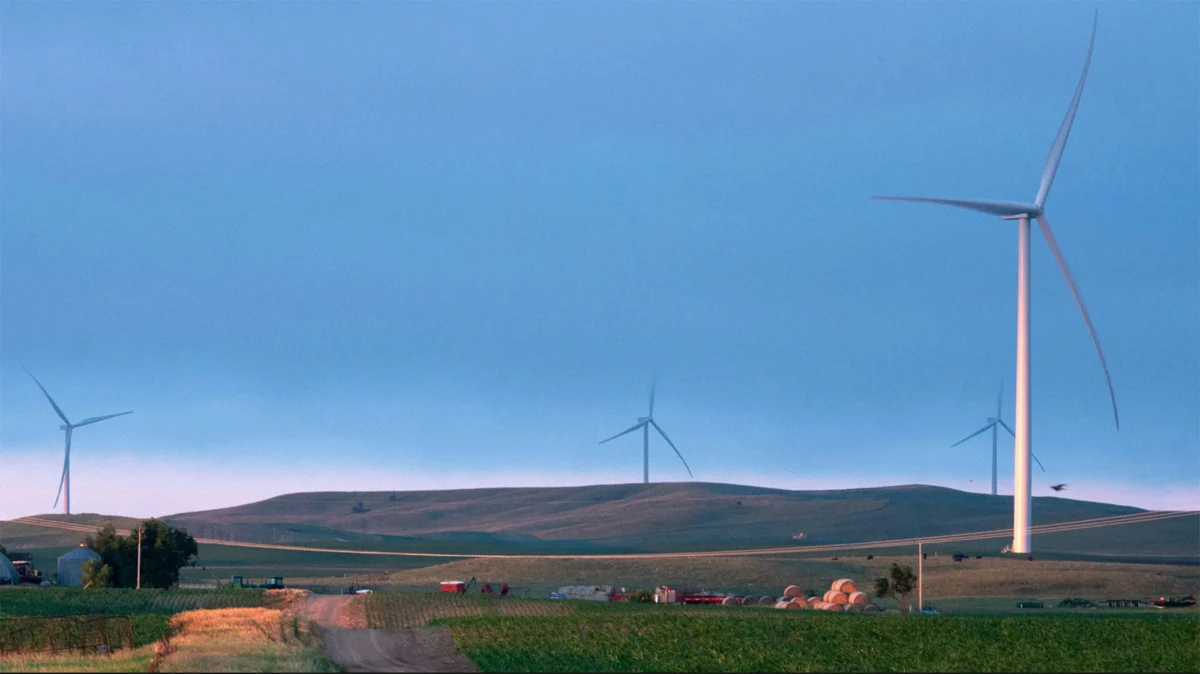
In the sweeping, open plains of Wishek, North Dakota, the horizon has been permanently altered. Where once the eye met only the endless ripple of wheat and the quiet grazing of Angus cattle, colossal 3-megawatt wind turbines now pierce the sky. For fourth-generation farmer George Wolff, these structures represent a pragmatic evolution of the agricultural landscape. For others, they serve as looming symbols of a community losing its identity to a corporate-driven energy transition.
The tension in Wishek—a small town of 850 residents located 90 miles southeast of Bismarck—is a microcosm of a broader, intensifying conflict unfolding across rural America. As the nation pivots toward renewable energy, the "prairie paradox" has taken hold: states that have long fueled the country with fossil fuels are now grappling with the cultural and economic friction of hosting the very wind farms intended to replace them.
The Badger Wind Farm: A Case Study in Division
The center of this local storm is the Badger Wind Farm, a 92-turbine, 250-megawatt project brought online by the Danish energy giant Ørsted in January 2026. The project represents the largest economic development in the history of McIntosh County.
For landowners like George Wolff, the turbines are a secondary crop. With two massive steel structures situated on his 3,500-acre property, he receives quarterly lease payments that help hedge against the volatility of agricultural markets. "If someone came out here and said they wanted to put an oil well on the farm, I’d listen," Wolff says. "They’re producing electricity, and that’s something we all use. If you can make it work, then do it."

However, this sentiment is far from universal. For many, the visual and social impact of the turbines has soured the initial promise of prosperity. Larry Wald, a lifelong resident and former city official, captures the prevailing resentment: "We used to live in open country. Now, these towers are the first thing you see when you come into Wishek and the last thing you see on your way out."
A Chronology of the North Dakota Wind Boom
To understand the current hostility, one must look at the trajectory of North Dakota’s energy policy over the last two decades.
- 2003: The state welcomes its first large-scale wind farm, the NextEra Energy Resources installations in LaMoure County.
- 2005–2020: North Dakota enjoys a "gold rush" era of renewable development, with 38 wind farms coming online. The state adopts an "all-of-the-above" energy policy, embracing wind alongside coal, oil, and gas.
- 2017: State Senator Dwight Cook proposes a two-year ban on wind farms, marking the first major political attempt to curb the industry’s influence on the state’s coal economy.
- 2020–2025: The momentum slows significantly. Only four major projects, including Badger, are completed in this five-year window.
- 2025: Representative Julie Fedorchak leads the charge in Washington to phase out federal tax credits for wind and solar, aligning with national conservative efforts to prioritize traditional fossil fuel production.
- August 2026: The Public Service Commission approves the Longspur wind project, though the approval process is marked by open hostility toward the industry from state commissioners.
Supporting Data: The Economic vs. Cultural Ledger
The economic argument for wind in North Dakota is mathematically robust. Statewide, wind energy has generated more than $10 billion in economic activity. In McIntosh County alone, the Badger Wind Farm is projected to yield roughly $1.3 million in annual tax revenue, funding schools, senior care, and emergency services.
Despite these figures, the political environment has hardened. Data from the North Dakota Department of Commerce indicates that while the state remains a premier location for wind potential, the "pipeline" for future development has thinned to a trickle. The state is no longer aggressively courting developers; instead, it is placing the industry under a microscope.

The social cost, according to critics like resident Lila Raile, cannot be captured in a tax receipt. For Raile, whose "dream home" now overlooks a field of flashing lights and spinning blades, the project represents an intrusion. "They claim to protect rural communities from outside energy companies, but people around here don’t feel protected at all," she says.
Official Responses and the "Coal vs. Wind" Narrative
The conflict has transcended local zoning disputes, becoming a centerpiece of the state’s partisan energy politics. The North Dakota Public Service Commission (PSC) has become a battleground. Chair Randy Christmann has been a vocal critic of the expansion, consistently framing wind energy as a Trojan horse for the "green agenda" aimed at shuttering coal plants.
During a May 2026 hearing, Christmann challenged a local rancher, Richard Schirado, regarding the decline of coal. "One is being added and the other one is being pushed out," Christmann argued. "That’s how they’re working together, is it?"
This narrative is bolstered by state legislators like Rep. Anna Novak, who represents the heart of the state’s coal country. Novak argues that the "all-of-the-above" strategy has reached its limit. "There has been the realization that more wind on the line, specifically in coal country, means that there’s less coal that’s mined and used for electricity generation," she asserts.

The industry, for its part, remains largely tight-lipped. Ørsted declined to participate in formal site visits for this report, though company representatives have engaged in "goodwill donations," including $150,000 for local infrastructure in Wishek, to smooth over community relations.
Future Implications: Can the Social Fabric Mend?
The current moratorium on new wind projects in McIntosh County signals a "wait-and-see" approach that is becoming common across the Midwest. As the industry faces both federal policy headwinds—such as the repeal of tax credits—and local, grassroots resistance, the era of rapid, unchecked expansion in the prairies appears to be drawing to a close.
For the people of Wishek, the reality is now settled. Former Mayor Brenda Dohn, who oversaw the project’s inception, urges a shift in perspective. "It’s here," she says. "You may not like what’s happened, but OK, now what? You can’t light them on fire, you can’t kick them over. So how do we move forward from this?"
The answer to that question will likely define the next decade of rural development in the United States. As farmers like George Wolff look toward passing their land to the next generation, they are betting that the revenue from the wind will be as essential to their children’s survival as the soil itself.

Yet, for those who value the unobstructed vistas of the past, the turbines stand as a permanent reminder of a shift in the global order. Whether the integration of these massive technologies into rural life will lead to a new form of agricultural sustainability or a permanent social divide remains the central, unresolved question of the American energy transition. The wind continues to blow across the North Dakota prairies—the only question left is who will profit from it, and at what cost to the community spirit.
About the Author