In the modern digital landscape, the smartphone has transitioned from a tool of convenience to an extension of the self. From the moment we wake up to the final scroll before sleep, these devices act as portals to the world—but for many, they have become an inescapable tether. A major new study conducted by the Pew Research Center between May 26 and June 1, 2026, reveals a striking paradox: while Americans remain deeply reliant on their devices for connection and information, a majority feel they are losing the battle for their own time.
According to the data, 53% of U.S. adults acknowledge that they spend too much time on their smartphones. This sentiment is not evenly distributed across the population; it is sharply divided by age, with younger generations feeling the weight of screen dependency far more acutely than their older counterparts.
The Generation Gap in Screen Time
The narrative of "smartphone addiction" is often framed as a universal struggle, but the data suggests it is primarily a generational one. Among adults aged 18 to 29, a staggering 70% report that they spend too much time on their devices. This percentage dips to 64% for those aged 30 to 49, while falling to 49% for the 50-64 age demographic. By the time we reach the cohort of adults 65 and older, only 25% believe their usage is excessive.
This disparity is further underscored by how these groups describe their usage patterns. Roughly one-in-four adults overall report using their smartphones "almost constantly." When broken down by age, the contrast becomes stark: 42% of adults under 30 claim to be on their phones almost constantly, compared to just 9% of those 65 and older. These figures paint a picture of a society where digital immersion is not just a habit, but a fundamental baseline for daily existence among younger cohorts.
A Chronology of Digital Dependency
The rise of the smartphone has been one of the most rapid technological transformations in human history. To understand the current climate of "screen fatigue," one must look at how usage has evolved over the past two decades.
- Early 2010s: The smartphone becomes a mainstream commodity. Initial discourse focuses on the utility of mobile internet and the "anywhere, anytime" connectivity it provides.
- Mid-2010s: Social media integration accelerates. The "pull" of the phone increases as push notifications and infinite-scroll feeds become standard design features, creating a behavioral loop of constant checking.
- Late 2010s to Early 2020s: The "Digital Wellbeing" movement gains traction. Tech companies begin implementing built-in screen time trackers and "do not disturb" features, acknowledging that users are struggling to self-regulate.
- 2026 (Current Context): As revealed by the latest Pew survey, the struggle has reached a tipping point. Despite a decade of awareness campaigns and tools designed to help users disconnect, nearly half of the population still reports feeling that their usage is out of control.
The Struggle to Cut Back
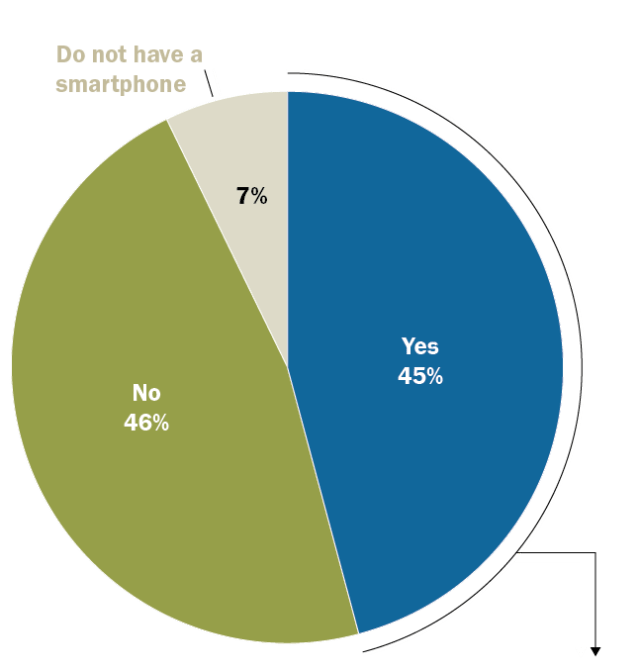
The data from 2026 highlights a significant divide between intention and action. While 45% of U.S. adults report that they have actively tried to reduce their smartphone usage in the past 12 months, an nearly equal number (46%) have made no such effort.
For those who have attempted to curtail their screen time, the results are decidedly mixed. Only 25% of these individuals describe themselves as "extremely" or "very" successful in their efforts. The majority—52%—describe themselves as only "somewhat successful," while 23% admit their attempts at digital detoxing have been largely ineffective.
The demographic trends here are telling: adults under 50 are significantly more likely to attempt to cut back (58% of those 18-49) compared to just 23% of those 65 and older. This suggests that the perceived need for a "digital break" is linked to the intensity of one’s digital life, which is inherently tied to the workplace and social demands faced by younger adults.
The Dual-Edged Sword: Benefits vs. Burdens
When Americans are asked about the specific impacts of their smartphones, the responses reveal a complex cost-benefit analysis. The device is viewed as a vital tool for staying informed (73% say it helps) and feeling connected to others (51% say it helps). In these domains, the positive utility of the smartphone remains unchallenged.
However, the downsides become clear when the conversation shifts to physiological and psychological well-being. The most prominent area of concern is sleep. 41% of respondents report that their smartphone use hurts their sleep quality, while only 5% say it helps. This is particularly pronounced among the youth; a staggering 62% of adults under 30 believe their smartphone usage negatively impacts their sleep.
Productivity is another battleground. While 30% feel their phone helps their productivity, 34% feel it hinders it—a near-even split that highlights the ongoing tension between using a device for work versus being distracted by it. The impact on mood is more neutral, with 51% saying their phone has no impact on their emotional state, though again, younger users are more likely to report a negative effect compared to older users.
Implications for Public Health and Design
The findings from the Pew Research Center raise critical questions for policymakers, tech developers, and mental health professionals. If a majority of the population feels their device usage is excessive, but attempts to change that behavior are only moderately successful, we must ask: is the current design of our digital environment fundamentally at odds with human well-being?

1. The Design Ethics Question
The "infinite scroll" and notification-heavy architectures of modern mobile operating systems were designed to maximize engagement. As the public becomes increasingly aware of the toll this takes on sleep, productivity, and general well-being, there is mounting pressure on technology companies to move toward "calm technology"—designs that prioritize user agency over retention.
2. The Mental Health Dimension
The fact that younger adults are simultaneously the heaviest users and the most likely to report negative impacts on sleep and productivity suggests a growing mental health burden. If 62% of young adults feel their sleep is compromised by their phones, this is not just a personal habit issue—it is a public health crisis that could have long-term consequences for the physical and cognitive health of an entire generation.
3. A Shift in Societal Norms
We are currently in a transition period regarding digital etiquette. Just as society eventually created norms around television watching and, later, email checking, we are in the process of defining what "healthy" smartphone use looks like. However, as long as the digital infrastructure is built on the premise of constant connectivity, individual willpower will continue to be insufficient for most users.
Conclusion
The 2026 Pew Research Center survey confirms that we are a society in a tug-of-war with our technology. We value the connectivity and the information our smartphones provide, yet we are increasingly aware that this convenience comes at a cost to our rest, our focus, and our peace of mind.

As we move forward, the challenge will be to reconcile our reliance on these devices with our fundamental human needs. Until then, the smartphone will remain a tool that many of us feel we cannot live without, yet deeply wish we could put down.
Methodology Note:
This analysis is based on a survey of 9,750 U.S. adults conducted by the Pew Research Center from May 26 to June 1, 2026. The participants were members of the American Trends Panel, a nationally representative group of adults. The full report, including the questionnaire and methodology, is available through the Pew Research Center archives.
About the Author