As the second term of the Trump administration intensifies its focus on immigration enforcement, public perception of U.S. Immigration and Customs Enforcement (ICE) has experienced a significant downturn. A comprehensive new survey from the Pew Research Center, conducted between September 28 and October 4, 2026, reveals that a clear majority of Americans now hold an unfavorable view of the agency, reflecting a deepening national divide over the administration’s signature "invasion" rhetoric and its associated deportation strategies.
The Current Landscape: A Negative Trend
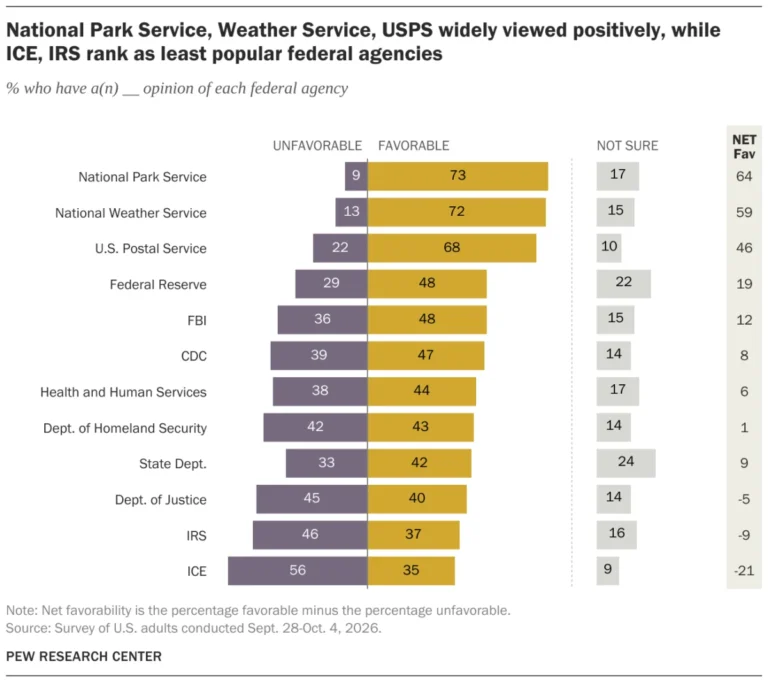
According to the survey of 5,062 U.S. adults, 56% of Americans report having an unfavorable opinion of ICE. This marks a notable shift from 2025, where the unfavorable rating stood at 49%. Only 35% of respondents currently view the agency favorably, a decline from 40% just one year ago.
The data positions ICE as the least favorably viewed among the 12 major federal agencies and departments currently being tracked by the Center. This erosion of support is not limited to a single demographic or political cohort; rather, it appears to be a broad-based cooling of sentiment toward the agency tasked with executing the administration’s aggressive border and interior enforcement policies.
Chronology of Enforcement and Public Reaction
The tension surrounding ICE is inextricably linked to the policy trajectory of the current administration.

- Early 2026: President Trump reaffirmed his commitment to the largest mass deportation effort in American history, citing an alleged "invasion" by criminal elements. This rhetoric became the cornerstone of the administration’s legislative and executive agenda.
- March 17, 2026: A visual representation of the administration’s policy became public when masked federal agents in "Police ICE" tactical gear were photographed patrolling the New York Federal Plaza Immigration Court. The image served as a stark reminder of the increased presence of federal enforcement within urban centers.
- Late 2026 (Survey Period): The Pew Research Center captured the public mood during a period of heightened activity. As deportation operations moved from the rhetoric of the campaign trail to the reality of courtrooms and residential communities, public opinion began to solidify against the agency.
Supporting Data: A Partisan and Demographic Fracture
While the downward trend is consistent across the political spectrum, the partisan gap remains substantial.
Partisan Divergence
Republicans and those who lean toward the GOP remain the strongest supporters of the agency, though their enthusiasm has tempered. Currently, two-thirds (67%) of Republicans view ICE favorably, a decrease from the 72% recorded in 2025. Conversely, the opposition among Democrats has reached near-total consensus; 84% of Democrats and Democratic-leaning independents now hold an unfavorable view of the agency, rising from 78% last year.
Racial and Ethnic Perspectives
The survey provides a granular look at how different racial and ethnic groups perceive the agency:
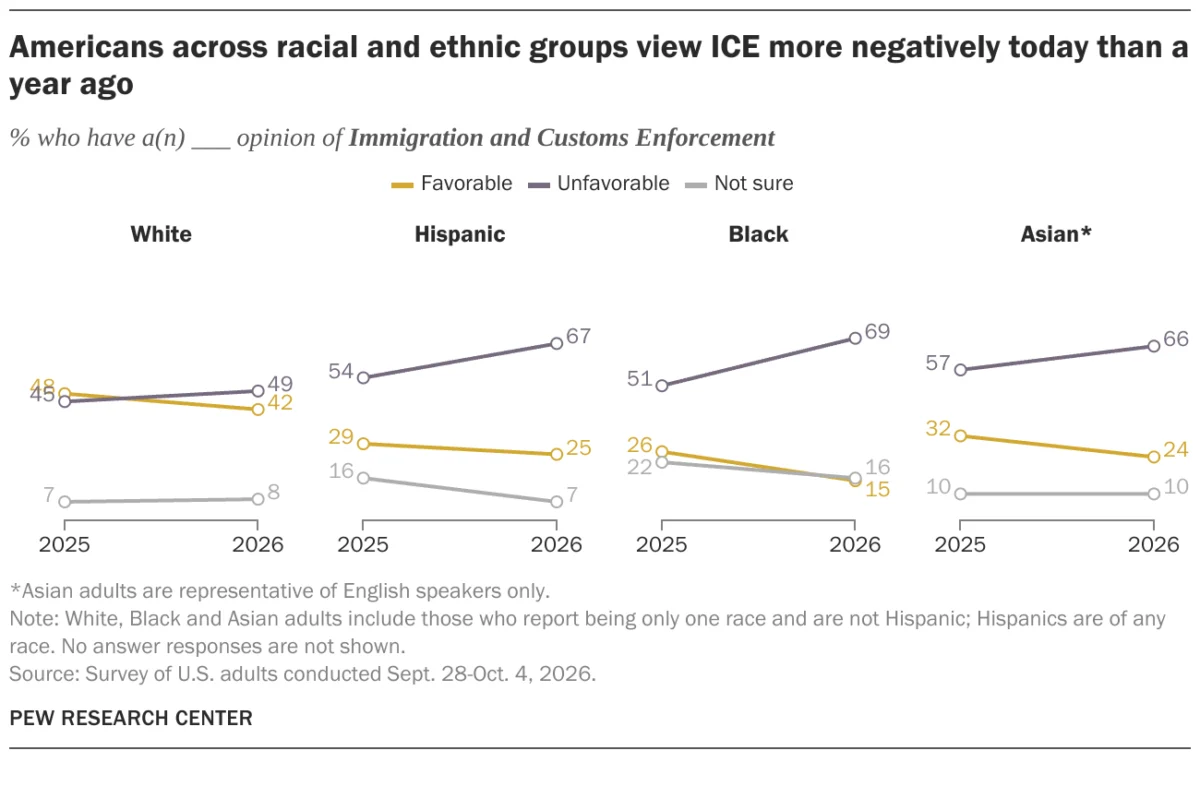
- Black, Hispanic, and Asian Adults: These groups express the highest levels of skepticism and negativity toward ICE. Majorities of Black (69%), Hispanic (67%), and Asian (66%) adults report unfavorable opinions. Each of these groups has shown a marked increase in negative sentiment compared to the 2025 data.
- White Adults: While White adults remain the group most likely to hold a favorable view of the agency compared to others, they are not immune to the trend. Nearly half (49%) now express an unfavorable view, up from 45% in 2025, while favorable ratings among this group have dipped from 48% to 42%.
The Republican Internal Split
Perhaps most telling is the nuance within the Republican party. White Republicans (71% favorable) remain far more supportive of ICE than Hispanic Republicans (53% favorable). This internal divergence highlights that even within the coalition that supports the current administration’s immigration platform, the practical application of enforcement policies is viewed through different cultural and experiential lenses.

Official Responses and Administrative Strategy
The Trump administration has consistently framed these enforcement actions as a matter of national security and public safety. Officials argue that by targeting "criminals" and those who have entered the country illegally, they are restoring the rule of law.
In public briefings, spokespersons for the Department of Homeland Security (DHS) have emphasized that the agency is merely fulfilling its statutory obligations. "ICE is the primary tool for maintaining the integrity of our immigration system," one official noted during a recent press availability. However, the administration has remained largely silent on the polling data, preferring to focus on the operational successes and volume of deportations rather than the public relations fallout.
Critics, however, argue that the "invasion" rhetoric has done more than simply mobilize a political base—it has permanently altered the public image of a federal agency that was originally designed for administrative and law enforcement functions. Civil rights organizations have pointed to the 2026 survey results as evidence that the public is becoming increasingly alarmed by the militarization of immigration enforcement.
Broader Implications: What Lies Ahead?
The implications of these findings are profound for the remainder of the presidential term.

Political Fallout
For policymakers, the data suggests that the "tough on immigration" stance may be reaching a point of diminishing returns. While the policy satisfies a core segment of the electorate, the consistent erosion of support among independents and the hardening of opposition among minority groups could pose challenges in future electoral cycles. If an agency tasked with a central pillar of the administration’s platform is viewed unfavorably by more than half the country, it creates a "brand" problem for the administration at large.
Institutional Morale
The data also raises questions about the long-term impact on the federal workforce. When a federal agency is consistently viewed through a negative, partisan lens, it can affect recruitment, retention, and the internal culture of the organization. As agents carry out their duties, the knowledge that a majority of the American public holds an unfavorable view of their institution could complicate the agency’s ability to maintain public trust and cooperation in local communities.
The Future of Immigration Policy
The steady increase in negative sentiment is likely to encourage advocacy groups to push for deeper reform. As the public becomes more comfortable with the idea of limiting or reforming ICE’s current operational mandate, the debate may shift from "how to enforce" to "whether to restructure."
Ultimately, the 2026 Pew Research survey provides a clear snapshot of a nation wrestling with the human and institutional costs of its immigration policies. With the administration showing no signs of slowing its deportation efforts, the chasm between the government’s operational goals and the public’s sentiment is likely to remain a defining feature of the American political landscape for the foreseeable future.

For more details on the methodology, the full dataset, or to review the specific survey questions, readers can access the official Pew Research Center report.
About the Author