In the fast-evolving landscape of modern manufacturing, the obsession with Industry 4.0—artificial intelligence, predictive maintenance, and robotic automation—often overshadows the most critical component of industrial success: the workforce. As the industry faces a demographic shift of historic proportions, the imperative for robust succession planning has transitioned from a back-office human resources task to a frontline operational necessity.
For nearly two decades, the editorial stewardship of Plant Engineering has provided a front-row seat to the transformation of the manufacturing sector. While technology has redefined the "how" of production, the "who" remains the ultimate variable in plant stability. As the industry prepares for the next generation of industrial leaders, the lessons learned from the past two decades provide a clear roadmap: organizational continuity is not a byproduct of chance, but the result of intentional knowledge transfer.
The Demographic Ticking Clock: A Chronology of the Skills Gap
The manufacturing sector is currently navigating what labor economists often call the "Great Retirement." A chronological look at the industrial workforce reveals a widening chasm between the departure of veteran expertise and the arrival of digital-native talent.
- The 1990s and Early 2000s: A period of relative workforce stability where institutional knowledge was maintained through long-tenure employment. Training was largely apprenticeship-based and informal.
- The 2010s: The "Silver Tsunami" begins as the first wave of Baby Boomers hits retirement age. Simultaneously, the rapid digitization of plant floors creates a demand for new, technical skill sets that the existing workforce is not always equipped to provide.
- The 2020s: The convergence of post-pandemic labor shifts and accelerated automation. Companies find themselves in a race to capture "tribal knowledge" before the generation that built the modern plant floor departs permanently.
This chronology underscores a fundamental reality: the informal knowledge held by veteran engineers and maintenance technicians—such as the specific "quirks" of a legacy machine or the nuances of a plant’s proprietary processes—is currently at high risk of being lost.
Supporting Data: The Cost of Institutional Amnesia
The implications of failing to implement a formal succession strategy are measurable and severe. According to industry data, the average manufacturing employee tenure has seen a downward trend, leading to a "knowledge leak" that impacts the bottom line.
- Productivity Erosion: Research indicates that when a senior technician leaves without a structured handover, it can take up to 18 months for a replacement to reach full proficiency. During this "ramp-up" period, mean-time-to-repair (MTTR) often increases, leading to higher unplanned downtime.
- The Cost of Errors: In high-stakes environments—such as chemical processing, food safety, or heavy metal fabrication—a lack of documented institutional knowledge leads to preventable safety incidents. The cost of a single safety oversight can far outweigh the investment required to build a formal mentorship program.
- The Knowledge Gap: Surveys of plant managers suggest that nearly 60% of critical operational knowledge is undocumented, existing only in the minds of employees with 20+ years of experience. This "hidden asset" is currently the most vulnerable part of the corporate balance sheet.
Strategic Perspectives: Defining Succession Beyond the C-Suite
Succession planning is frequently misconstrued as a process of grooming future CEOs. In the industrial context, however, it is a risk mitigation strategy. It is about ensuring that if a critical plant operator, lead maintenance engineer, or process control specialist leaves, the facility’s output does not suffer.
Identifying Critical Roles
The first step in any effective succession strategy is a "Criticality Audit." Organizations must ask:
- Which roles, if vacated, would cause an immediate shutdown or catastrophic loss of quality?
- Which employees are the "sole keepers" of legacy process data?
- Which relationships—whether with key vendors, specialized subcontractors, or regulatory bodies—are tied to a single individual?
Documenting the Undocumented
Much of the expertise in a manufacturing plant is "tacit"—it is learned through experience rather than textbooks. To capture this, forward-thinking plants are utilizing:
- Digital Knowledge Repositories: Using tablets and video capture tools to record veteran technicians performing complex maintenance tasks.
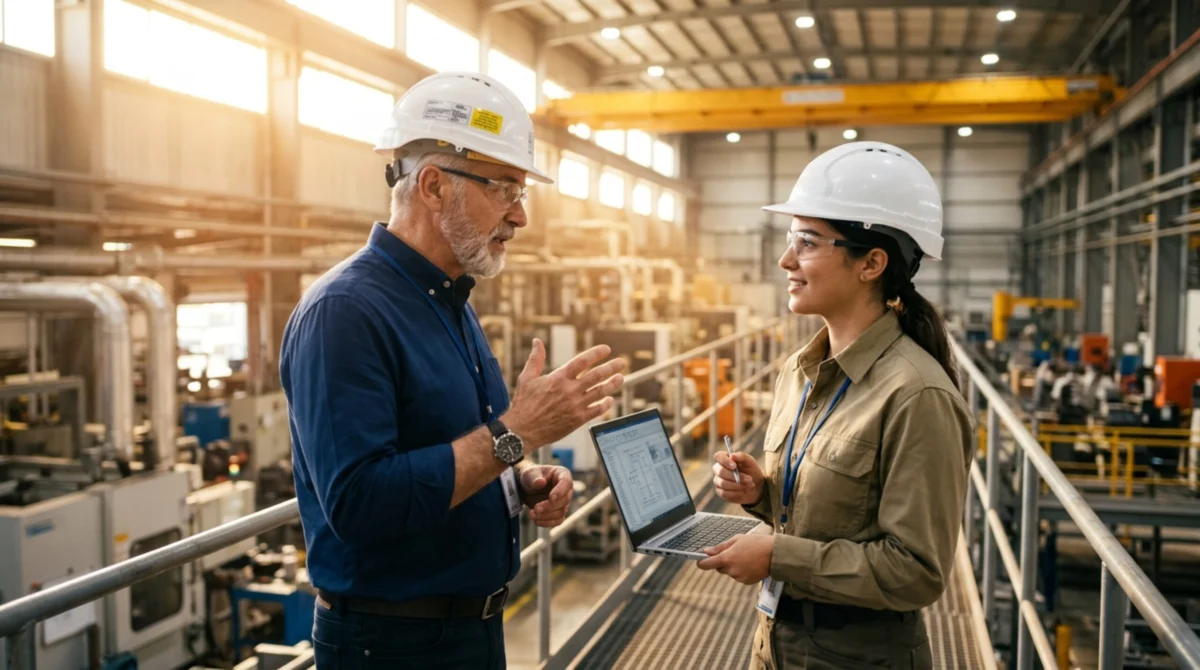
- Structured Mentorship: Moving away from "shadowing" (which is passive) toward "active co-piloting," where the mentee takes the lead on a task while the mentor supervises.
- Cross-Training Rotations: Deliberately moving staff between departments to ensure that no single machine or process is a "black box" understood by only one person.
The Cultural Shift: Knowledge Sharing as a Core Value
The most significant hurdle to effective succession planning is not technical; it is cultural. In many plants, veteran workers may feel that their value is inextricably linked to being the "only one who knows how to fix the boiler." Conversely, younger workers may be hesitant to ask for guidance for fear of appearing incompetent.
Effective leadership requires a total pivot:
- Redefining Mentorship: Organizations must incentivize the transfer of knowledge. Experienced workers should be recognized and compensated for their role as mentors, not just for their technical output.
- Psychological Safety: A culture must be cultivated where asking questions is treated as a professional strength. When a facility celebrates "teaching moments" as much as "production milestones," the knowledge gap begins to close.
- Integrating the Generations: The best results are often found in "reverse mentoring" programs, where younger employees help veterans navigate new digital tools, while veterans help younger staff understand the underlying physics and history of the plant’s hardware.
Implications for the Future: Building a Resilient Enterprise
As we look toward the future, it is clear that technology and talent are not competing interests—they are interdependent. The most sophisticated automation system in the world is only as effective as the operator who manages it, the technician who maintains it, and the engineer who optimizes it.
If the goal of modern manufacturing is resilience, then succession planning is the primary tool for achieving it. A facility that can survive the departure of its most senior talent without a drop in output is a facility that is truly prepared for the 21st century.
The Roadmap for Leadership
For those currently holding the reins in industrial operations, the mandate is clear:
- Audit your knowledge base today. Do not wait for a resignation letter to discover what you don’t know.
- Make knowledge transfer an operational KPI. Treat it with the same rigor as safety metrics or production quotas.
- Invest in the next generation. Provide the tools, the time, and the authority for emerging leaders to learn the ropes while the veterans are still on-site to guide them.
The manufacturing industry is in the midst of a generational handoff. While the equipment of tomorrow will undoubtedly be faster, cleaner, and more efficient, the heartbeat of the factory remains its people. By prioritizing the systematic transfer of knowledge, the industry can ensure that the expertise of the past fuels the innovations of the future. The best time to start the transition is not when a crisis arises, but today, while the wisdom is still in the room.
About the Author