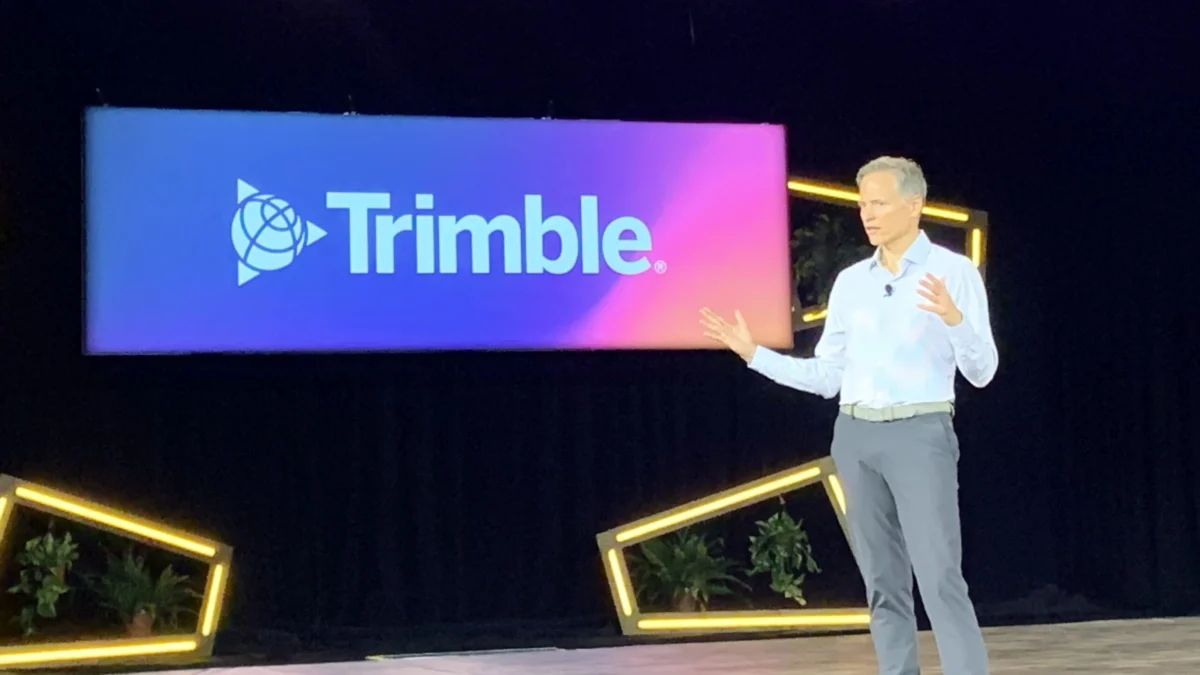
SAN DIEGO — At the annual Insight 2026 conference, Trimble CEO Rob Painter addressed the elephant in the room with a blend of corporate stoicism and technological enthusiasm. As the company continues its high-stakes strategic review of its transportation and logistics business, Trimble finds itself in a paradoxical position: aggressively deploying cutting-edge artificial intelligence to modernize global freight systems, while simultaneously weighing whether that very business should remain under the Trimble corporate umbrella.
The Strategic Review: A Delicate Balancing Act
In August, Trimble (Nasdaq: TRMB) made waves in the industry by announcing a comprehensive strategic review of its transportation and logistics unit. The company retained the services of Goldman Sachs to navigate the process, confirming that it had received “credible, unsolicited interest” from multiple external parties.
Speaking to reporters at an executive media roundtable this Monday, Painter confirmed that the review remains active. When asked if the interest from multiple parties persists, he provided a blunt, affirmative response: "Yes to everything you said."
Despite the gravity of a potential divestiture, Painter was keen to temper expectations regarding a timeline. There is no urgency to finalize a deal, and he explicitly noted that "most strategic reviews end up with continuing to do what we do." While he acknowledged the possibility of a spin-off or a sale, his primary focus remains on the fiduciary obligation to ensure the best outcome for shareholders, customers, and employees.
"It’s not surprising to me that we’ve had inbound interest," Painter said. "It’s a scarce asset, a scarce set of capabilities. We’re a public company. We have a fiduciary obligation to the shareholders to listen if we have credible interest."
Chronology of a Potential Transformation
The journey toward this crossroads has been marked by significant acquisitions and a steady pivot toward integrated software ecosystems.
- 2023: Trimble completes the acquisition of Transporeon, a move that significantly bolstered its ability to connect shippers, carriers, and brokers across the European and global freight landscape.
- August 2025: Trimble officially announces the launch of a formal strategic review of its transportation business, appointing Goldman Sachs as its financial advisor to evaluate interest from third parties.
- Late 2025 – Early 2026: The transportation unit continues to operate under "business as usual," with internal product development accelerating.
- March 2026 (Insight Conference): Trimble debuts "Arc Agent" and a suite of AI-driven orchestration tools, signaling that the unit is not merely in "maintenance mode" while awaiting a sale.
Painter’s rhetoric remains carefully calibrated. He continues to describe the transportation segment as a "terrific business with an exciting future," repeatedly stating his personal comfort with remaining the ongoing owner of the division. "My view is this is a Trimble business and let’s say until it’s not, if that’s the case," he remarked.
Supporting Data: Investing in the Future of Freight
While the corporate structure of the transportation unit remains in flux, the technological roadmap is anything but stagnant. Trimble used the Insight 2026 conference to demonstrate that it is doubling down on modernizing the trucking industry through AI.
Voice AI and Orchestration
The company unveiled a suite of technologies designed to facilitate "agent-ready" platforms. According to Michael Kornhauser, who leads Trimble’s transportation operations in North America, the modernization strategy is built on a "low-lift" approach. Instead of forcing customers to undergo expensive, multi-year migrations, Trimble’s new updates are designed to sit atop existing Transportation Management Systems (TMS).
"We felt that was the quickest way to get our customers in their existing systems to a place where AI can impact their business today," Kornhauser noted. This strategy allows carriers to retain the integrations and processes they have built over decades while leveraging the power of new AI agents.
The Rise of Arc Agent
The centerpiece of this technology rollout is "Arc Agent," a unified AI agent designed for high-level versatility. Unlike traditional AI tools that require specialized coding for every minor task, Arc Agent is built to acquire multiple skills over time.
In a striking demonstration, executives showcased a task involving currency conversion for TMT Trucking. A process that would have traditionally required a three- to six-month development cycle—including custom coding and professional services—was executed within the Arc framework in approximately 35 minutes. "You don’t have to have an engineering degree to build a skill," said Philipp Pfister, vice president of Transporeon.
Addressing the Risks: AI Governance and Security
The push toward autonomous AI in the logistics sector brings with it significant operational risks, a reality that Painter and his team openly acknowledged.
"Pretty quickly, you go from, ‘Wow, this is pretty cool’ to ‘Wait a minute, how are we going to govern this?’" Painter said. The concerns revolve primarily around data privacy, cybersecurity, and the protection of proprietary logistics information.
To mitigate these risks, Trimble is focusing on two pillars:
- Massive Cyber Resilience Investment: The company is committing tens of millions of dollars annually to ensure its platforms remain secure against sophisticated digital threats.
- Human-in-the-Loop Architecture: Pfister emphasized that Arc Agent is designed with human oversight at its core. Users retain the ability to verify, approve, and provide feedback on the AI’s actions, ensuring that the technology acts as a force multiplier rather than an autonomous actor that could inadvertently compromise sensitive business data.
Expanding the Global Footprint: The Mexico Factor
A critical component of Trimble’s transportation strategy is the increasing complexity of U.S.-Mexico freight movements. As supply chains continue to near-shore and trade volumes shift, the demand for sophisticated cross-border mapping and tracking has surged.
Kornhauser revealed that Trimble is actively enhancing its "Mexico Maps" data, specifically targeting truck-relevant points along the border. By adding granular data to its existing network of 6 million mapped places in North America, Trimble aims to provide carriers with unprecedented visibility into cross-border transit, which is notoriously difficult to track due to diverse infrastructure standards.
Implications: A Business at the Edge of Change
The core question remains: What does this mean for the industry?
If Trimble decides to spin off or sell the unit, the buyer would inherit a business that is currently in the middle of a massive technological transition. The integration of Transporeon and the successful rollout of AI orchestration tools have made the unit more valuable, yet these investments also tie the business to Trimble’s broader corporate culture and R&D capabilities.
For customers, the uncertainty regarding ownership is secondary to the immediate utility of the new AI tools. The ability to enhance existing TMS platforms without "tearing out and replacing" legacy software is a compelling value proposition that keeps customers loyal, regardless of who holds the title of "parent company."
The "Ongoing Playbook"
For now, Trimble’s message to the market is one of consistency. Painter’s "super comfortable" outlook serves as a signal to clients that the current leadership is not distracted by the strategic review.
"I’m super comfortable if I’m back in front of you again in weeks, months, or a year from now at our next conference and we’re executing the playbook because that’s how we’re operating right now," Painter concluded.
As Trimble navigates this period of uncertainty, the industry is watching closely. Whether the transportation unit eventually finds a new home or remains a cornerstone of the Trimble portfolio, the focus on AI-driven efficiency and cross-border optimization appears to be a permanent fixture of the company’s long-term strategy. The "scarce assets" that Trimble currently manages—its vast data sets, its deep integrations into trucking fleets, and its emerging AI capabilities—will remain high-value targets for any entity looking to control the future of the global supply chain.
About the Author