For decades, the manufacturing sector has been transformed by the philosophy of "Lean." From the iconic Toyota Production System to the widespread adoption of 5S, Kanban, and Six Sigma, industrial facilities have become masters at eliminating waste on the factory floor. Yet, a glaring disconnect remains: while production lines are optimized for efficiency, maintenance departments often continue to operate under outdated, reactive, or inefficient frameworks.
This gap is particularly evident in the management of compressed air systems—often referred to as the "fourth utility" of industry. While companies invest heavily in energy-efficient compressors, they frequently fail to apply lean logic to the ongoing maintenance of these vital systems. By extending lean principles to maintenance, organizations can move beyond simple repairs and toward a culture of operational excellence, energy conservation, and significant cost reduction.
The Core Philosophy: Shifting from Reactive to Proactive
The primary goal of lean maintenance is the elimination of "muda"—the Japanese term for waste. In a maintenance context, waste manifests as excessive downtime, redundant preventive maintenance (PM) tasks, unnecessary spare parts inventory, and the silent, expensive drain of energy inefficiency.
The transition to a lean maintenance model requires a fundamental shift in mindset. It demands that facilities stop viewing maintenance as a "necessary evil" or a reactive cost center, and instead treat it as a strategic asset. By integrating maintenance into the broader lean framework, plants can stabilize their processes, improve the Total Cost of Ownership (TCO) for their capital equipment, and drastically reduce the energy footprint of their compressed air utilities.
1. The Gradual Approach: Start Small, Scale Big
One of the most common mistakes in implementing lean maintenance is the attempt to overhaul an entire department overnight. Lean is inherently iterative. Organizations should begin by identifying high-impact, low-cost opportunities.
The focus should always be on lifetime energy costs rather than initial purchase price. For air compressors, the purchase price is often the smallest portion of the TCO, with electricity consumption accounting for the vast majority. By starting with simple, low-cost upgrades—such as adding inexpensive flow monitors or digital pressure sensors—maintenance teams can build a foundation of data-driven decision-making without requiring massive capital expenditure.
2. Prioritizing Mission-Critical Functions
Not all equipment is created equal. Lean maintenance dictates that resources must be allocated to assets that directly impact production flow. If a specific compressor failure can shut down an entire packaging line, that system must be the priority for predictive analytics and condition-based monitoring.
By utilizing Overall Equipment Effectiveness (OEE) metrics, maintenance managers can identify where unplanned downtime is originating. By aligning maintenance KPIs with production goals, the team ensures that the "maintenance budget" is actually a "production insurance policy."
3. Challenging the "Preventive" Maintenance Dogma
Perhaps the most controversial aspect of lean maintenance is the critique of traditional Preventive Maintenance (PM). Many plants rely on calendar-based schedules—changing a filter every three months or a lubricant every six months, regardless of whether the part is worn or the oil is degraded.
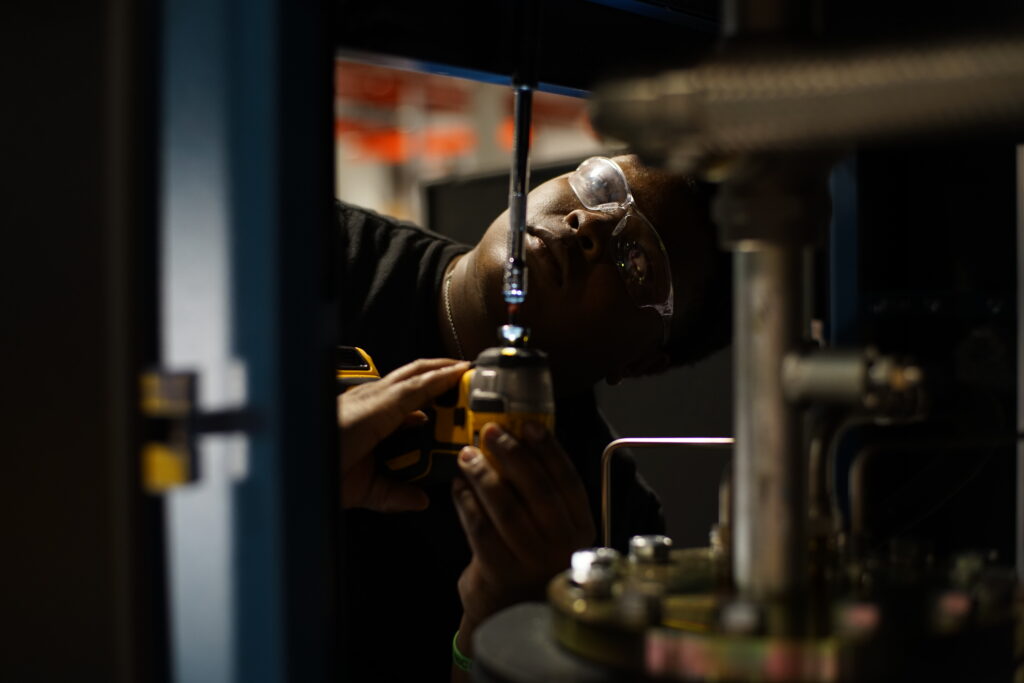
From a lean perspective, calendar-based PM is a form of over-processing. It wastes labor hours and parts, and it risks human error during unnecessary invasive procedures. Lean maintenance advocates for "condition-based" or predictive maintenance. If the machine is functioning optimally, it shouldn’t be touched. If sensor data indicates a degradation in performance, that is the signal for action. By aligning maintenance actions with real-world data, companies achieve the "right maintenance at the right time."
4. Identifying the "Purest Form of Waste": Leaks
In the realm of compressed air, leaks represent the ultimate failure of lean processes. It is estimated that the average industrial facility loses 20% to 30% of its generated air to leaks. This is energy, converted into compressed air, and vented into the atmosphere—a direct loss of profit with zero added value.
Beyond leaks, system pressure is another frequent offender. Operating a header pressure that is 10 psi higher than necessary is a common habit, but it acts as a constant multiplier for waste. Higher pressure forces air through leaks faster and increases the load on the compressor, accelerating wear and energy consumption. Lean maintenance requires the continuous "right-sizing" of these operating parameters.
5. The Imperative of Measurement: "You Can’t Improve What You Can’t See"
Measurement is the bedrock of any lean initiative. Following the DMAIC (Define, Measure, Analyze, Improve, Control) process is essential for compressed air systems.
The "North Star" metric for any compressed air system is Specific Power—the ratio of electricity consumed to the volume of air produced (measured in cfm/kWh). By tracking this metric alongside system demand and discharge pressure, managers can establish a "baseline of normal." When the system drifts from this baseline, the cause must be investigated. Today, IoT-enabled sensors and AI-driven diagnostic software can identify these deviations in real-time, often long before a human operator could detect a change in sound or vibration.
6. The 5S Strategy: Cleanliness as a Diagnostic Tool
The 5S methodology (Sort, Set in order, Shine, Standardize, Sustain) is often dismissed as "housekeeping," but in a maintenance environment, it is a diagnostic tool. A clean machine is easier to inspect.
For example, keeping a compressor cabinet free of dust and debris isn’t just about appearance; it prevents the clogging of heat exchangers, which leads to overheating and premature component failure. Similarly, cleaning up oil spills allows for the immediate identification of new, active leaks. If a floor is perpetually covered in oil, a new leak remains hidden until the machine eventually fails.
Furthermore, 5S in the parts crib is vital. Excess inventory of obsolete parts or incorrect filters is a massive waste of capital. A streamlined, organized parts system ensures that when a failure occurs, the right part is available, reducing Mean Time to Repair (MTTR).
7. Sustainability of Change
The "Sustain" in 5S is the most difficult to achieve. Lean initiatives often fail because they are treated as temporary projects rather than cultural shifts. If a company implements a new predictive maintenance program but reverts to the "old way" of doing things when pressure mounts, the investment is lost. To be sustainable, these changes must be integrated into the standard operating procedures (SOPs) and reflected in the daily workflows of the maintenance staff.
8. Root Cause Analysis (RCA)
Lean maintenance demands that we stop "patching" problems. If an air system suffers from chronic oil carryover, simply replacing the separator filter every few weeks is a failure of logic. The root cause—perhaps an overfilled reservoir, a failing scavenge line, or even the use of substandard third-party lubricants—must be addressed. By digging deeper, maintenance teams stop the cycle of recurring failures and free up their time for more strategic projects.
9. The Power of Visual Management
Even in the age of digital dashboards, the "visual" in visual management remains powerful. If a red light on a compressor signals a problem, the entire facility should know. KPIs should be displayed prominently, and alerts should be simple. When the entire team—from the night watchman to the plant manager—understands what "good" looks like, the facility gains an army of sensors. Many significant failures have been averted simply because a staff member noticed a visual cue and reported it.
10. The Value of Expert Consultation
Finally, lean does not mean "do it alone." Compressed air systems are complex, and the expertise required to optimize them often resides with specialized consultants. An air audit is the most effective way to establish a baseline and identify the low-hanging fruit for energy savings. A trusted expert can assist in navigating the complexities of AI-driven remote monitoring and ensure that the maintenance program is built on reliable data rather than guesswork.
The Role of the CMMS: The Backbone of Efficiency
A Computerized Maintenance Management System (CMMS) is the engine of a lean maintenance program. It centralizes all data, from equipment history to sensor logs and spare parts inventory. However, a CMMS is only as good as the data entered into it.
The transition from preventive to predictive maintenance is entirely dependent on the quality of the data stored within the CMMS. By leveraging this system to track, trend, and automate maintenance tasks, organizations can achieve a level of operational stability that was previously impossible.
Conclusion: The Path Forward
Adopting lean maintenance is not a destination but a journey of continuous improvement. By applying these ten principles—from slowing down and measuring accurately to fostering a culture of cleanliness and root-cause analysis—industrial facilities can turn their maintenance departments into engines of efficiency.
In an era where energy costs are volatile and downtime is increasingly expensive, the "lean" approach to maintenance is no longer a competitive advantage—it is a requirement for survival. By treating the compressed air system with the same rigor as the production line, manufacturers can ensure that their utilities are as efficient, reliable, and productive as the products they create.
About the Author