The traditional clink of coins and the rustle of paper money are becoming increasingly rare sounds in the American marketplace. As the financial habits of the nation undergo a seismic shift, the United States is rapidly moving toward a future where cash is no longer king, but a niche alternative. According to data from the 2026 Pew Research Center survey and the Federal Reserve Bank of Atlanta’s Survey and Diary of Consumer Payment Choice, the American public has decisively pivoted toward digital and card-based payment methods, leaving physical currency behind in a trend that shows no signs of reversing.
The Shrinking Footprint of Physical Cash
The shift away from cash is not merely a gradual transition; it is a rapid decline. Since 2015, the percentage of Americans who rely on cash for all or nearly all of their weekly transactions has been cut in half, plummeting from 24% to a mere 12%. Perhaps more striking is the rise of the “cashless consumer”: currently, 42% of U.S. adults report that they do not use cash for a single purchase during a typical week—a significant increase from the 24% who reported the same a decade ago.
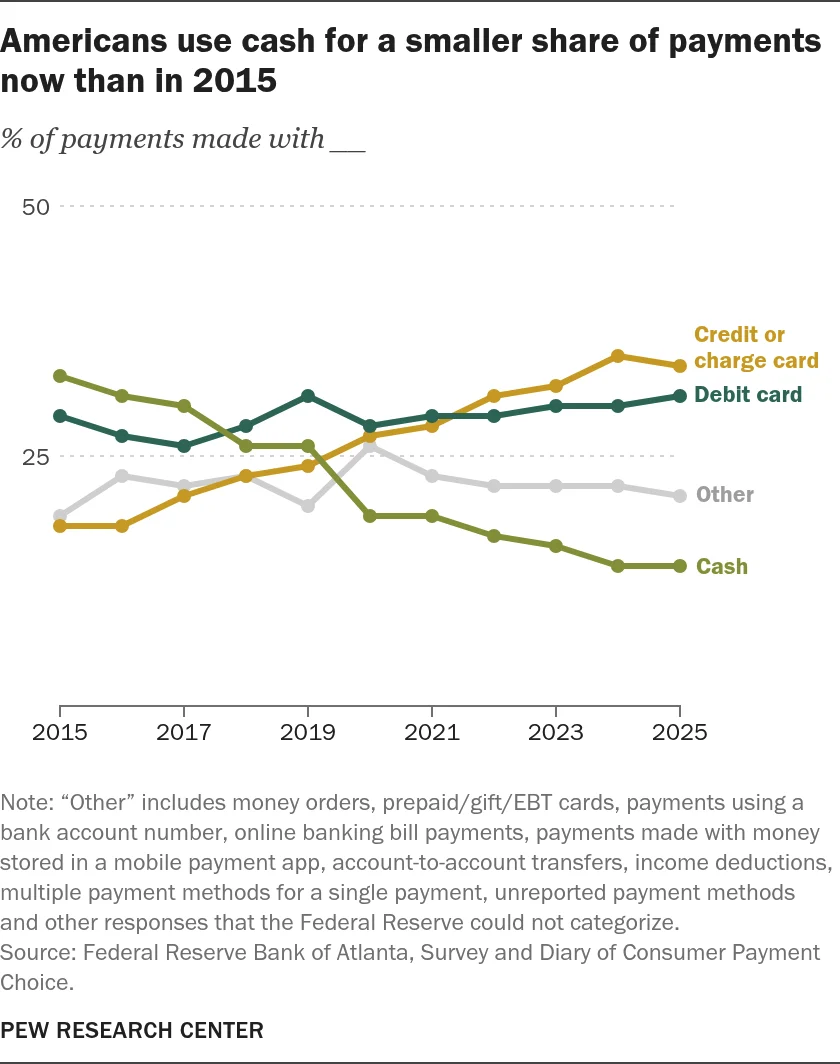
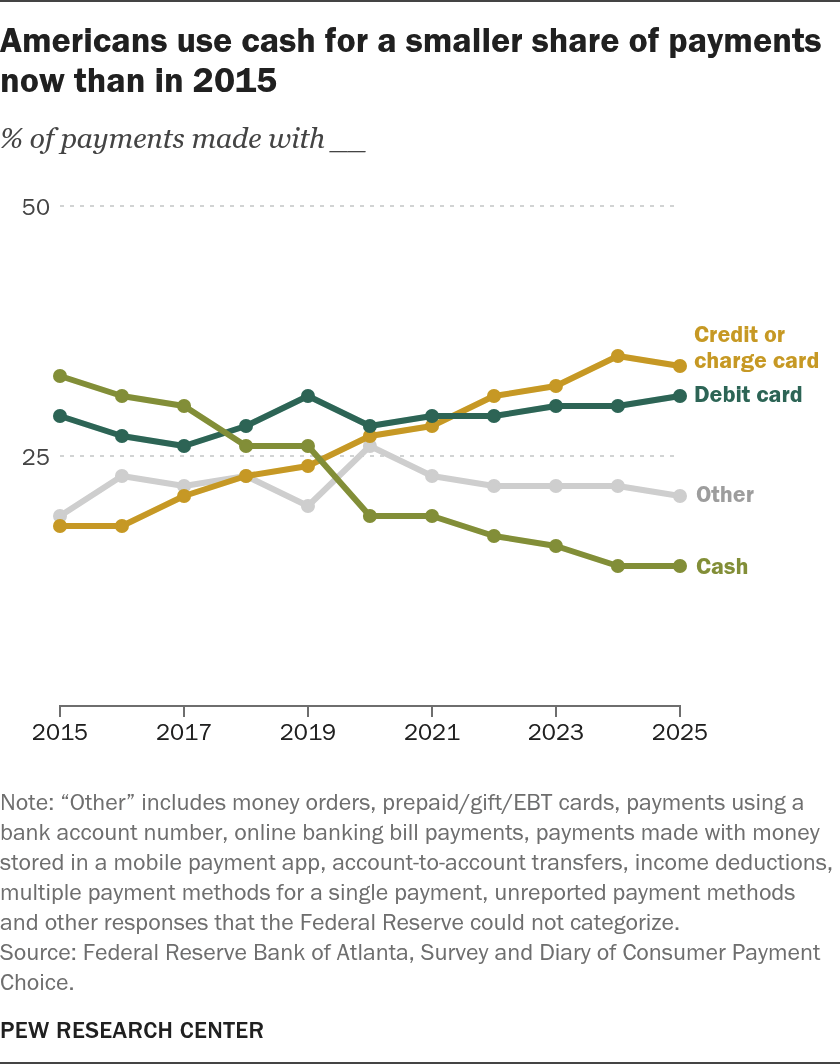
This decline is reflected in the overall volume of payments. In 2015, cash was the undisputed leader in retail transactions, accounting for roughly one-third of all payments. Today, that figure has dwindled to just 14%. As physical money loses its status as the default medium of exchange, it has been systematically supplanted by credit and debit card networks, which offer a combination of convenience, security, and integration with modern digital banking ecosystems.
A Chronology of the Shift: From Paper to Plastic
The transformation of the American payment landscape can be traced through a distinct timeline of evolving consumer behavior.
- 2015: The Peak of Traditionalism: At the start of the decade, cash remained the primary tool for commerce. While debit and credit cards were widely available, the public preference for the tactile nature of cash remained strong. Debit cards trailed cash at 29%, with credit cards accounting for 18%.
- 2018: The Tipping Point: A major milestone occurred in 2018 when, for the first time in modern records, the volume of debit card transactions surpassed the volume of cash transactions. This signaled that the convenience of “tapping” or “swiping” had officially outweighed the habit of carrying physical currency.
- 2020–2021: The Pandemic Catalyst: The COVID-19 pandemic acted as an accelerant for the cashless movement. Concerns over hygiene, combined with the rapid expansion of e-commerce and contactless delivery services, caused cash usage to drop from 26% in 2019 to 19% in 2020. This period forced even the most hesitant consumers to adapt to digital payment terminals.
- 2022: The Credit Card Takeover: In 2022, a new hierarchy was established: credit cards officially became more frequently used than debit cards. This shift reflects a growing consumer desire for the rewards, fraud protections, and credit-building capabilities inherent in credit card usage.
- 2025–2026: The Digital Dominance: As of the latest data, credit cards account for 34% of all transactions, with debit cards capturing 31%. Together, these two plastic-based methods represent nearly two-thirds of all payments made in the United States, effectively relegating cash to a distant third-place position.
Supporting Data: Transaction Values and Behavioral Patterns
The data provided by the Federal Reserve Bank of Atlanta offers a granular look at why these trends persist. Payment choice is not random; it is highly correlated with the dollar value of the transaction.
The Economics of Payment Choice
There is a clear hierarchy in how Americans choose to pay based on the size of the purchase. The average value of a cash transaction in 2025 was $58. In contrast, consumers opted for debit cards for transactions averaging $74, and credit cards for those averaging $80.
This suggests that for everyday, mid-sized retail purchases, consumers have internalized a preference for cards. However, the data reveals a different story for large-scale financial obligations. Payments made via checks, account transfers, and online banking platforms—methods that require more administrative effort—tend to be significantly larger, averaging between $400 and $700. These methods are rarely used for daily retail, but they remain the backbone of the "bill-pay" economy. Meanwhile, mobile payment apps occupy a middle ground, often used for person-to-person transfers or smaller, quick-service retail payments with an average transaction value of $98.
Preference vs. Practice
A crucial takeaway from the research is the discrepancy between what people do and what they prefer. Nine out of ten in-person credit and debit card transactions are made by people who explicitly want to use those methods. Conversely, 70% of cash transactions are made by people who would prefer to use a card but are perhaps using cash due to store policies, small transaction amounts, or personal budgeting habits. This data suggests that the "cashless" trend is being driven by consumer desire rather than mere merchant enforcement.
Implications for the Future of Commerce
The move toward a cashless society has profound implications for stakeholders across the economy, ranging from federal regulators to small business owners.
For Consumers: Convenience vs. Exclusion
For the average consumer, the shift to digital payments offers unprecedented convenience. Mobile wallets, integrated banking apps, and the widespread acceptance of contactless payments have reduced transaction times and streamlined record-keeping. However, the decline of cash risks marginalizing vulnerable populations, including the "unbanked"—individuals who lack access to traditional bank accounts and rely entirely on physical currency. Financial inclusion remains a critical challenge as the economy pivots away from the one payment method that is universally accessible.
For Businesses: Speed vs. Cost
For retailers, the shift is a double-edged sword. While digital payments allow for faster throughput at the point of sale, they come with transaction fees that cut into profit margins. Merchants must balance the cost of payment processing against the reality that consumers increasingly walk away from businesses that do not accept their preferred digital payment methods.
The Role of Policy and Regulation
The Federal Reserve continues to monitor these shifts to ensure the integrity of the U.S. payment system. The "Survey and Diary of Consumer Payment Choice" serves as a vital tool for policymakers tasked with maintaining stability in an era of rapid technological disruption. As the role of the central bank evolves, questions regarding the potential for a Central Bank Digital Currency (CBDC) or further regulation of private payment networks will likely dominate economic discourse in the coming years.
Conclusion: A New Financial Reality
The landscape of American consumerism has undergone a permanent, structural change. The data from the past decade is unequivocal: Americans have largely migrated from the wallet-full-of-cash era to a digital-first existence. While the physical dollar bill may not disappear entirely, its role in daily commerce has been irrevocably diminished.
As we look toward the future, the challenge will not be in preventing the decline of cash, but in ensuring that the new digital infrastructure is inclusive, secure, and resilient. The transition from paper to plastic is complete; the next phase of the financial evolution will likely focus on the integration of artificial intelligence in fraud detection, the expansion of instant payment networks, and the continued struggle to bridge the digital divide for all Americans. The way we pay is a mirror of the way we live, and for the modern American, that life is increasingly fast, digital, and connected.
About the Author