In the high-stakes world of corporate leadership, the ability to pivot is often touted as a primary virtue. However, when the lifeblood of a company—cash flow—is suddenly altered, the response of a Chief Executive is rarely a singular, calculated strategy. Instead, it is an exercise in instinct, shaped by ownership structure, current liquidity levels, and the looming shadow of macroeconomic uncertainty.
A groundbreaking study by Chief Executive Research has peeled back the curtain on these behavioral reflexes, surveying 321 U.S. CEOs to determine how they would react to sudden, unexpected liquidity fluctuations. By presenting hypothetical scenarios involving a one-time cash-flow shock—equal to 5, 10, or 20 percent of annual revenue—the study forced leaders to reveal their hidden priorities. The results provide a fascinating window into the "corporate nervous system," revealing that how a leader reacts to a sudden windfall or a sudden shortfall tells us more about the broader economy than traditional balance-sheet analysis ever could.
The Mechanics of the Study: Measuring Instinct
The survey, conducted in early July, was designed to test pure leadership instinct rather than long-term strategic planning. By assigning these hypothetical shocks randomly, the researchers stripped away the context of actual performance, forcing CEOs to rely on their established management philosophies.
Damjan Pfajfar, who leads the Center for Inflation Research at the Federal Reserve Bank of Cleveland, emphasizes the systemic importance of these findings. "This data provides useful information about the margins of adjustments and the role of the financial sector in smoothing short-term shocks," Pfajfar stated. By identifying which levers CEOs pull—whether they burn reserves, throttle spending, or seek credit—we gain a clearer picture of how the American economy might behave during periods of extreme volatility, such as those witnessed during the 2008 financial crisis or the onset of the COVID-19 pandemic.
Chronology of a Crisis: How Leaders React
While every business is unique, the study reveals a distinct hierarchy in how CEOs respond to liquidity changes.
The Windfall Response
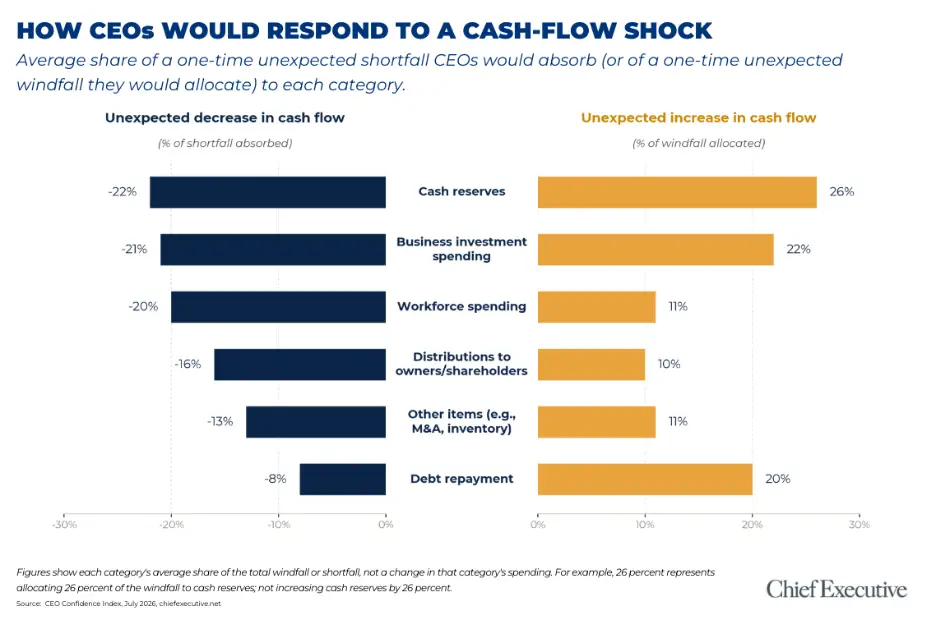
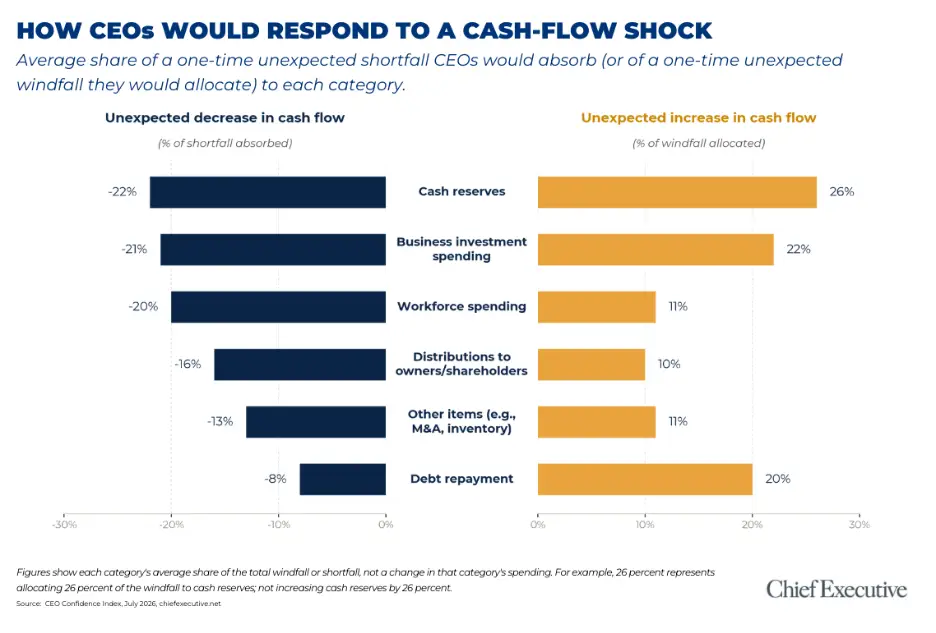
When presented with an unexpected cash infusion, the average CEO is surprisingly conservative. Rather than immediately reinvesting in aggressive growth, 46 percent of respondents indicated they would prioritize cash reserves and debt repayment. Only about 32 percent would direct that capital toward workforce expansion or business investment.
This defensive posture is heavily influenced by the prevailing economic sentiment. CEOs who anticipate a recession or an economic slowdown are significantly more likely to hoard cash, with 52 percent of them funneling windfalls into reserves and debt, compared to 44 percent of those who hold an optimistic view of the economy.
The Shortfall Response
Conversely, when faced with a cash-flow deficit, CEOs do not panic-sell or slash one department to save another. Instead, they demonstrate a balanced, almost surgical approach to austerity. The shortfall is typically absorbed through a proportional reduction across three main pillars: cash reserves, business investment, and workforce spending. Notably, debt repayment is the most protected lever, with only 8 percent of CEOs willing to slow down their debt obligations to cover a shortfall.
Ownership Matters: The Hidden Variable
One of the study’s most significant findings is the profound impact of ownership structure on decision-making. The traditional view of the "corporate leader" obscures the fact that a CEO’s mandate is dictated by who holds the strings.
Non-Profits: The Growth Engine
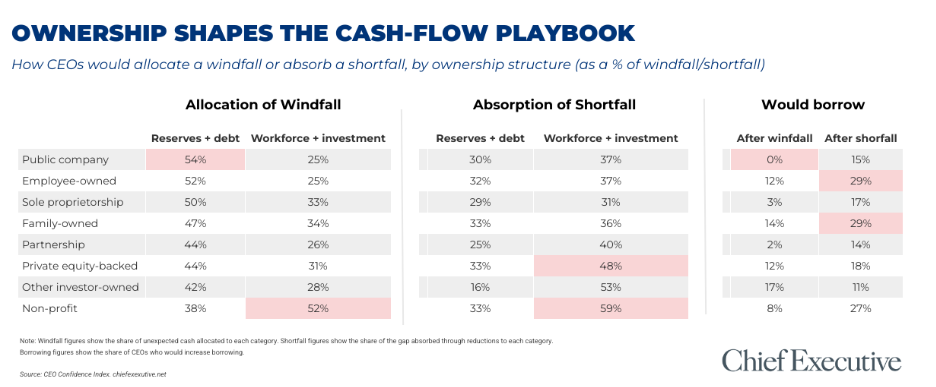
Perhaps counterintuitively, non-profit organizations emerge as the most growth-oriented entities in the survey. Free from the pressure of shareholder dividends, non-profit CEOs are willing to push a windfall back into the business, with 52 percent of extra cash allocated to workforce and investment. In a downturn, they are equally aggressive in their internal adjustments, absorbing 59 percent of a shortfall through cuts to those same operational areas.
Public Companies: The Defenders of Value
Public companies operate at the opposite end of the spectrum. CEOs of publicly traded firms are the most likely to prioritize the balance sheet, directing 54 percent of any windfall toward reserves and debt. Their reluctance to borrow is also high; they are among the least likely to seek credit to cover a shortfall, preferring to manage the shock through internal adjustments rather than external debt.
Private Equity and Family-Owned Firms
Private equity (PE)-backed companies present a complex profile. While one might expect PE-backed leaders to be hyper-aggressive, they allocate about 31 percent of windfalls to growth, a figure that sits squarely in the middle of the pack. Where they distinguish themselves is in their treatment of owners: PE-backed companies are the least likely to cut distributions to investors during a shortfall (only 5 percent), whereas family-owned firms and sole proprietorships are far more likely to reduce payouts (22 percent) to protect the underlying business.
Liquidity: The Great Dividing Line
The study highlights that "runway"—the amount of cash and credit a company has on hand—is the ultimate determinant of a CEO’s behavioral flexibility.
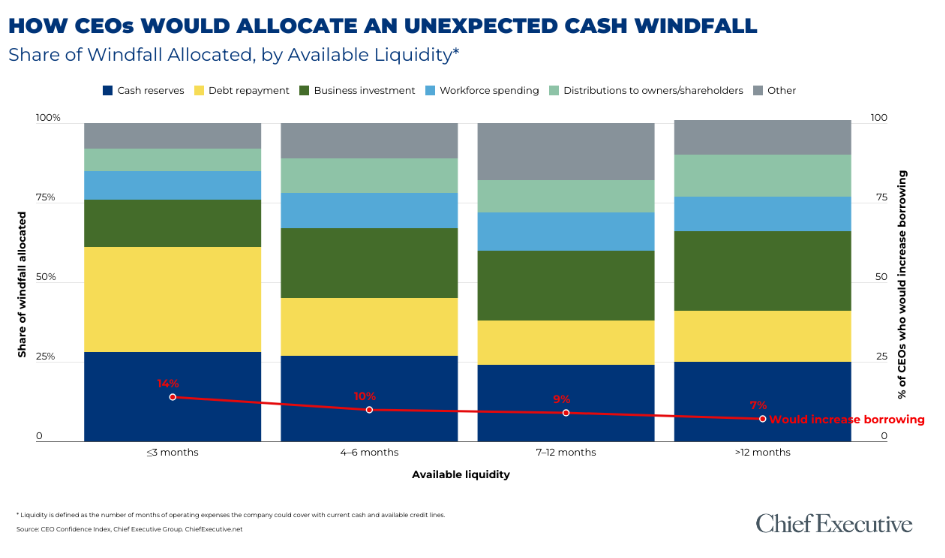
Approximately one-quarter of the surveyed CEOs operate with three months or less of runway. For these leaders, the decision-making process is fraught with tension. When these "thin-cushion" companies receive a windfall, they do not splurge; they reinforce their defenses. They direct 61 percent of that cash toward reserves and debt—a marked contrast to companies with over a year of runway, which feel more comfortable allocating that cash toward growth.
The divergence is even more stark during a shortfall. Companies with limited liquidity are forced to rely heavily on borrowing (43 percent of these CEOs would take on debt to cover the gap) compared to just 8 percent of companies with a strong, long-term cash cushion.
Implications for the Broader Economy
The implications of these behaviors extend far beyond the boardroom. When corporate leaders across the nation act in lockstep—hoarding cash during uncertainty or cutting labor costs during a contraction—the collective impact can exacerbate or mitigate a macroeconomic cycle.
Maurice Ware, CEO of the Kenneth Young Center, summarizes the delicate balancing act: "The goal would be to protect the mission, stabilize operations, invest where there is measurable return, and avoid decisions that solve a short-term issue while creating a larger structural problem later."
This focus on long-term sustainability is a recurring theme. The reluctance to use debt as a first-line solution—with over 70 percent of CEOs choosing to absorb shocks through other levers rather than taking on new debt—suggests that American businesses are, by and large, risk-averse regarding leverage. However, as the size of the shortfall increases, so does the propensity to borrow, particularly among those with lower liquidity, suggesting that borrowing remains a "last resort" that becomes increasingly attractive as the situation grows dire.
The Future of Corporate Resilience
As the global economy faces ongoing challenges, from inflationary pressures to supply chain volatility, the data from Chief Executive Research provides a vital benchmark for leaders. Understanding how one’s peers respond to cash-flow volatility allows for better benchmarking and more thoughtful capital allocation strategies.
Ultimately, the study suggests that the most resilient companies are those that have built sufficient "runway" to avoid being forced into reactive, short-term decision-making. Whether a CEO is a steward of a non-profit, a public entity, or a family-owned firm, the ability to balance immediate cash discipline with the long-term mission remains the gold standard of executive leadership. As James Loftis, Jr., CEO of Loftis/Robbins, noted: "I only borrow money based on two scenarios: opportunity and debt recovery calculations." That level of disciplined, strategic thinking is what defines the most successful organizations in the face of an unpredictable future.
About the Author