In a landscape defined by economic ambiguity, the U.S. manufacturing sector has emerged as an unlikely beacon of stability. According to the latest CEO Confidence Index—fielded between September 1 and 3, 2026, among more than 150 U.S. chief executives—the manufacturing sector has decoupled from the broader corporate sentiment. While non-manufacturing sectors experienced a sharp 6 percent decline in confidence, manufacturing held its ground, effectively taking the lead in current and future outlooks for the first time in 2026.
However, beneath this veneer of stability lies a complex and fracturing reality. A widening chasm is developing between industrial and consumer goods producers, while profit margins are coming under intense pressure. As CEOs navigate a maze of geopolitical instability, shifting demand, and inflationary headwinds, the industrial engine of the American economy is attempting to balance expansionary investment with the harsh realities of tightening liquidity.
The State of the Sector: A Chronology of Sentiment
For much of 2026, manufacturing confidence trailed the broader CEO population, averaging a score of 5.6 on current conditions compared to 5.7 for the aggregate CEO population. September represented a critical inflection point in this narrative.
The CEO Confidence Index measures business conditions on a scale of 1 to 10, where 1 represents poor and 10 signifies excellence. In August, manufacturing sentiment reached a 2026 high of 5.8. September saw this number remain unchanged—a static result that, in a cooling economic environment, paradoxically elevated the sector to the front of the pack.
Conversely, the non-manufacturing sector, which includes services, retail, and hospitality, saw its rating drop from 6.1 in August to 5.7 in September. This represents a significant reversal of fortunes. Throughout the year, manufacturers have maintained a 12-month outlook average of 6.1, while non-manufacturers have lagged at 6.0. The September data confirms that this gap is now the widest it has been since June, signaling a fundamental shift in how different sectors perceive the path forward.

Supporting Data: Confidence, Growth, and Inflationary Pressures
The divergence is most apparent in how CEOs view the 12-month horizon. While manufacturers saw a marginal easing in their year-ahead forecast—dropping from 6.1 to 6.0—non-manufacturers fell more sharply to 5.8, marking their weakest outlook since March.
Optimism, while thinning, remains more prevalent in factories than in offices. Forty-seven percent of manufacturers anticipate improved conditions a year from now, a notable jump from 41 percent in August. This stands in stark contrast to the non-manufacturing cohort, where only 31 percent share that level of optimism.
The Economic Outlook Split
The six-month economic outlook reveals a stark contradiction in market sentiment:
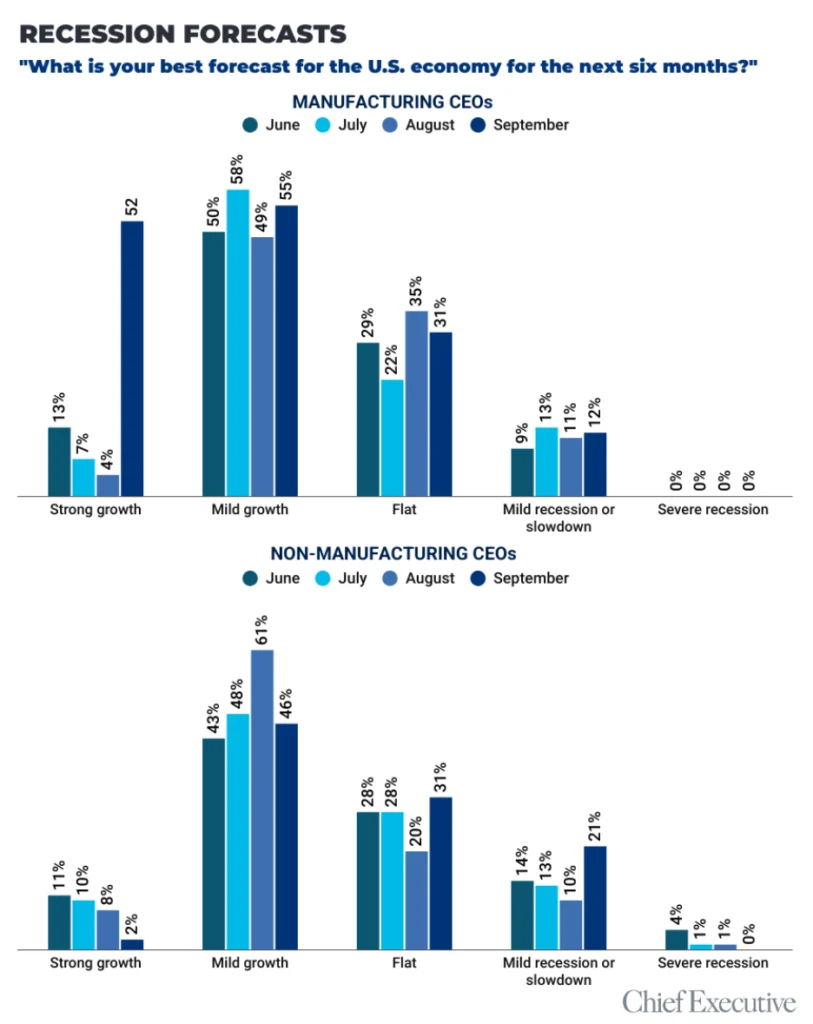
- Manufacturing Growth: 57 percent of manufacturing CEOs forecast growth (up from 54 percent in August), with the share expecting flat conditions falling to 31 percent. Notably, for the second consecutive month, no manufacturing CEO predicted a severe recession.
- Non-Manufacturing Contraction: In a sharp reversal, only 48 percent of non-manufacturing CEOs forecast growth, down from 69 percent in August. The proportion of those anticipating a mild recession or economic slowdown has doubled, rising from 10 percent to 21 percent.
However, the optimism is tempered by inflation. Manufacturers now expect headline CPI to run at 3.7 percent over the next year, an increase from 3.5 percent in August. Alarmingly, 35 percent of manufacturers now anticipate inflation rates of 4 percent or higher, placing downward pressure on real profit margins.
The Industrial vs. Consumer Divide
The most critical narrative emerging from the September data is the widening split between industrial and consumer goods producers. The "manufacturing" label is no longer a monolith.

Industrial goods manufacturers are currently more bullish, rating current conditions at 6.0 and projecting a 6.2 for the year ahead. Consumer goods producers, feeling the bite of a more cautious household, rate conditions at a much lower 5.1, with a tempered 12-month forecast of 5.5.
Perspectives from the Frontlines
The reasons for this gap are as varied as the products being manufactured.
- The Industrial Pulse: For many industrial firms, the outlook is buoyed by specific capital-intensive sectors. A mid-sized industrial CEO in New Jersey pointed to "data centers and general construction pick up" as the primary drivers of their optimism.
- The Consumer Softening: Conversely, the consumer sector is facing a different reality. A mid-sized consumer manufacturer in Michigan, acting as a contract partner for major brands, reported: "All of them are much softer in demand than originally forecasted."
- Energy and Geopolitics: Cost pressures are also unevenly distributed. A Massachusetts-based consumer manufacturer noted, "Geopolitics have increased the cost of energy dramatically and is affecting many parts of the business."
This sentiment is echoed by firms with global footprints. A North Carolina industrial CEO identified a cumulative drag on operations, citing "uncertainty in the marketplace due to the Iran war, tariffs, inflation, and interest rates."
Official Responses and Strategic Implications
The squeeze on profitability is arguably the most significant development in the September data. While revenue expectations remained relatively steady, profit expectations plummeted. The gap between revenue and profit outlooks widened from 7 points in August to 12 points in September.
One in five manufacturers now expects profits to fall this year, up from one in six just a month prior. Even more concerning, the number of CEOs bracing for a profit decline of 20 percent or more has more than doubled to 10 percent.

Strategic Pivots
How are firms responding to this pressure? The data suggests a two-pronged strategy:
- Inventory Management: 56 percent of manufacturers are prioritizing a reduction in inventory levels over the next 12 months, a defensive move to protect liquidity. In contrast, only 21 percent of non-manufacturers are taking similar actions.
- Payment Terms: 31 percent of manufacturers are looking to stretch supplier payment terms, signaling that cash flow management is becoming a high-priority survival tactic.
- Capital Allocation: Despite these pressures, the sector has not abandoned its long-term growth plans. Capital spending intentions remain stable, and the share of manufacturers planning to increase headcount rose to 49 percent from 45 percent in August.
The role of Washington remains a point of contention. For non-manufacturers, policy and politics are the primary drivers of uncertainty (cited by 44 percent of respondents). Manufacturers are less focused on politics (31 percent) and more concerned with the practical, compounding effects of tariffs, demand fluctuations, and supply chain costs. As one Illinois-based industrial CEO succinctly put it: "Tariffs threatening cash."
Conclusion: A Sector in Transition
The September CEO Confidence Index paints a picture of a manufacturing sector that is resilient but increasingly strained. By holding its ground while other sectors retreat, manufacturing has demonstrated its role as the backbone of the economy. However, the internal divergence between industrial and consumer producers, combined with a tightening grip on liquidity and a sharp decline in profit expectations, suggests that the "stability" currently observed may be fragile.
As the year approaches its final quarter, the ability of these firms to maintain their hiring and capital investment plans will depend largely on whether they can navigate the tightening margin environment without succumbing to the liquidity traps signaled by rising tariff costs and slowing consumer demand. For now, the manufacturing sector remains in the driver’s seat of the U.S. economy, but it is a vehicle navigating an increasingly difficult and uncertain road.
About the Author