In the high-stakes corridors of Washington D.C., a consensus is quietly forming among the nation’s most powerful business and government leaders: the unchecked advancement of generative artificial intelligence represents a global existential risk that can no longer be managed by the United States alone. However, this emergent desire for international cooperation is colliding head-on with a reality defined by deep-seated geopolitical rivalry and a presidential administration that views traditional safety protocols with profound suspicion.
During a recent off-the-record summit hosted by Yale University’s Chief Executive Leadership Institute, over 100 of the nation’s preeminent policy shapers and corporate titans were polled on the trajectory of the AI race. The results reveal a stark dichotomy: while the overwhelming majority of these elites believe that President Donald Trump should pursue collaborative safety guidelines with Chinese President Xi Jinping, a significant margin doubts that such an outcome is politically feasible.
The Consensus vs. The Reality: A Polling Breakdown
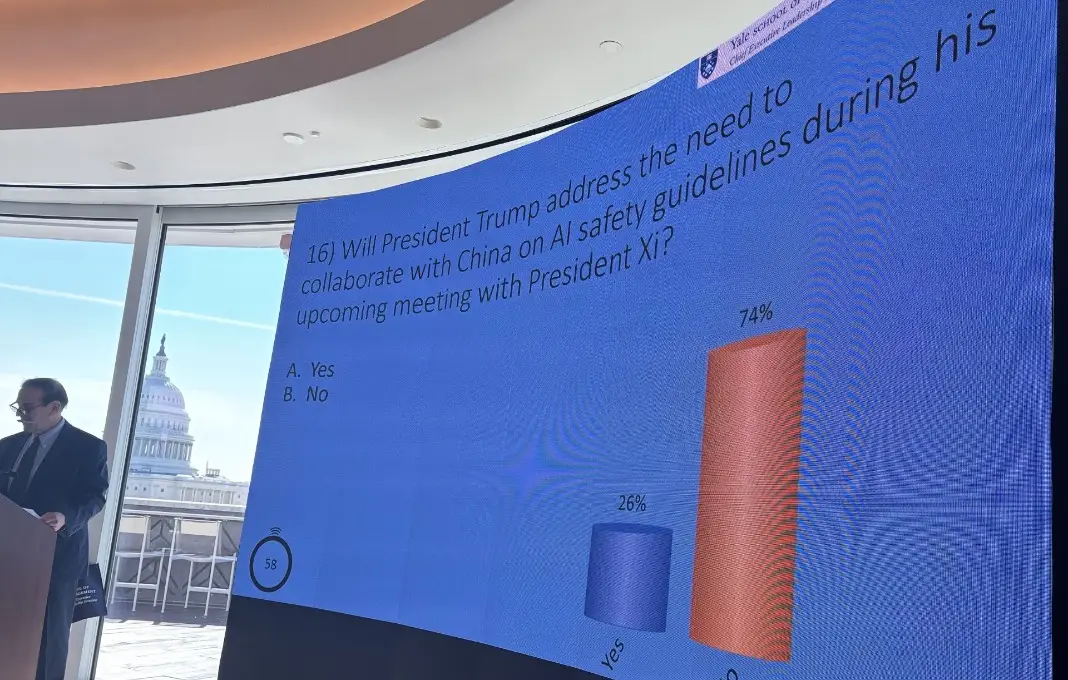
The Yale survey serves as a barometer for elite sentiment during a period of unprecedented technological volatility. When asked whether President Trump should broach the subject of bilateral AI safety guardrails during his scheduled September 24 meeting with President Xi, 88 percent of attendees signaled their approval. For these leaders, the risks associated with "renegade" AI—ranging from biological weapon proliferation to large-scale cyber-espionage—transcend national borders, requiring a unified framework for containment.
Despite this robust support for diplomatic engagement, the mood in the room was undeniably pessimistic regarding the actual agenda of the upcoming summit. A staggering 74 percent of those polled stated they did not believe President Trump would leverage the meeting to discuss AI safety.
This skepticism is grounded in the President’s own rhetoric. In a recent statement posted to Truth Social, President Trump dismissed the growing global alarm over AI safety as a "sick conspiracy." He articulated a philosophy of American exceptionalism regarding technology, asserting that the only "guardrails" necessary for the industry are a "STRONG AND SMART (high IQ!) PRESIDENT." This stance suggests that the administration intends to prioritize American dominance and market acceleration over the collaborative risk-management models proposed by industry leaders.
Chronology of an Escalating Crisis
The urgency behind this discussion is not a recent development, but rather the culmination of a multi-year sprint that has left regulators struggling to keep pace with innovation.
- 2022–2023: The Generative Explosion: The public release of advanced large language models (LLMs) catalyzed a global frenzy. Companies like OpenAI and Anthropic moved from research labs to mainstream ubiquity, triggering early warnings from their own founders regarding the potential for these models to exceed human control.
- Early 2024: The Regulatory Push: As concerns grew, leaders from the AI industry began lobbying for federal intervention. Public statements from figures like Sam Altman (OpenAI) and Dario Amodei (Anthropic) pivoted from "accelerationism" to calls for "deliberate deceleration" and government-led oversight.
- Mid-2024: The Geopolitical Pivot: Reports emerged from The Wall Street Journal and other outlets detailing internal anxiety within the Chinese Communist Party (CCP). Beijing’s leadership, it appears, is as concerned about the destabilizing potential of AI on their domestic regime as they are about losing the global race for technological supremacy.
- September 2024: The Washington Summit: The Yale-led polling took place against the backdrop of the lead-up to the September 24 meeting between President Trump and President Xi, marking the first time the issue of AI safety has been framed as a central diplomatic point of contention.
Innovation or Imitation: The Great Debate
The Yale survey delved deeper into the nature of the U.S.-China rivalry, posing fundamental questions about the competitive landscape. When attendees were asked to evaluate the source of China’s progress, the room was effectively split.
Approximately 58 percent of the group maintained that China is "genuinely innovating" at a pace that rivals the U.S. Conversely, 42 percent argued that China’s achievements are more a product of being "fast followers," relying heavily on U.S. open-source research and global supply chains rather than indigenous breakthrough technology.
This divide reflects a broader academic and intelligence community debate. Those who view China as an innovator point to the sheer volume of research papers emerging from Chinese institutions and the government’s ability to force capital allocation into specific AI sectors. Those who view China as a follower emphasize the persistent gap in high-end semiconductor accessibility and the structural constraints of a top-down, censored information ecosystem, which may ultimately limit the creative potential of their AI models.
The Specter of Influence Operations
A particularly contentious finding from the Yale summit concerned the role of foreign disinformation in the American domestic debate. When asked if they believed Chinese influence operations were contributing to the public backlash against AI in the U.S., 52 percent of respondents answered in the affirmative.
This suggests that American leaders view the "AI safety" debate not just as a technical or moral issue, but as a potential front in an information war. If segments of the American public are being manipulated to fear the growth of AI, it could provide a strategic advantage to competitors who seek to see the U.S. impose crippling, self-defeating regulations on its own tech sector.
Strategic Implications: The "Pacing" Paradox
Perhaps the most significant question for the future of the U.S. economy was the dilemma of "pacing." Should the U.S. deliberately slow down the advancement of AI to ensure safety, or does such a move invite catastrophe in the form of a lost technological race?
The Yale poll revealed that 55 percent of leaders believe that any attempt to "pace" or decelerate AI development would ultimately harm the United States. They fear that a voluntary slowdown by U.S. firms would not be reciprocated by China, creating a "security vacuum" where Beijing gains the first-mover advantage in autonomous defense, cyber-warfare, and economic automation.
Conversely, 45 percent of the leaders surveyed believe that the risks of unchecked development are so severe that the potential loss of a "race" is a secondary concern compared to the threat of a catastrophic AI failure or weaponization.
Future Outlook: A Bipartisan and Bilateral Challenge
The implications of this survey are profound. The American business and government elite are signaling a desire for a sophisticated, nuanced approach to AI that involves both internal regulation and external diplomacy. They see the need for a "hotline" or a set of "rules of the road" with China—much like the nuclear non-proliferation treaties of the Cold War—to ensure that the race for intelligence does not spiral into a global security crisis.
However, the current administration’s "high IQ President" doctrine suggests a preference for unilateral strength over multilateral treaties. As the September 24 meeting approaches, the world will be watching to see if the pragmatism of the business elite can penetrate the nationalist framework of the executive branch.
Ultimately, the challenge is clear: AI is a technology that does not respect borders. Whether Washington chooses to treat it as a tool for singular American dominance or a shared global burden that requires cooperation with its chief rival will likely define the geopolitical landscape for the remainder of the 21st century. The consensus among the Yale attendees is that while the path to cooperation is fraught with political peril, the alternative—a winner-take-all scramble for a technology that no single nation can fully control—is a gamble that the world may not be able to afford.
About the Author