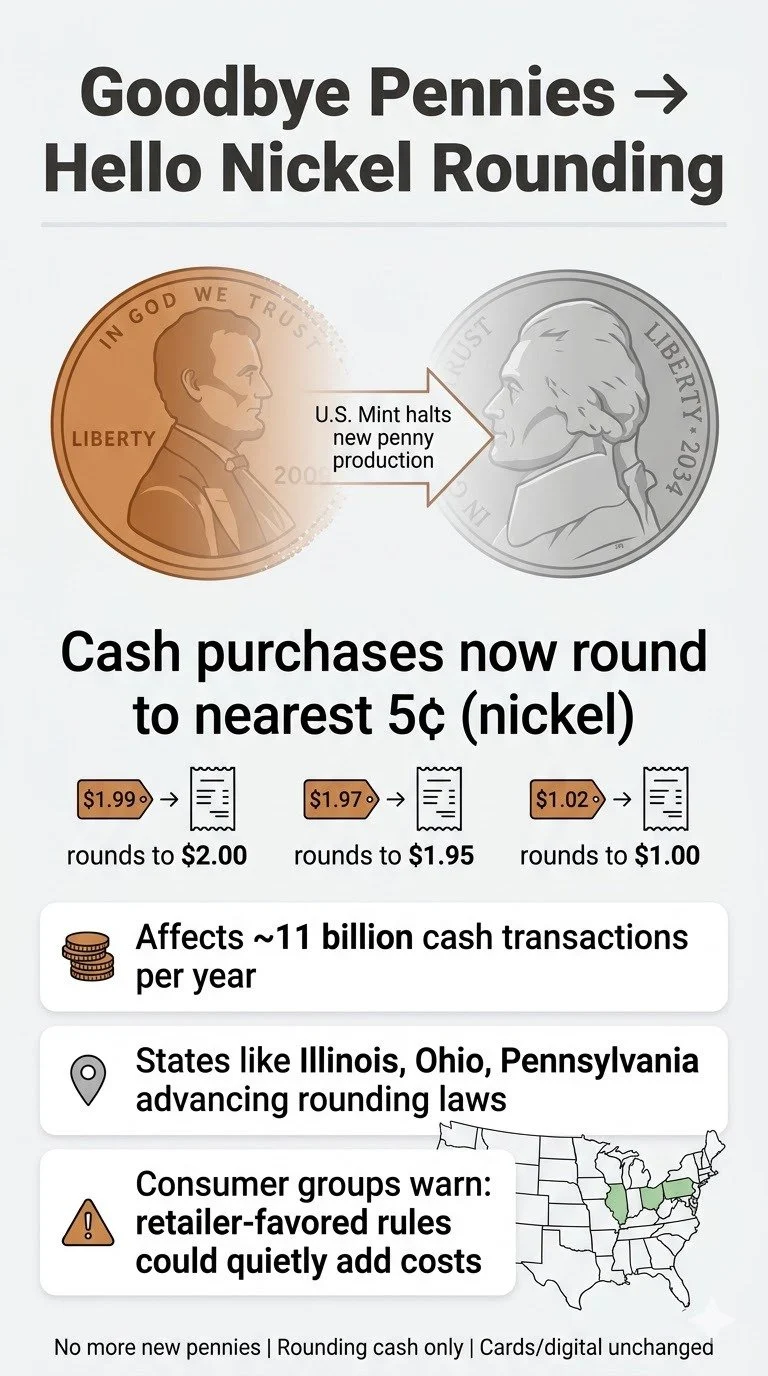
The humble copper-plated coin, once a staple of the American pocket, is nearing the end of its functional life. As the United States Mint quietly throttles the production of new pennies, the American retail landscape is facing a logistical reckoning. With the supply of one-cent pieces dwindling, state legislatures across the country have launched a frantic legislative scramble to establish new standards for cash transactions, specifically focusing on the practice of rounding to the nearest nickel.
This transition marks a significant shift in the mechanics of everyday commerce. While digital and card-based payments—which account for the vast majority of modern transactions—remain unaffected due to their ability to process fractional currency, cash remains a vital medium of exchange. In 2023 alone, cash was utilized in approximately 18 percent of all point-of-sale transactions. As these coins vanish from circulation, the lack of a standardized federal policy has left retailers and consumers in a state of growing uncertainty.
The Legislative Domino Effect: A State-by-State Breakdown
The vacuum left by the declining availability of pennies has prompted at least six state legislatures to introduce bills designed to govern the "rounding" of cash purchases. This legislative trend, highlighted in recent reports by PBS News, signals a move toward a post-penny economy that lacks federal oversight.
The Landscape of Proposed Legislation
Currently, Illinois, Ohio, and Pennsylvania are at the forefront of this movement. However, these states are approaching the issue with vastly different philosophies. The central tension lies in whether the rounding process should favor the consumer, the retailer, or adhere to a neutral, purely mathematical model.
- Illinois: Representing the most aggressive stance, the Illinois legislature is currently championing a bill that mandates rounding in favor of the consumer. The bill, which successfully advanced out of committee last week, includes punitive measures for non-compliance, with potential fines reaching $500 per violation. A pivotal floor vote is scheduled for April 12.
- New York: In a departure from the strict mandates seen elsewhere, New York’s proposed legislation takes a more flexible approach. It would allow individual retailers to determine their own rounding methodology, provided they post clear, visible signage at every point of sale to inform customers of the specific policy in effect.
This patchwork of regulations is already drawing fire from industry experts, who warn that the lack of a centralized, national standard will inevitably lead to operational chaos for multi-state retailers.
Chronology: How We Arrived at the "Penny Problem"
The decline of the penny has been a slow-moving evolution, spanning decades of economic debate and inflationary pressures.
- 1980s–2000s: The rising cost of zinc and copper, combined with the increasing labor and distribution costs associated with small-denomination coins, makes the penny increasingly expensive to produce. The U.S. Mint consistently reports that it costs more than one cent to manufacture and distribute a single penny.
- 2013: Canada officially eliminates the penny from its currency system, opting for a "balanced rounding" approach. The transition is widely considered a success, with minimal impact on consumer purchasing power and high levels of public acceptance.
- 2020–2023: As contactless payments and digital wallets explode in popularity due to the COVID-19 pandemic, the velocity of cash circulation slows significantly. The U.S. Mint begins a gradual reduction in penny production as part of a strategic shift toward digital currency modernization.
- Early 2024: Retailers report a noticeable shortage of pennies in circulation, leading to the first wave of legislative action in state houses across the U.S.
Supporting Data: The Economic Implications of Rounding
The stakes of this transition are higher than they appear on the surface. Federal Reserve data indicates that there are approximately 11 billion cash transactions annually in the United States. Even a minor adjustment of a few cents per transaction carries massive economic weight.
The Consumer-Retailer Tug-of-War
Consumer advocacy groups have raised alarms regarding the potential for "rounding creep." If retailers are permitted to round in their favor—essentially rounding up to the nearest nickel on every transaction—the cumulative effect could be staggering. Analysts suggest that such policies could extract an average of two cents per transaction from the shopper, potentially resulting in a transfer of hundreds of millions of dollars from the pockets of consumers to the coffers of retail chains.
Conversely, retailers argue that the administrative burden of handling pennies—which involves counting, rolling, and depositing small change—is an inefficient use of labor. The National Retail Federation (NRF) notes that while the change in value per transaction seems negligible, the cost of implementing inconsistent software across different states is a genuine threat to business operations.
Official Responses: The Call for Federal Guidance
The retail industry is speaking with one voice: they are pleading with Congress to step in. The prospect of operating under 50 different sets of rounding rules is viewed as a logistical nightmare for national chains.
The "Chaos" Factor
Jason Miller, chief policy officer at the Retail Industry Leaders Association, has been vocal about the dangers of a fractured legislative environment. "We need uniform standards, or you’ll have a retailer rounding down in Michigan and rounding up in Indiana," Miller stated. "That creates chaos in daily operations and consumer confusion."
The NRF has reinforced this sentiment, arguing that the complexity of reprogramming point-of-sale (POS) systems on a state-by-state basis is prohibitively expensive and prone to error. Retailers are essentially asking for a federal "rounding mandate" that would harmonize the process, ensuring that whether a shopper is in Seattle or Savannah, the rounding logic remains consistent and transparent.
Implications: Learning from the Canadian Precedent
As the United States grapples with the transition, many observers are looking toward the northern border. Canada’s experience with the elimination of the penny provides a roadmap for a smooth transition.
When Canada implemented its "balanced rounding" system in 2013, the policy was straightforward: totals ending in 1, 2, 6, or 7 were rounded down, while totals ending in 3, 4, 8, or 9 were rounded up. The result was a statistically neutral outcome. Studies conducted in the aftermath of the change showed that the impact on individual consumers was negligible—less than one cent per purchase on average. Furthermore, Canadian retailers reported almost no consumer backlash once the policy was implemented.
The U.S. situation, however, is complicated by the lack of a nationwide mandate. Without federal intervention, the U.S. runs the risk of a "fragmented economy," where the price of a gallon of milk or a loaf of bread could fluctuate based on the specific rounding laws of a given county or state.
Looking Ahead: The Future of Small Change
The debate over the penny is, at its core, a debate about the evolution of money itself. As the U.S. continues its steady march toward a digital-first economy, the physical coin becomes less of a necessity and more of a nostalgic relic.
For now, the momentum remains with the state legislatures. As Illinois prepares for its April vote, other states are watching closely. If the bill passes, it could set a precedent for consumer-friendly rounding that other states might feel pressured to adopt. However, the looming threat of regulatory "chaos" remains the primary motivator for a potential federal response.
The question remains: will Congress act to preempt this patchwork of state laws, or will it allow the states to serve as a testing ground for the future of cash transactions? Regardless of the legislative path chosen, the days of the penny are clearly numbered. For the average American, the change will be subtle, but the implications for the retail sector and the integrity of the currency are profound. As we transition, the focus will remain on ensuring that the move away from the penny does not result in an unfair financial burden on the consumer, nor an impossible operational hurdle for the merchant.
The death of the penny may be inevitable, but its legacy—and the rules that replace it—will define the next era of American commerce.
About the Author