In the current landscape of American politics, the chasm between public expectation and party performance has become a defining feature of the electorate. New polling data reveals a complex, shifting landscape where voters are increasingly skeptical of both major political parties, particularly when it comes to the most pressing policy challenges of the day. From the economy and healthcare to the rapidly evolving frontier of artificial intelligence, Americans are signaling a profound sense of alienation, often feeling that neither the Republican nor the Democratic Party truly aligns with their vision for the nation’s future.
Main Facts: A Divided Electorate
The core findings of recent survey data underscore a pervasive volatility in voter sentiment. Across a broad spectrum of policy domains—ranging from fiscal responsibility to social issues—the "Neither Party" category has consistently emerged as a significant, and in some cases dominant, force.
While the Republican Party maintains an advantage on issues traditionally viewed as their core strengths, such as crime and immigration, the Democratic Party continues to hold a distinct lead in public perception regarding healthcare, abortion, and environmental policy. However, the most striking takeaway is the sheer number of Americans who report that they do not see their interests reflected by either side of the aisle. When asked about artificial intelligence, for instance, a staggering 51% of respondents opted for the "neither" category, suggesting that both parties have failed to communicate a coherent or reassuring vision on emerging technology.
Chronology: The Erosion of Party Allegiance
The evolution of these sentiments did not occur in a vacuum. To understand the current state of public opinion, one must look at the gradual shift in party alignment over the last several years.
- Pre-2020: The political landscape was marked by more rigid, binary affiliations. Voters were largely defined by their primary party identification, with crossover agreement being a rarity.
- 2020–2022: As the global pandemic and subsequent economic instability took hold, public trust in established institutions began to fracture. The "Neither" category began to gain momentum as voters reacted to the perceived polarization of both parties.
- 2023: The mid-period saw a resurgence of specific issue-based loyalties. While abortion and environmental policy galvanized the Democratic base, Republican messaging on crime and border security solidified their standing in the minds of conservative voters.
- 2024 to Present: We are now seeing a period of "cautious ambiguity." Voters are increasingly moving toward a model of transactional support—agreeing with a party on one specific issue (e.g., the economy) while rejecting them on another (e.g., social or foreign policy).
Supporting Data: Mapping the Policy Divide
A granular look at the data highlights where these battles are being fought.
The Economic Tug-of-War
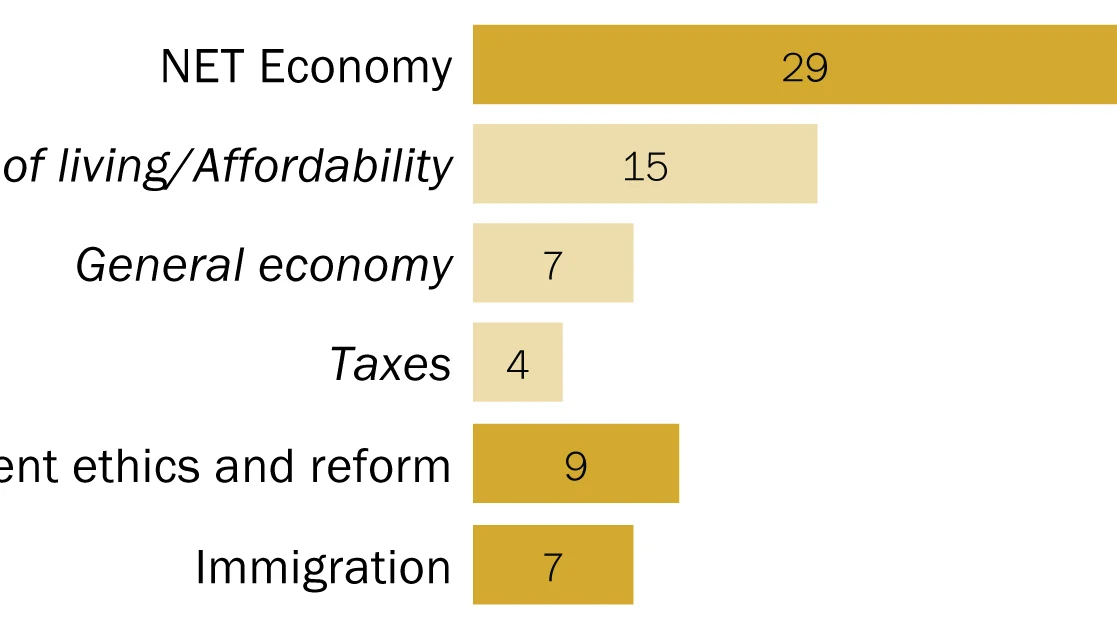
The economy remains the central battleground for American voters. The polling data shows a fluid situation where both parties struggle to maintain a consistent lead. In recent assessments, the Republican Party’s support on economic policy has hovered between 35% and 42%, while the Democrats have maintained a range of 30% to 38%. The fact that approximately 25% of the electorate feels neither party has the right solutions suggests that the "economic anxiety" narrative is not just a slogan, but a deeply felt reality for a quarter of the country.
Social Issues and Polarization
On issues such as LGBTQ+ rights, the divide is more pronounced. The Democratic Party consistently outperforms the GOP, often maintaining a 10-to-15-point lead in voter agreement. However, the GOP has seen a gradual upward trend in its polling on social issues, suggesting a hardening of positions on both sides. Conversely, on the issue of crime, the Republican Party holds a clear, sustained advantage, often polling in the mid-40s, while the Democratic Party struggles to break the 30% threshold.
The "Neither" Phenomenon: A Warning Sign
The most critical data point for party strategists is the "Neither Party" share. On issues like AI policy (51% for "neither") and the budget deficit (33% for "neither"), the data reflects a profound lack of confidence. When more than half of the electorate believes that neither party has a viable path forward for a major issue like artificial intelligence, it signals an institutional failure to engage with the realities of the modern world.
Official Responses: How the Parties See It
Predictably, the two parties view these numbers through starkly different lenses.
The Republican Perspective:
Republican strategists often point to the high numbers in crime and immigration as evidence that their "common sense" approach is resonating. Regarding the "neither" category, the GOP argues that this represents voters who are not necessarily "independent" but rather those who are waiting for a more forceful articulation of conservative values. They contend that as the economy continues to face inflationary pressures, their focus on fiscal restraint and border enforcement will continue to peel voters away from the Democratic column.
The Democratic Perspective:
The Democratic National Committee and its affiliates emphasize their polling advantages in healthcare and climate change as evidence of their alignment with the "future of the country." They argue that their policies on abortion rights and environmental protections represent the "majority view" of the American public. Regarding the "neither" sentiments, Democrats often suggest that this represents a failure of communication rather than a failure of policy, and they are actively working to frame their legislative successes—such as the Inflation Reduction Act—as solutions that the public has yet to fully grasp.
Implications: The Future of the American Political Order
The implications of this polling data are profound for the future of American governance.
1. The Rise of the Issue-Based Voter
The days of "party-line" voting may be waning in favor of an issue-based approach. As voters become more informed and less tribal, they are increasingly likely to switch their support based on the specific policy domain being discussed. This makes the "swing voter" more elusive and more demanding than ever before.
2. The Threat of Political Apathy
Perhaps the most dangerous implication of the high "neither" scores is the risk of apathy. If a large segment of the population feels that no party represents their interests, they are less likely to participate in the democratic process. This could lead to lower voter turnout, increased political cynicism, and a further erosion of the legitimacy of governing institutions.
3. The Need for Policy Innovation
Both parties are currently struggling to address "new-world" problems with "old-world" rhetoric. The overwhelming "neither" response regarding AI is a wake-up call. It suggests that the electorate is looking for leaders who can grapple with the complexities of the 21st century rather than those who are content to fight the battles of the 20th.
4. A Mandate for Moderation
The data suggests that the path to victory in future elections may not lie in further radicalization or base-appeasement, but in capturing the "exhausted middle." With 20-30% of the electorate consistently failing to find a home with either party, there is a significant, untapped demographic waiting for a coherent, pragmatic platform that prioritizes results over rhetoric.
In conclusion, the American electorate is currently in a state of flux. While the major parties continue to exert immense influence over the political process, their hold on the collective imagination of the public is weakening. The numbers tell a story of a nation that is deeply divided, yet simultaneously united in its skepticism of the current political status quo. Whether the parties can pivot to address these concerns, or whether they continue to drift further away from the center, will determine the trajectory of American democracy for decades to come.
About the Author