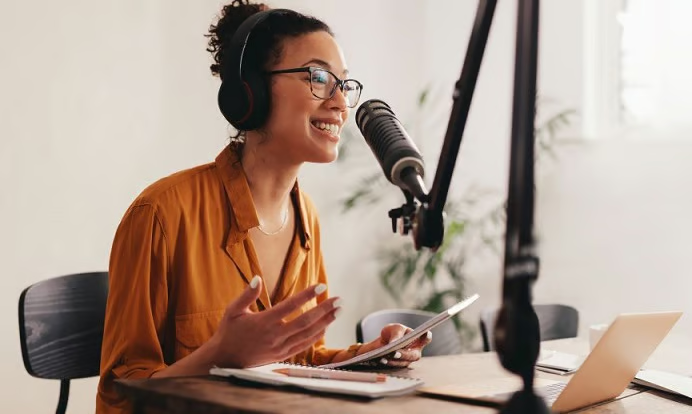
The podcasting medium has transcended its niche origins to become a cornerstone of modern digital media. According to industry research from platforms like Buzzsprout, the podcast listener base surged by 29.5 percent between 2018 and 2021—a growth trajectory that shows no sign of deceleration. For business owners, creators, and thought leaders, the podcast has become the digital equivalent of a business card, a networking tool, and a brand-building powerhouse.
Yet, despite the low barrier to entry, the jump from "having an idea" to "broadcasting to the world" can be daunting. Producing a professional-grade podcast requires a strategic blend of technical proficiency, acoustic awareness, and consistent marketing. This guide serves as a blueprint for launching a high-quality production, from selecting your first microphone to executing a long-term growth strategy.
The Foundation: Technical Hardware and Acoustic Engineering
The most common mistake novice podcasters make is underestimating the importance of audio fidelity. In an era where listeners have thousands of free content choices, production value is the primary differentiator between an amateur experiment and a professional brand.
Understanding Microphone Architecture
Your microphone is your most critical investment. Before purchasing, it is essential to distinguish between two primary connection types:
- USB Microphones: These are the gold standard for beginners. They plug directly into your computer, acting as an external sound card. They require no extra hardware and are ideal for solo creators or remote recording setups.
- XLR Microphones: These require an external audio interface or mixer. While they offer a steeper learning curve, they provide superior sound quality and professional-grade control over gain and signal processing.
Furthermore, you must choose between Condenser and Dynamic microphones. Condenser mics are sensitive and capture high-frequency detail, making them perfect for quiet, controlled studio environments. Dynamic mics, conversely, are rugged and less sensitive to background ambient noise, making them the preferred choice for podcasters who may be recording in less-than-ideal spaces or interviewing multiple guests.
Curated Hardware Recommendations
- The Budget USB Entry: The Blue Snowball iCE remains a perennial favorite for its plug-and-play simplicity. It offers crisp, clear voice capture without requiring a complex configuration.
- The Premium USB Choice: For those who want visual flair, the HyperX QuadCast S is exceptional. Its built-in shock mount and gain control, combined with customizable RGB lighting, make it ideal for creators who also film their recording sessions for YouTube.
- The Broadcast Standard: For those ready to step into the world of XLR, the Rode PodMic is the industry workhorse. It delivers a rich, broadcast-balanced sound. When paired with a studio boom arm like the Rode PSA1, it mimics the feel of a professional radio station.
- The Professional Benchmark: The Shure SM7B is arguably the most recognizable microphone in the podcasting industry. Its air-suspension shock isolation effectively eliminates the "mechanical noise" and breathiness that plague lesser microphones, providing a studio-polished sound.
Environmental Control: Mastering Soundproofing
Equipment is only as good as the room it inhabits. Even a top-tier microphone will capture the echo of a hard-surfaced room or the hum of a refrigerator.
Strategic soundproofing is non-negotiable. While software can clean up minor artifacts in post-production, it cannot fix a hollow-sounding room. Investing in the Aokeo Studio Recording Microphone Isolation Shield can act as a physical barrier against unwanted echoes. Furthermore, installing DEKIRU Acoustic Foam Panels in your recording space significantly reduces reverberation, transforming a spare office into an acoustically dead, professional-grade studio.
The Role of the Mixer and Monitoring
For shows featuring multiple hosts or remote guests, a mixer is essential. A device like the RODECaster Pro provides a "Podcast Production Studio" in a single box. It allows for the integration of pre-recorded sound effects, music beds, and individual volume control for every participant.
Portable solutions, such as the Zoom PodTrak P4, have revolutionized remote interviewing. These devices include "mix-minus" technology, which prevents the annoying echo often heard during video calls by intelligently routing audio signals so the remote caller does not hear their own voice reflected back to them.
Post-Production: The Software Landscape
Editing is where the story is actually written. Your choice of Digital Audio Workstation (DAW) will depend on your hardware and your technical comfort level.
- Audacity: The industry-standard entry point. It is open-source, free, and robust enough for basic cutting, noise reduction, and level normalization.
- GarageBand: For Mac users, this is the most accessible professional-grade tool. It offers an intuitive interface and excellent library assets for beginners.
- Adobe Audition: A step up for those who require multi-track editing, advanced noise removal, and industry-standard mastering tools. It is a subscription-based powerhouse that integrates well with other Creative Cloud software.
- Pro Tools: The gold standard in the music and audio industry. It is designed for those who require precise, sample-accurate editing and complex signal chains.
Marketing: Building a Community Beyond the Mic
Launching the podcast is only 50% of the battle. The other 50% is audience acquisition. You must approach your podcast like any other consumer product.
The Social Media Ecosystem
Don’t attempt to conquer every platform simultaneously. Start where your target audience lives. Whether it is LinkedIn for B2B podcasts, Instagram for visual storytelling, or TikTok for short-form highlights, choose one or two platforms and dominate them. Use management tools like Buffer or Hootsuite to maintain a consistent posting schedule. Visual assets are paramount—use tools like Canva to create "audiograms" or quote graphics that highlight the most impactful moments from your episodes.
Email Marketing: Owning Your Audience
Social media algorithms are fickle; your email list is your own. A newsletter allows you to nurture your audience, share "behind-the-scenes" show notes, and inform listeners of upcoming guest appearances. By utilizing platforms like MailChimp or Constant Contact, you can build a direct line of communication with your subscribers, ensuring they are the first to know when a new episode drops or when you release exclusive merchandise.
Implications for the Future
The implications of the current podcasting boom are clear: the barrier between the creator and the consumer has effectively vanished. As hardware becomes more affordable and software more intuitive, the competitive landscape is shifting from "who has the best equipment" to "who has the most compelling narrative."
Success in 2024 and beyond will require a disciplined approach to consistency and production quality. By investing in the right foundational tools—a reliable microphone, a sound-treated environment, and a professional-grade editor—and supporting that production with a rigorous marketing strategy, creators can turn a hobbyist venture into a sustainable media brand.
The technology to rival legacy media giants is now available on a shoestring budget. The question is no longer whether you can start a podcast; it is whether you have the strategy to ensure your voice is heard above the noise.
About the Author