By Staff Reporter
In a rapidly shifting educational landscape, the presence of smartphones in the classroom has become one of the most contentious debates of the decade. As educators, parents, and policymakers grapple with the impact of digital ubiquity on adolescent development, a clear consensus is beginning to emerge from the American public. According to the latest data from the Pew Research Center, support for removing smartphones from the learning environment has reached a historic high, signaling a cultural pivot away from the permissive digital policies that defined the early 2010s.
The Core Findings: A Shift in Sentiment
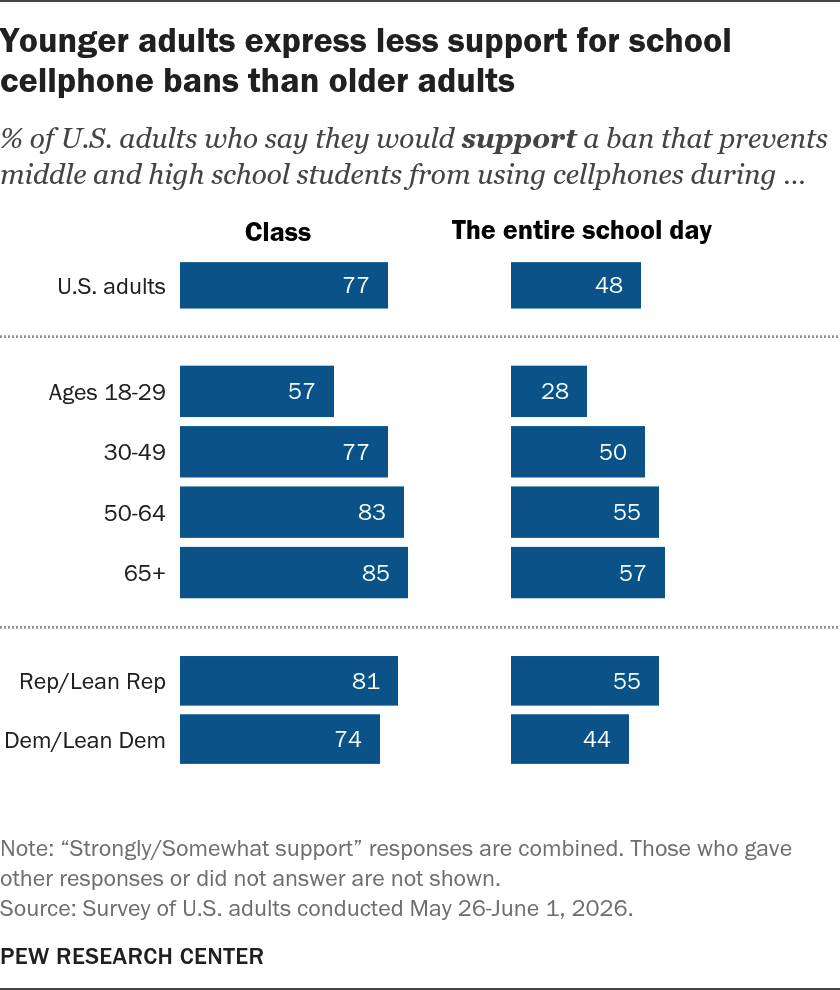
The survey, conducted between May 26 and June 1, 2026, reveals that approximately 77% of U.S. adults now support bans on cellphone use during instructional time for middle and high school students. This figure represents the second consecutive year of growth in public support for such policies. Opposition remains a minority position, with only 18% of respondents expressing disapproval of in-class restrictions, while a mere 6% remain undecided.
Perhaps more significant than the support for in-class restrictions is the evolving attitude toward "bell-to-bell" bans—policies that prohibit smartphone usage for the entire duration of the school day. For the first time, public sentiment has tipped in favor of these comprehensive restrictions. Nearly half of all American adults (48%) now support an all-day ban, a marked increase from the 36% who held this view in 2024. As public opinion hardens against the "always-on" nature of student connectivity, the debate is moving from the abstract to the legislative.
A Chronology of the Digital Debate
To understand the current fervor for phone-free schools, one must look back at the trajectory of the last three years.
2024: The Early Turning Point
In 2024, the conversation was largely focused on the necessity of phones for safety and communication. At that time, only 68% of Americans supported in-class bans, and support for all-day, "wall-to-wall" restrictions was significantly lower at 36%. The primary arguments for keeping phones in classrooms centered on parental anxiety and the belief that students needed access to their devices in the event of an emergency.
2025: Evidence and Efficacy
By 2025, the narrative began to shift. As more school districts began experimenting with Yondr pouches and stricter locker policies, the focus moved toward academic outcomes. Research surfaced suggesting that removing smartphones reduced distraction, improved social interaction, and fostered better classroom behavior. During this period, support for in-class bans rose to 74%, while support for full-day bans climbed to 44%. Public discourse started to reflect a growing realization: the potential for distraction and cyberbullying during the school day outweighed the perceived benefits of constant connectivity.
2026: A New Consensus
The latest data from 2026 cements this trend. The rise to 77% support for in-class bans and 48% for full-day bans demonstrates that this is not a passing fad but a sustained reaction to the perceived negative impacts of digital saturation. States across the nation have begun codifying these sentiments into law, moving from local school board policies to statewide mandates.
Analyzing the Data: Demographic and Political Fault Lines
The Pew Research Center’s comprehensive data illustrates that while support for bans is broad, it is not uniform.
Generational Divides
Age plays a critical role in how Americans view technology in schools. Younger adults (those aged 18–29) are notably more hesitant to support strict bans. Only 57% of this demographic support in-class restrictions, and only 28% support full-day bans. This contrasts sharply with older generations, where support for all-day bans exceeds 50% for those aged 30 and older, reaching as high as 57% among those 65 and older. This gap may reflect a generational difference in how these groups perceive the role of a smartphone—either as an essential, inseparable limb or as a persistent, avoidable distraction.
The Political Spectrum
Political affiliation also correlates with these views. Republicans and those who lean Republican are consistently more supportive of restrictive cellphone policies, with 81% favoring in-class bans and 55% supporting full-day bans. Democrats and Democratic-leaning independents show slightly lower levels of support, at 74% and 44% respectively. Despite these differences, the trend line for both parties is moving in the same direction: toward a classroom environment where the phone is left in a locker or at home.
Official Responses and Educational Implications
The mounting public support is putting immense pressure on school boards and state legislatures. Educators have long reported that the constant ping of notifications and the social pressures of apps like TikTok and Instagram significantly hinder the ability to maintain a focused learning environment.
Educational experts are increasingly pointing toward the "mental health crisis" as a catalyst for this movement. By removing the device, schools are attempting to create a "digital sanctuary" where students can interact face-to-face without the mediation of a screen.
However, administrators remain cautious. The logistical challenge of enforcing a full-day ban—collecting thousands of devices, ensuring their security, and managing the inevitable pushback from students—is immense. Furthermore, the debate continues to stall in some regions due to the persistent "safety argument" from parents who feel that in an era of school-related violence, the ability to text their child in real-time is a non-negotiable requirement.
Implications for the Future of Learning
What does this sea change mean for the future of the American classroom?
- The Return to Analog: As schools move to ban phones, there is a renewed emphasis on physical textbooks, handwritten assignments, and traditional face-to-face collaborative projects. The "tech-first" approach that dominated the late 2010s is being replaced by a more intentional, moderated integration of technology.
- Social Skill Development: Educators are reporting that the removal of phones is facilitating a "social renaissance." Students are observed talking more in the cafeteria and during passing periods, leading to a potential reduction in the social isolation often linked to heavy social media use.
- Policy Standardization: The trend suggests that in the coming years, we may see a transition from "district-level policies" to "state-level mandates." As public pressure mounts, politicians are finding that advocating for "phone-free schools" is a popular platform that transcends traditional partisan divides.
- The "Safety" Counter-Narrative: Despite the growing support for bans, the safety concern remains the primary hurdle. Future iterations of these policies will likely involve compromise—such as "emergency-only" protocols or the use of specialized, locking storage containers that allow for rapid access during a drill or crisis, yet prevent unauthorized use during the day.
Conclusion: The Path Forward
The 2026 data serves as a clear indictment of the status quo. Americans are signaling that they are tired of the digital chaos that has permeated the educational system. Whether through top-down mandates or bottom-up school board initiatives, the move toward stricter cellphone regulation is gaining momentum.
As we look toward the 2027 school year, the question for policymakers is no longer whether they should limit smartphone access, but how to implement these changes effectively and equitably. The goal is to create an environment where technology serves as a tool for learning rather than a barrier to it. For now, the public has made its preference known: the classroom is for learning, not for scrolling.
Methodology and Research Notes
This analysis is based on a survey of 9,750 U.S. adults conducted by the Pew Research Center from May 26 to June 1, 2026. The participants were drawn from the Center’s American Trends Panel, a nationally representative group. The results carry a margin of error consistent with rigorous survey standards. Readers interested in the full dataset, including the specific phrasing of the survey questions and the comprehensive methodology, can access the research repository at the Pew Research Center’s official website.
About the Author