July 30, 2026
In an age where information is as abundant as it is fragmented, the American public finds itself locked in a complex struggle to discern fact from fiction. The recent Cyclospora outbreak—a parasitic infection linked to agricultural products—has served as a potent case study for this struggle. Beyond the immediate public health concerns, the outbreak has exposed deep fissures in how citizens consume information, trust institutions, and define the very act of "doing their own research."
As misinformation spreads through digital ecosystems, the divide between institutional guidance and alternative narratives has widened, challenging the ability of government agencies to communicate effectively during a crisis.
The Anatomy of an Outbreak: Fact vs. Conspiracy
The recent Cyclospora outbreak, which traced the pathogen to products from Taylor Farms, was more than just a food safety issue; it was a flashpoint for social media-fueled conjecture. According to reporting from The New York Times, as the outbreak gained momentum, online spaces became breeding grounds for elaborate conspiracy theories.
Among the most prominent narratives were unsubstantiated claims alleging political collusion between the Trump administration and the affected company. These threads, which often thrive in the echo chambers of social media platforms, suggest that the intersection of corporate interests and political influence can bypass traditional gatekeepers. Such theories gain traction precisely because they tap into a pre-existing reservoir of public skepticism regarding both corporate accountability and federal oversight.
A Chronology of Declining Trust
To understand how these narratives take root, one must look at the long-term erosion of faith in public information sources.
- Pre-2025 Foundation: Years of polarized political discourse and fragmented media consumption had already begun to shift the landscape. The COVID-19 pandemic served as a catalyst, permanently altering the way Americans view public health guidance.
- April 2025: A Pew Research Center survey confirmed the depth of the issue: 50% of Americans reported that it is at least somewhat difficult to judge the accuracy of health information, regardless of the source.
- December 2025: Further research into the "complicated relationship with news" revealed that the term "doing your own research" had been co-opted by those who define the act as questioning established authorities rather than verifying information through established scientific channels.
- July 2026: The current Cyclospora outbreak reached a peak of public discourse, demonstrating that despite advanced digital literacy efforts, the ability to discern accurate health data remains a struggle for the majority of the population.
Supporting Data: The Trust Gap
The data regarding public trust is stark. While government health agencies remain a primary source of information for 76% of Americans, the quality of that trust is fragile.
Only 25% of those who consume government-provided health information describe it as "extremely or very accurate." A full 55% view it as only "somewhat accurate," and nearly one in five (19%) view it with profound skepticism, labeling it as "not too or not at all accurate."
The contrast with social media is even more dramatic. While many Americans turn to social media for health updates, the level of confidence in that information is abysmal. Only 7% of social media users find that information "extremely or very accurate," while 47%—nearly half—regard it as fundamentally untrustworthy. Despite this low level of stated trust, social media remains the primary engine for the rapid dissemination of the very conspiracy theories that confuse the public during health crises.
The Generational Shift in Media Consumption
The trend toward alternative media is not uniform; it is sharply divided by age and political leanings. An analysis by the Associated Press highlights a growing cohort of progressive Americans who have largely abandoned traditional news outlets. These individuals, particularly younger Democrats, are migrating toward podcasts, independent influencers, and digital-only news platforms.
The generational divide is striking. Democrats aged 18 to 29 are significantly less likely than their elders (aged 65+) to trust national news organizations (61% vs. 79%). Conversely, this younger demographic is far more likely to trust information derived from social media platforms (51% vs. 21%).
This migration is not necessarily a rejection of truth, but rather a pursuit of a "fuller story." As one 25-year-old participant in a recent focus group noted: "Often times I find myself having to seek alternative news outlets or articles to get the full story of what really is happening or to fill in the gaps of missing details." This sentiment reveals that the perceived "gaps" in mainstream reporting are being filled—often with misinformation—by alternative sources that promise a more comprehensive, albeit unverified, narrative.
Defining "Doing Your Own Research"
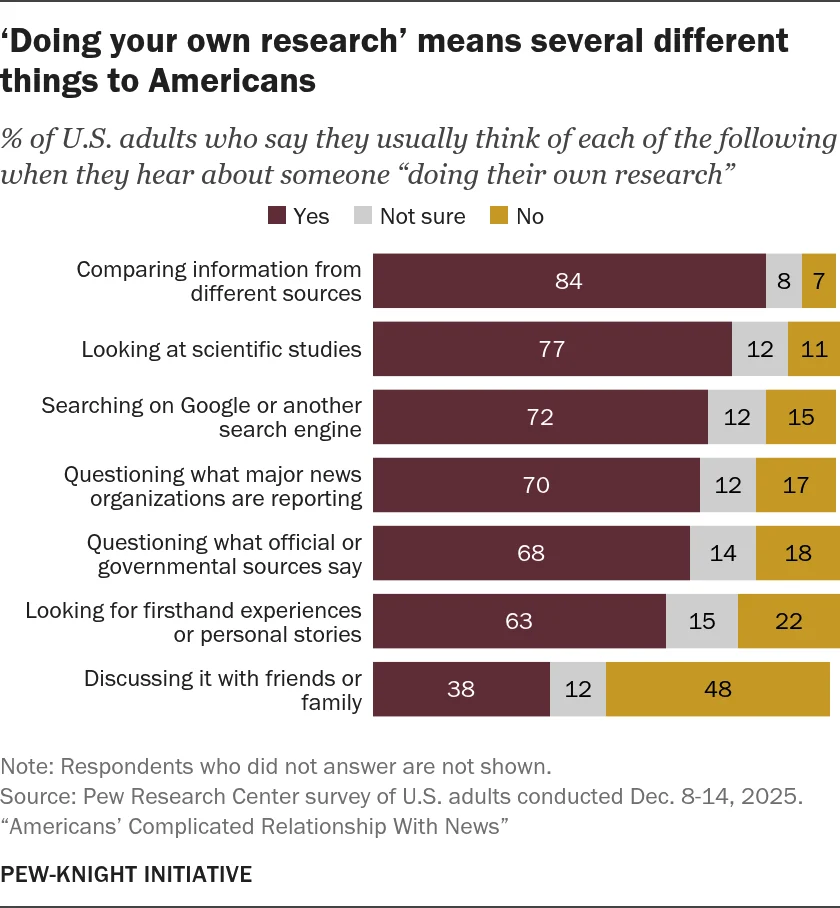
The term "doing your own research" has become a cultural signifier with multiple, often conflicting, definitions. According to the Pew-Knight Initiative, when Americans say they are doing their own research, they are usually engaging in a mix of behaviors:
- Comparing sources: 84% of respondents see this as a key component of research.
- Consulting scientific studies: 77% view this as a legitimate research practice.
- Questioning mainstream/government sources: 70% of Americans associate "doing their own research" with a healthy skepticism of traditional news organizations, and 68% associate it with questioning government agencies.
This creates a paradox: while the majority of people believe they are acting with due diligence by questioning authorities, this very skepticism makes them more susceptible to conspiratorial narratives that thrive on the premise that the "truth" is being hidden by the establishment.
Implications for Public Policy and Health
The implications of this environment are profound. When a significant portion of the population views government health guidance as a starting point for their own "alternative" investigation rather than a definitive authority, the speed and efficacy of public health responses are compromised.
- Communication Failures: Health agencies must find ways to bridge the trust gap. Simply providing "the facts" is no longer sufficient when the audience is primed to view those facts as suspect.
- The Rise of Independent Media: As younger audiences continue to flee traditional news, the burden of accuracy falls on a new, largely unregulated class of content creators. This necessitates a new framework for media literacy that targets podcasting and social media consumption.
- Polarization of Health: When health crises, such as the Cyclospora outbreak, are filtered through political lenses, the resulting misinformation does more than confuse; it puts lives at risk by discouraging adherence to evidence-based safety protocols.
Conclusion: Rebuilding the Foundation
The crisis of information is, at its heart, a crisis of social cohesion. The Cyclospora outbreak is merely a symptom of a larger, systemic inability to agree on a shared set of facts. As we look ahead, the challenge for both media organizations and government institutions is not just to provide information, but to rebuild the credibility required for that information to be accepted.
Until the gap between institutional transparency and public perception is narrowed, the American information landscape will remain highly volatile, leaving citizens vulnerable to the next wave of viral misinformation.
The Briefing is compiled by the Pew Research Center staff, including Naomi Forman-Katz, Christopher St. Aubin, Emily Tomasik, Joanne Haner, and Sawyer Reed. It is edited by Michael Lipka and copy edited by David Kent. For inquiries, contact [email protected].
About the Author