By Staff Reporters
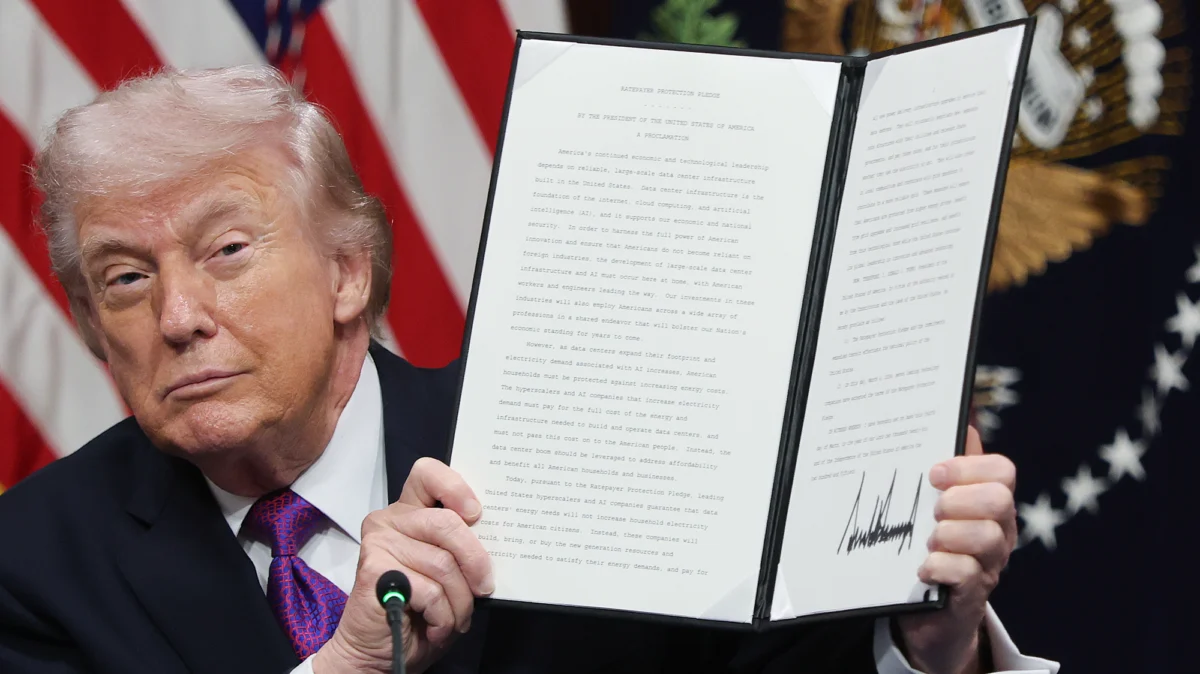
In a high-stakes move aimed at curbing the inflationary pressures of the artificial intelligence revolution, President Donald Trump announced this week that roughly 200 entities have formally signed onto his "Ratepayer Protection Pledge." The agreement, a nonbinding commitment designed to shift the financial burden of massive AI data center construction away from residential consumers and onto the tech giants themselves, represents the administration’s most significant attempt to address the escalating cost of electricity across the United States.
The announcement, made at the Environmental Protection Agency (EPA) headquarters in Washington, D.C., signals a pivot in the White House’s strategy to balance the demands of the global AI arms race with the immediate economic anxieties of American households facing rising utility bills.
The Evolution of the Pledge: From Tech Giants to Utilities
The "Ratepayer Protection Pledge" was first unveiled in March 2026, targeting the initial wave of energy-intensive AI expansion. At its inception, the list of signatories was limited to the seven titans of the technology sector: Google, Microsoft, Meta, Oracle, xAI, OpenAI, and Amazon. The core premise was simple: as these companies build out vast data centers that consume gigawatts of power, the infrastructure costs—such as grid upgrades, transmission line expansions, and new power generation—should be borne by the developers, not the average citizen.
By late July, the scope of the agreement had expanded significantly. According to the White House, the pledge now covers entities that distribute roughly 80 percent of all electricity to homes and businesses across the country. The inclusion of major utilities like Duke Energy and NextEra, alongside data center developers and regional electricity cooperatives, marks a shift from a tech-centric pact to an industry-wide mandate.
During the press conference, President Trump was flanked by EPA Administrator Lee Zeldin and Energy Secretary Chris Wright. The event was bolstered by the presence of 23 Republican governors, including Brian Kemp of Georgia, Mike DeWine of Ohio, Spencer Cox of Utah, and Jeff Landry of Louisiana. This show of force by state executives highlights the local political pressure surrounding the energy crisis; in many of these states, citizens have seen double-digit percentage increases in their power bills as data center demand outstrips existing supply.
A Chronology of the Data Center Backlash
The friction between the AI boom and the power grid did not emerge overnight. To understand the current policy landscape, one must look at the timeline of the last eighteen months:
- Early 2025: The rapid acceleration of large-scale AI models leads to an unprecedented spike in energy demand. Grid operators issue warnings that regional capacity is being stretched to its limits.
- March 2026: President Trump announces the "Ratepayer Protection Pledge," attempting to preempt public anger by asking Big Tech to voluntarily assume infrastructure costs.
- June 2026: Bureau of Labor Statistics data confirms that utility prices have risen 4 percent year-over-year, fueling voter dissatisfaction ahead of the November midterms.
- July 14, 2026: New York becomes the first state to enact a formal, temporary moratorium on new AI data center developments, citing concerns over grid stability and environmental impact.
- Late July 2026: Texas Governor Greg Abbott, previously a staunch advocate for business development, calls for a moratorium on data center construction in rural Texas, citing the strain on the state’s independent power grid.
- July 23, 2026: The Trump administration hosts the formal signing event at the EPA, claiming the pledge now covers 80 percent of U.S. power distribution.
The Economic Data: Why Power Bills Are Rising
The core of the issue lies in the sheer scale of the energy required for modern AI training and inference. A single large-scale data center can consume as much electricity as a mid-sized city. When a utility provider is forced to build new transmission lines or bring older, more expensive power plants back online to satisfy this sudden, massive load, the costs are traditionally recovered through "rate cases"—proceedings that allow utilities to increase the price per kilowatt-hour for all customers.
According to federal data, the 4 percent year-over-year increase in utility costs is not merely a reflection of inflation; it is a direct consequence of "load growth." Critics argue that the current rate-making structure is effectively a subsidy for AI companies, as residential ratepayers are forced to fund the grid expansions necessary for private, highly profitable tech ventures.
President Trump’s rhetoric at the press conference sought to paint the administration as the protector of the common worker. "We have kept rates down, way down," Trump stated, adding that the American people "need relief from soaring energy bills month after month and real action from these companies to pay their fair share."
Official Responses and Political Implications
The political response to the pledge has been polarized. On one hand, the administration and its allies view the pledge as a necessary "guardrail" that allows for American technological dominance without sacrificing the economic well-being of the middle class.
White House spokesperson Taylor Rogers framed the initiative as a win-win. "The president’s bold action is turning data centers into engines of growth for local communities, while cementing America’s dominance in the global AI race," Rogers said. "We are ensuring everyone involved in building and powering data centers covers their own costs instead of passing them on to American families."
However, the opposition—ranging from progressive lawmakers to environmental advocacy groups—remains deeply skeptical. The criticism centers on the "nonbinding" nature of the pledge. Without federal legislation or regulatory enforcement from the Federal Energy Regulatory Commission (FERC), critics argue that the pledge is merely a public relations exercise.
Senator Bernie Sanders (I-Vermont) and Representative Alexandria Ocasio-Cortez (D-NY) have continued to push for a more aggressive, binding approach, including a national moratorium. Their proposed legislation would mandate that data center developers provide proof of carbon-neutral energy sourcing and full financial responsibility for grid impact studies before a single shovel hits the ground.
Environmental and Social Implications
The environmental concerns surrounding data centers go beyond the cost of electricity. There is the issue of water consumption for cooling, the land-use impact on rural areas, and the reliance on fossil fuels to meet the immediate, high-speed demand of the AI sector.
Patrick Drupp, climate policy director at the Sierra Club, was particularly scathing in his assessment of the White House announcement. "The American people don’t care about weak pledges and empty promises," Drupp stated. "The companies signing on have done nothing to show their work on how they will lower costs. It is a paper-thin commitment to families who are struggling to keep the lights on."
Similarly, Lena Moffitt of Evergreen Action described the event as a "photo op with big tech" that fails to address the structural issues of the power market. "Trump promised again and again to cut Americans’ energy costs, but instead he’s letting the same corporations driving up demand write their own rules—a voluntary pledge with no teeth and no consequences if they break it," Moffitt said.
A Nation at a Crossroads
As the midterm elections approach, the intersection of AI, energy, and inflation has become a defining issue of the campaign. For the administration, the challenge is to prove that "American dominance in the global AI race" can coexist with affordable energy. For the critics, the challenge is to turn the growing public frustration into concrete legislative action that mandates accountability.
With Texas—the nation’s energy heartland—now calling for restrictions on data center development, it is clear that the status quo is no longer sustainable. Whether this "Ratepayer Protection Pledge" will evolve into a robust regulatory framework or fade into the background as another symbolic political gesture remains to be seen. What is certain, however, is that the grid is being pushed to its limits, and the debate over who pays the bill for the digital future is only just beginning.
About the Author