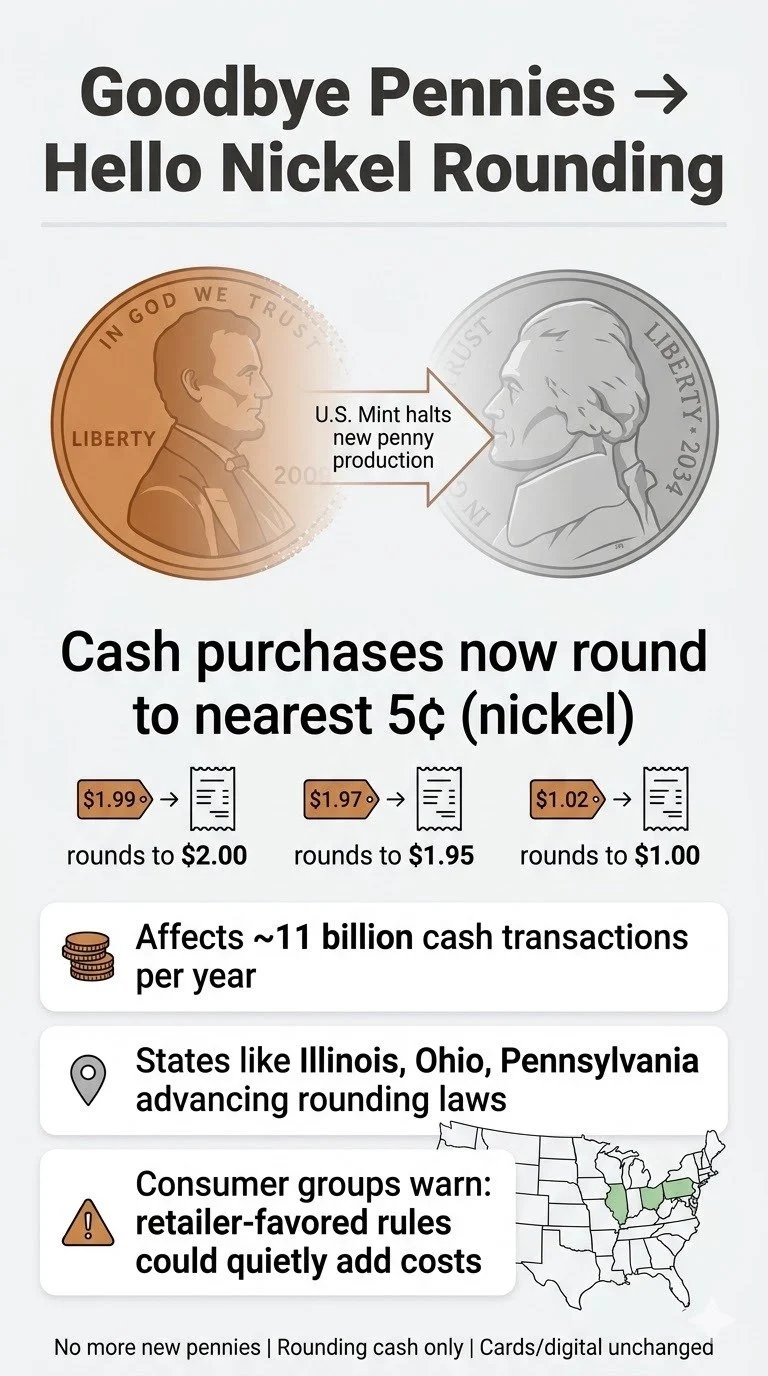
The American pocket is getting lighter, and the landscape of retail commerce is undergoing a quiet but seismic shift. Following the U.S. Mint’s decision to officially halt the production of new pennies, the nation is confronting the logistical reality of a currency system losing its smallest denomination. While digital payments and credit cards continue to dominate the modern economy, cash remains a critical, if diminishing, pillar of point-of-sale transactions. As the physical supply of one-cent coins begins to dwindle, at least six state legislatures have rushed to introduce bills aimed at standardizing how retailers handle "rounding" for cash purchases—a move that carries significant economic and operational implications.
The Disappearing Penny: A Structural Shift in Commerce
For over two centuries, the penny has been a staple of American life, yet its utility has been increasingly questioned due to the rising costs of production and the inflationary pressures that have eroded its purchasing power. With the Mint’s production halt, the U.S. is effectively entering a post-penny era, a transition that echoes the path taken by several other developed nations.
However, unlike digital transactions—which represent the vast majority of modern payments and remain unaffected due to their ability to calculate exact, fractional amounts—cash transactions are now hitting a wall. According to Federal Reserve data, cash still accounted for 18 percent of all point-of-sale purchases in 2023, amounting to roughly 11 billion individual transactions annually. Without a standardized approach to how these transactions conclude, the retail sector faces a potential "chaos of change," where the final cost of a gallon of milk or a pack of gum could vary depending on the local jurisdiction.
Chronology of the Legislative Rush
The legislative response to the penny shortage has been swift and, in some corners, contentious. While the federal government has yet to provide comprehensive guidance, state houses have become the primary battleground for setting new "rounding" standards.
- Late 2023/Early 2024: Following internal reports regarding the cessation of penny production, industry analysts and state representatives began drafting initial frameworks for mandatory rounding.
- February 2024: Legislative filings in Illinois, Ohio, and Pennsylvania hit the public record, signaling a coordinated push to establish legal rules for cash-based rounding.
- March 2024: Committees in several states began public hearings. The Illinois bill, which mandates rounding in favor of the consumer, cleared its committee hurdle, setting a precedent for other states to follow.
- April 2024: A pivotal floor vote is scheduled for April 12 in Illinois. This vote is expected to serve as a bellwether for how the rest of the country might approach the issue, potentially triggering a chain reaction of similar legislation across the Midwest and beyond.
Supporting Data: The Cost of the "Rounding" Gap
The economic stakes of these legislative changes are surprisingly high. Consumer advocacy groups have raised alarms regarding the potential for "rounding creep"—a phenomenon where retailers could strategically adjust their rounding methods to capture fractional profits.
According to projections, if rounding rules are left to the discretion of individual retailers or are biased in favor of the store, the aggregate impact could be massive. Some models suggest that rounding could extract an extra two cents per transaction on average. When applied to 11 billion annual cash transactions, this could result in a wealth transfer of hundreds of millions of dollars from consumers to the retail industry.
Conversely, the retail sector argues that the cost of compliance—specifically the need to reprogram thousands of point-of-sale (POS) systems—is a significant burden. The National Retail Federation (NRF) has emphasized that inconsistent state-by-state laws are the primary threat to operational efficiency. If a national chain must implement one rounding algorithm in Illinois, another in New York, and a third in a state with no legislation, the administrative and technical costs could easily eclipse any minor profit gains from the rounding itself.
Official Responses and Industry Concerns
The industry perspective is clear: they are calling for federal intervention to prevent a patchwork of conflicting mandates. Jason Miller, chief policy officer at the Retail Industry Leaders Association (RILA), has been a vocal proponent of federal guidance.
"We need uniform standards, or you’ll have a retailer rounding down in Michigan and rounding up in Indiana," Miller stated during a recent industry forum. "That creates chaos in daily operations and consumer confusion." Miller’s warning highlights the "chaos" that occurs at the register when staff are forced to explain to customers why the tax or total amount varies based on a state’s specific legislative interpretation of "fair rounding."
The legislative proposals themselves show a wide range of philosophies:
- The Consumer-First Model: Currently being championed in Illinois, this model mandates that all rounding must benefit the customer, effectively requiring stores to "round down" to the nearest nickel. The Illinois bill includes strict enforcement, with fines of up to $500 per violation.
- The Neutral Mathematical Model: Some states are proposing a "nearest neighbor" approach, where 1-2 cents round down, and 3-4 cents round up, maintaining a neutral mathematical balance that neither inherently favors the retailer nor the shopper.
- The Flexible Retailer Model: New York’s proposal represents a middle ground, allowing retailers to choose their preferred rounding methodology provided they post clear, visible signage at every point of sale to ensure transparency.
Global Precedents: The Canadian Experience
To understand the potential outcome of the U.S. transition, experts point to Canada, which officially phased out the penny in 2013. The transition was largely smooth, primarily because the Canadian government adopted a simple, balanced rounding system that was widely understood by the public.
Studies conducted after the Canadian shift revealed that the impact on individual consumers was negligible. Over the course of a year, the average consumer lost or gained less than a single cent per purchase. Because the system was standardized nationwide, there was no confusion, and retailers reported almost no consumer complaints. The Canadian success story serves as a template for what the NRF and other industry groups are hoping for in the U.S.: a predictable, unified, and simple federal mandate that removes the uncertainty of state-by-state compliance.
Implications: A Fragmented or Unified Future?
As the U.S. faces this transition, the implications for the future of cash are profound. The current legislative movement represents more than just a change in currency; it represents a test of federalism in an increasingly digital world.
If Congress fails to act, the retail landscape may become increasingly fragmented. Large national chains will likely face the highest costs, forced to invest in complex software updates to accommodate varying state laws. Small businesses, meanwhile, may struggle with the administrative burden of calculating and justifying these new totals to their customers.
Furthermore, the "rounding" debate opens up a broader conversation about the future of physical currency in the U.S. If the penny is gone and cash transactions are becoming a rarity, the necessity of maintaining a cash infrastructure—including banks, ATMs, and transport—comes into question. For now, however, the immediate focus remains on the register. As April 12 approaches and the Illinois vote looms, policymakers, retailers, and consumers alike are watching to see if the U.S. will move toward a cohesive, national solution or drift into a period of localized, conflicting retail regulations that could complicate the simple act of buying a cup of coffee for years to come.
Ultimately, the transition away from the penny is not merely a logistical hurdle—it is a cultural shift. Whether this change is managed with the precision of a national mandate or the friction of fifty different state laws will define the final chapter of the American penny’s long and storied history.
About the Author