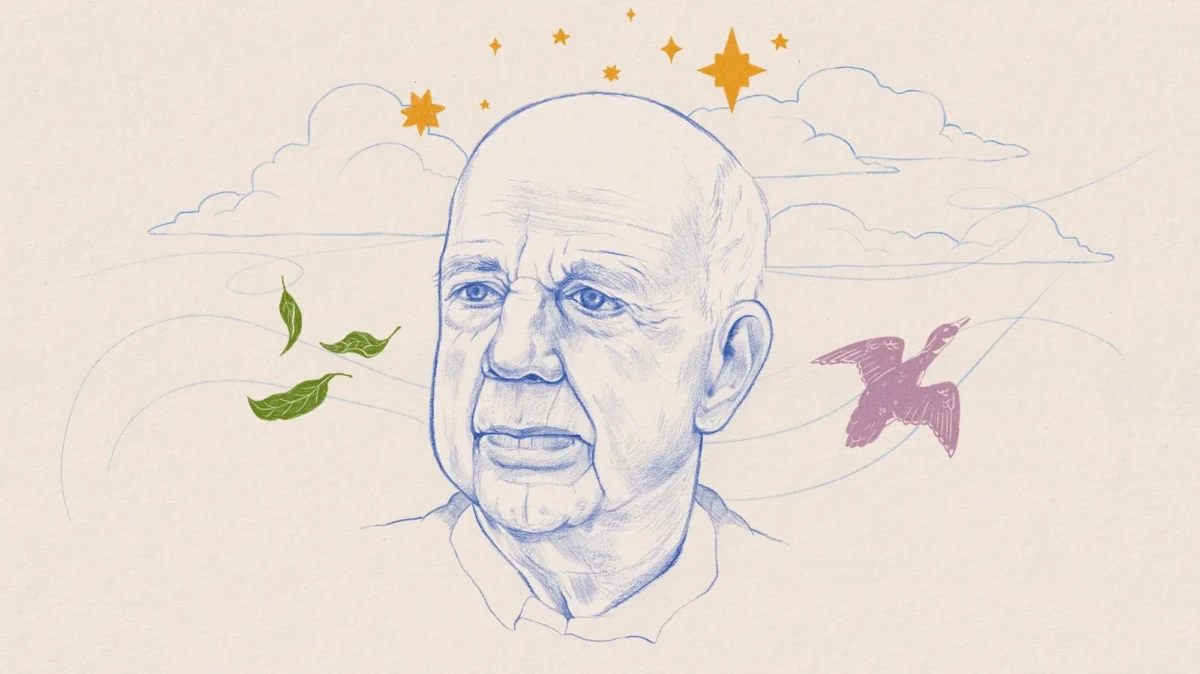
Wendell Berry, the celebrated poet, essayist, novelist, and environmental philosopher who spent his life tending to both his Kentucky soil and the American conscience, passed away on August 31 at the age of 92. From his farmhouse in Henry County, Kentucky, Berry cultivated a body of work that challenged the industrial, technological, and economic orthodoxies of the modern era.
Over a career spanning more than six decades, Berry authored over 50 books, yet he remained famously detached from the tools of the modern age. He famously eschewed computers and smartphones, opting instead for the deliberate, tactile process of pen and paper. His death marks the end of an era for the agrarian movement, leaving behind a legacy that transcends the labels of "environmentalist" or "writer," positioning him instead as a moral compass for a society he often felt had lost its way.
A Life Rooted in Place: A Chronology
To understand Wendell Berry is to understand the geography of Henry County. Born in 1934 in Newcastle, Kentucky, his identity was inextricably linked to the land his family had farmed for generations.
- 1950s–1960s: Berry’s intellectual foundation was laid at the University of Kentucky and later through his participation in the Wallace Stegner Fellowship at Stanford. After teaching at various universities, including a pivotal tenure at New York University and later back at the University of Kentucky, he made the radical choice to return to his family’s farm in 1964.
- 1972: The publication of his seminal essay, Think Little, crystallized his philosophy during the nascent stages of the environmental movement. He argued that the "public crisis" of environmental degradation was inseparable from the "private crisis" of individual consumption and disconnection.
- 1979–2011: Berry translated his literary convictions into civil disobedience. His arrest in 1979 for protesting a nuclear power plant signaled his transition into a vocal activist. In 2011, he gained national headlines for participating in a sit-in at the Kentucky state capitol to protest mountaintop removal coal mining.
- 1987: His essay, Why I am not Going to Buy a Computer, cemented his reputation as a counter-cultural figure, sparking debates about the dehumanizing nature of industrial technology.
- 2026: His passing serves as a moment of national reflection on his life’s work, which urged humanity to move away from the linear logic of extraction and toward the cyclical logic of stewardship.
The Philosophy of the "Mad Farmer"
Berry’s worldview was defined by a rejection of dualism. He despised the fragmentation of modern life—the split between the body and soul, the human and the non-human, and the political tribalism that defines contemporary discourse.
In his famous poem, Manifesto: Mad Farmer Liberation Front, Berry offered a blueprint for a life of resistance: "Invest in the millennium. Plant sequoias. Say that your main crop is the forest that you did not plant." This was not merely poetic advice; it was a call to abandon the instant-gratification culture of the 20th and 21st centuries.
Jeffrey Bilbro, an English professor at Grove City College and a scholar of Berry’s work, notes that Berry’s activism was born of a profound, sometimes painful, necessity. "For an uncompromising person or a person of convictions, I think he recognized the need in a fallen world," Bilbro observed. "Our hands are all dirty, and we’re making these compromises, and it’s better to be honest about the necessity to do so and try to do what we can to live right."
Challenging the Industrial Machine
Berry’s skepticism toward industrialization was often mischaracterized as mere "Luddism." However, his stance was deeply rooted in the 19th-century movement where textile workers fought to protect the dignity of their craft against the encroaching automation of their time.
Berry argued that when tools become so complex that they alienate the user from the source of their work, they become tools of oppression. This perspective put him at odds with corporate interests, most notably in the coal industry. In a defining act of principle, Berry withdrew his personal papers from the University of Kentucky in 2015 after the institution accepted a $7 million donation from Alliance Coal—a company he had long criticized for its environmental impact on his home state.
Official and Academic Perspectives
The literary and environmental communities have been quick to eulogize Berry, though they often struggle to categorize him. He was a man of deep faith, yet he was a "bad weather church-goer," preferring to find the divine in the Kentucky woods rather than the pews of an institution.
His work held a unique "broad appeal" that crossed the traditional American political divide. Conservatives admired his defense of family, land, and local community, while progressives lauded his uncompromising environmentalism and anti-corporate stance. This cross-pollination was a result of his insistence that true conservation is a conservative act—preserving what is good—and that true progress is a radical act—changing what is destructive.
The Implications of a "Cycle of Death and Rebirth"
Perhaps the most enduring element of Berry’s philosophy is his view on time. While mainstream environmentalism often utilizes the language of "saving the world" or "avoiding the apocalypse," Berry viewed the world as a cyclical entity. He rejected the linear path that leads inevitably toward either total destruction or technological salvation.
In his poem A Discipline, he writes: "It is the time’s discipline to think / of the death of all living, and yet live." This acknowledgment of mortality—both individual and environmental—was not meant to foster apathy, but rather to foster a deeper, more humble commitment to the land.
The "Think Little" Legacy
The implication of Berry’s life is that we cannot solve global crises through policy alone. He posited that the health of the planet is a mirror reflection of the health of our local communities and personal habits.
If we are to move forward in a world still grappling with climate change and social decay, Berry’s life suggests that the solution is found in the "smallest handful of earth." By tending a garden, by knowing one’s neighbors, and by refusing to let technology or industry sever the connection between the person and the place, we can begin to heal the rupture.
Berry’s death does not mark a conclusion, but rather a point of departure for those he influenced. He leaves behind a call to action that is remarkably simple, yet profoundly difficult to execute: to recognize that we are part of the earth, and to act accordingly. As he famously taught, the mountaintop stripped by mining may not return to a forest in our lifetime, but the act of planting a single seed is, in itself, a victory against the void.
In a world that demands speed, digital integration, and constant growth, Wendell Berry’s life remains an enduring argument for the value of slowing down, looking closely, and choosing, with every action, to be a member of the community of life.
About the Author