For many entrepreneurs, the journey of building a business from the ground up is a deeply personal endeavor. Yet, there inevitably arrives a "growth inflection point"—that critical juncture where the founder’s hands-on management style must yield to the specialized expertise of a professional leadership team. For CEOs preparing to take their companies to the next level, this transition necessitates a difficult, often sobering, conversation: what is top-tier talent actually worth in today’s competitive labor market?
The challenge is often psychological as much as it is financial. Founders who have spent years bootstrapping, often keeping their own salaries modest to reinvest in the business, frequently experience "sticker shock" when they first benchmark the cost of a seasoned president, CFO, or COO. The realization that an incoming executive might command a compensation package significantly higher than the founder’s own take-home pay can be a difficult hurdle to clear, yet it is a necessary evolution for companies aiming to scale.
The Evolution of Executive Leadership: A Historical Perspective
The trajectory of a successful private company usually follows a predictable arc. In the early stages, the founder acts as the primary driver of strategy, sales, and operations. Decisions are made intuitively, and compensation is often tied to the immediate cash flow of the business.
However, as revenue thresholds are crossed—moving from the $10 million range to $50 million and beyond—the complexity of the organization outgrows the capacity of any single leader. Historically, this is when the "professionalization" phase begins. In the last decade, this transition has accelerated. Market volatility, the increasing complexity of supply chains, and the stringent demands of digital transformation have forced private companies to recruit talent from the C-suites of much larger, more sophisticated corporations.
This influx of talent has fundamentally altered the compensation landscape. Where once a local, "homegrown" executive might have sufficed, companies today are competing for seasoned professionals who bring institutional knowledge from private equity-backed firms or Fortune 500 organizations. This shift has turned executive recruitment into a high-stakes bidding war where market-aligned compensation is no longer optional—it is a prerequisite for survival.
Supporting Data: The 2026–2027 Compensation Landscape
New research from the Chief Executive Group provides a sobering, data-driven look at the current market. The 2026–2027 CEO & Senior Executive Compensation Report serves as a vital compass for boards and founders navigating these waters.
National Median Compensation (2025 Data)
The national medians for U.S. private companies paint a clear picture of the current investment required to secure senior leadership:
- Presidents: $354,608
- Chief Operating Officers (COOs): $282,940
- Chief Financial Officers (CFOs): $272,434
Revenue-Based Scaling
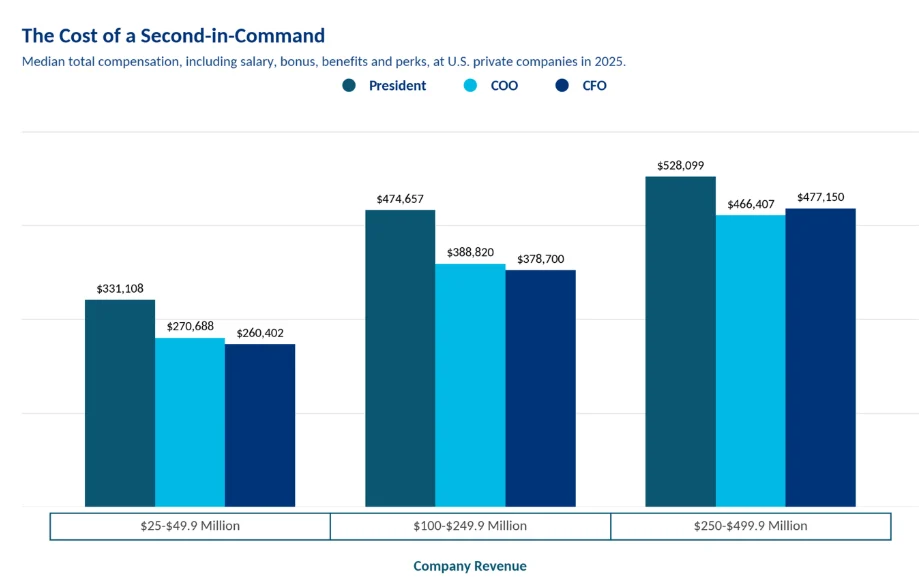
As expected, these figures scale aggressively with the size of the enterprise. For companies generating between $25 million and $49.9 million, the investment is substantial but manageable. However, as organizations reach the $250 million to $499.9 million revenue bracket, compensation for these roles reaches significantly higher echelons:
| Revenue Bracket | President Median | COO Median | CFO Median |
|---|---|---|---|
| $25M – $49.9M | $331,108 | $270,688 | $260,402 |
| $100M – $249.9M | $474,657 | $388,820 | $378,700 |
| $250M – $499.9M | $528,099 | $466,407 | $477,150 |
These figures encompass total compensation, including base salary, annual bonuses, equity grants, benefits, and executive perks. Crucially, these are medians. The report emphasizes that for high-impact roles—particularly those requiring specialized turnaround expertise or experience in high-growth technology sectors—the market is consistently trending toward the top quartile. For instance, at companies with $100M to $250M in revenue, top-quartile CFO compensation can exceed $596,000, nearly 60% higher than the median.
Official Perspective: The Cost of Specialized Capabilities
According to industry analysts and human capital consultants, the mistake most founders make is viewing executive compensation through the lens of their own personal earnings.
"The founder’s salary is a historical artifact of their risk-taking and ownership stake," explains one senior compensation consultant. "The incoming executive’s salary is a market-based procurement cost for specific capabilities."
When an owner hires a new president, they aren’t just hiring a "manager"; they are buying a specific set of skills required for the next phase of the company’s life cycle. For example:
- The Scaling President: A company entering a new, complex market needs a president who has successfully navigated similar expansions, often poaching talent from larger competitors where salaries are naturally inflated.
- The Transaction-Ready CFO: A founder eyeing an exit or seeking venture capital needs a CFO who understands the language of institutional investors, financing, and high-level reporting. These individuals command a premium because they directly increase the enterprise value and likelihood of a successful transaction.
- The Operational COO: For manufacturers, a COO who can squeeze inefficiencies out of a supply chain is worth significantly more than their annual salary if their operational discipline improves net margins by even 2 or 3 percentage points.
The Strategic Implications of the "Ownership Gap"
A recurring tension in the hiring process is the discrepancy between the CEO’s total financial interest and the hired executive’s compensation package.
Founders often struggle to reconcile paying a COO $300,000 in cash when the founder might only be taking a $200,000 salary. This comparison, however, is fundamentally flawed. The founder holds equity—the potential for a "liquidity event" that could be worth millions or even tens of millions. The hired executive is trading their time and professional reputation for cash compensation and potentially smaller equity incentives.
To bridge this gap, modern private companies are increasingly utilizing:
- Performance-Based Bonuses: Tying compensation to specific EBITDA targets or growth milestones.
- Long-Term Incentive Plans (LTIPs): Using phantom stock or stock options to align the executive’s long-term financial outcomes with the company’s enterprise value growth.
- Specialized Benefits: Tailoring perks to high-performing individuals, such as supplemental retirement plans or executive health benefits, which can be highly attractive without inflating the base salary.
Navigating the Competitive Landscape
The research highlights that compensation is not a monolithic figure; it varies significantly by industry and ownership structure. Private equity-backed firms, for instance, set the "high water mark" for compensation. They operate with a clear mandate for growth and are comfortable paying top-tier, market-leading salaries to ensure they have the best possible management to execute their investment thesis.
For independent, family-owned, or founder-led businesses, this creates a competitive disadvantage if they stick to outdated compensation models. If a family-owned business is trying to recruit from the same talent pool as a PE-backed firm, they must either match the compensation or find alternative ways to win, such as offering a superior company culture, greater autonomy, or more flexible working arrangements.
Final Analysis: Moving Beyond the Midpoint
As CEOs look to the future, the primary takeaway from the 2026–2027 CEO & Senior Executive Compensation Report is clear: budget against the range, not the midpoint.
If a company is aiming for high-growth, hiring "average" talent at the median price point may result in average results. To recruit the caliber of leadership that can transform a $50 million business into a $250 million business, boards and founders must be prepared to pay for the market rate of excellence.
Ultimately, the most successful leaders are those who view executive compensation not as an expense to be minimized, but as a capital investment to be optimized. By benchmarking against comparable companies and structuring compensation around the specific, high-value outcomes the business requires, founders can secure the leadership necessary to bridge the gap between their current reality and their future ambitions.
For those looking to refine their strategy, the full 2026–2027 CEO & Senior Executive Compensation Report offers the granularity required to ensure that every dollar of executive compensation is aligned with the long-term enterprise value of the firm. In a market where talent is the ultimate differentiator, the cost of being "right" is almost always higher than the cost of being "cheap."
About the Author