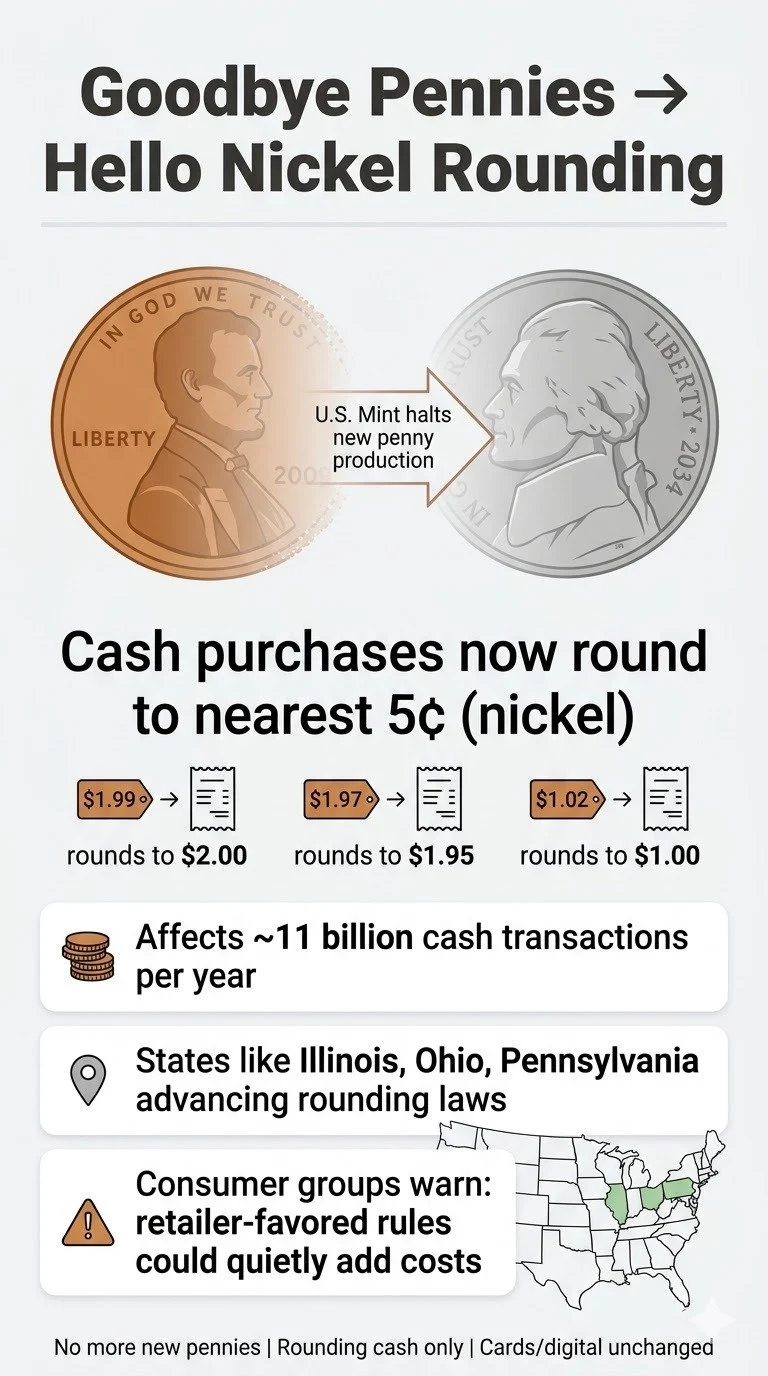
The American landscape of commerce is undergoing a subtle but profound structural shift. With the U.S. Mint quietly halting the production of new pennies, the nation is facing a logistical reality that has been debated for decades: the obsolescence of the one-cent coin. As physical currency continues to lose ground to digital payment methods, the disappearance of the penny has triggered a legislative domino effect. At least six state legislatures have introduced bills aimed at standardizing how retailers handle cash transactions, sparking a complex debate over fairness, mathematical neutrality, and the potential for millions of dollars in shifting consumer wealth.
The Current State of Cash: A Declining Medium
While the U.S. economy is increasingly digital, cash remains a vital component of the retail ecosystem. According to Federal Reserve payment data, cash accounted for approximately 18 percent of all point-of-sale purchases in 2023. This equates to an estimated 11 billion cash transactions annually.
For the vast majority of these purchases, the presence of the penny is a logistical headache. Retailers have long complained that the cost of handling, storing, and transporting pennies outweighs their utility. However, the sudden halt in production has moved the issue from a nuisance to a legal mandate. Because digital and card payments rely on electronic calculations that can account for fractions of a cent, they remain entirely unaffected. It is the "analog" cash transaction that now requires a new set of rules to bridge the gap left by the missing one-cent coin.
Chronology: From Mint Suspension to Legislative Action
The trajectory toward a "penny-less" economy has been accelerated by the Mint’s recent production stoppage. While the move was largely motivated by the rising costs of metal and production efficiency, it caught many state governments off guard.
- Early 2024: The U.S. Mint scales back and eventually halts the production of new pennies, citing economic inefficiency.
- February 2024: Legislative sessions across the country begin to see the introduction of "rounding bills," aimed at mitigating the impact of the coin shortage on retail checkout lanes.
- March 2024: Bills in Illinois, Ohio, and Pennsylvania gain traction, with committees beginning to debate the finer points of rounding protocols.
- Early April 2024: The Illinois bill successfully advances out of committee, setting a precedent for a floor vote scheduled for April 12.
- Present Day: Retail industry groups, including the National Retail Federation (NRF) and the Retail Industry Leaders Association (RILA), begin lobbying for federal intervention to prevent a patchwork of conflicting state laws.
The Legislative Battleground: Fairness vs. Utility
The primary point of contention in the current legislative filings is the methodology of rounding. If a total comes to $4.97, should it be rounded down to $4.95 or up to $5.00?
Diverse Approaches
The proposed bills are far from uniform, creating a potential minefield for national retail chains. The core conflict revolves around three schools of thought:
- Consumer-Friendly Rounding: Some states, notably Illinois, are pushing for legislation that mandates rounding in the consumer’s favor. The Illinois bill includes strict enforcement, with fines of up to $500 per violation for retailers who fail to comply.
- Mathematical Neutrality: This approach suggests rounding to the nearest nickel regardless of the total, effectively using standard arithmetic rounding (e.g., 1 and 2 cents round down; 3 and 4 cents round up).
- Retailer Choice: New York’s proposal represents a more flexible, albeit potentially confusing, approach. It would allow retailers to choose their own rounding method, provided they display clear, visible signage at every point of sale explaining their specific policy.
Supporting Data: The Economic Implications
The financial impact of these policies is not merely academic. Consumer advocacy groups have raised alarms regarding the potential for "hidden" revenue. If retailers were permitted to round up on all transactions, it could result in an extra two cents per purchase on average. While this seems trivial on an individual basis, across 11 billion annual cash transactions, this could represent a transfer of hundreds of millions of dollars from the pockets of consumers to the coffers of retailers.
Conversely, the retail sector argues that the cost of implementing these changes—reprogramming thousands of point-of-sale (POS) systems—is significant. The burden of compliance, combined with the risk of litigation or fines, makes the lack of a federal standard a primary concern for the industry.
Official Responses and the Industry Perspective
The National Retail Federation (NRF) has been vocal in its opposition to the current state-by-state approach. Their argument is rooted in operational efficiency. For a chain like Target, Walmart, or a regional grocery store that operates across multiple state lines, having to program different rounding algorithms for different jurisdictions is a logistical nightmare.
Jason Miller, chief policy officer at the Retail Industry Leaders Association, succinctly summarized the industry’s fear: "We need uniform standards, or you’ll have a retailer rounding down in Michigan and rounding up in Indiana. That creates chaos in daily operations and consumer confusion."
Retailers are effectively asking Congress to step in and provide federal guidance. They argue that a patchwork of laws will lead to inconsistent pricing, frustrated customers, and a fragmented marketplace that serves no one well.
Lessons from the North: The Canadian Model
To understand what a post-penny future might look like, observers often point to Canada, which eliminated its penny in 2013. The transition in Canada was relatively seamless, characterized by the adoption of a balanced, fair-rounding system.
Studies conducted on Canadian retail data following the transition showed that the impact was negligible. Consumers lost or gained less than one cent per transaction on average, and the economy absorbed the change without significant inflation or consumer backlash. Retailers in Canada reported no significant complaints, suggesting that the fear surrounding the penny’s disappearance may be greater than the actual economic reality.
Implications for the Future of Retail
The shift away from the penny is symbolic of the broader evolution of the U.S. economy. As physical coins become relics of a bygone era, the legislative efforts currently underway are merely the first tremors of a larger move toward a cashless or near-cashless society.
The Challenge of Compliance
For retailers, the immediate future involves a massive IT undertaking. Updating POS systems to accommodate variable rounding rules is not as simple as flipping a switch. It requires software updates, staff training, and the physical installation of signage—all of which carry costs. Furthermore, if a state mandates consumer-friendly rounding, retailers must ensure their systems are perfectly calibrated to avoid the $500-per-violation fines stipulated in bills like the one in Illinois.
The Consumer Experience
For the average shopper, the change will likely be subtle. Most will see a rounding adjustment on their receipts and, provided the policy is transparent, will likely accept it as a normal part of the checkout process. However, the risk of "rounding fatigue"—where consumers feel that every transaction is designed to extract a few extra pennies—could damage brand trust if not handled with transparency.
The Role of Congress
The ultimate question remains whether Congress will intervene. With the current political climate, federal legislative bandwidth is often consumed by larger fiscal issues, yet the necessity of a uniform standard for retail transactions may force the issue onto the floor. Without federal intervention, the "chaotic" scenario described by industry leaders like Jason Miller seems increasingly likely as more states join the movement to regulate the post-penny landscape.
Conclusion
The demise of the penny is more than a change in currency; it is a catalyst for the modernization of the American retail experience. As states like Illinois, Ohio, and Pennsylvania lead the charge in defining the rules of this new era, the importance of clarity, fairness, and uniformity cannot be overstated. Whether the solution comes from a federal mandate or a messy evolution of state-by-state regulations, the goal must remain the same: to ensure that the transition away from the penny remains as transparent and painless as possible for the millions of Americans who still rely on cash to participate in the economy. As the April 12 vote in Illinois approaches, the nation watches to see if the U.S. will successfully navigate the transition, or if it will be left with a fragmented, inefficient system that serves neither the merchant nor the consumer.
About the Author