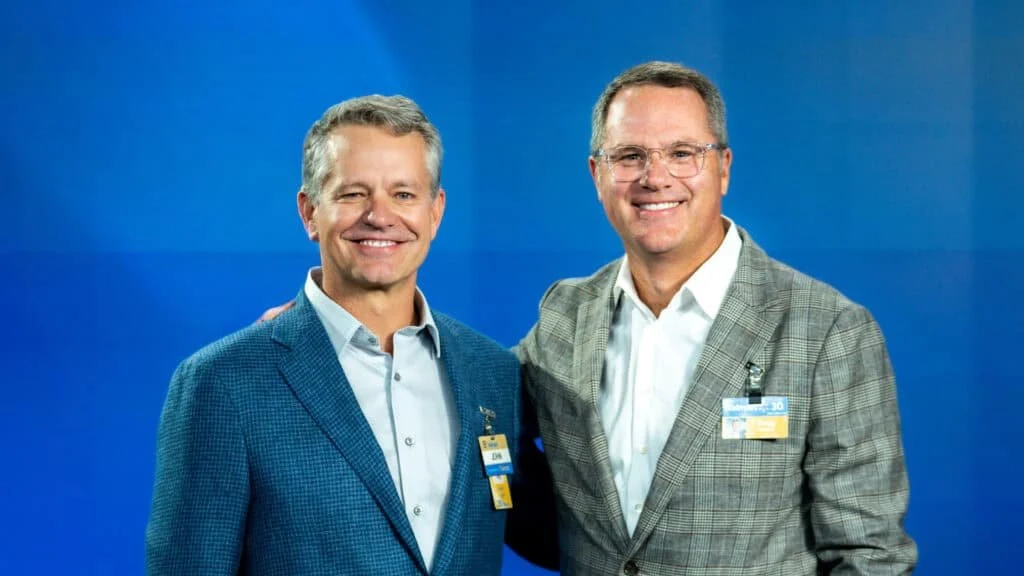
BENTONVILLE, AR – In a move that signals both continuity and a bold leap into the next frontier of global commerce, Walmart has announced that Doug McMillon, the architect of the retailer’s modern digital transformation, will retire as Chief Executive Officer after an illustrious 11-year tenure. Effective February 1, 2026, John Furner, the current President and CEO of Walmart U.S., will ascend to the top position, becoming only the sixth CEO in the company’s storied history dating back to 1962.
This transition is far more than a corporate formality; it is a calculated succession plan designed to fortify Walmart’s dominance in an increasingly complex, AI-driven, and hyper-competitive global retail landscape.
The Core Facts: A New Chapter in Bentonville
The announcement, made public on Thursday, November 14, 2025, confirmed that the transition will be methodical and phased. Doug McMillon, who steered the retail behemoth through arguably its most turbulent and innovative decade, will remain on Walmart’s Board of Directors until the annual shareholders’ meeting in June 2026. Furthermore, he will serve as an advisor to the company through January 2027, ensuring that his institutional knowledge and strategic vision remain accessible to his successor.
John Furner, 51, steps into the role with a resume that reads like a masterclass in retail operations. Having started as an hourly associate at Store 100 in Bentonville in 1993, his rise to the apex of the world’s largest company is a testament to the "promote from within" culture that Walmart prides itself on.
Chronology: The Evolution of Leadership
To understand the significance of this transition, one must look at the historical trajectory of the Walmart C-suite. The company has maintained a remarkable consistency in its leadership, a rarity in the volatile retail sector:
- Sam Walton (1962–1988): The founder who established the "Everyday Low Price" philosophy.
- David Glass (1988–2000): Guided the company through its explosive national and international expansion.
- Lee Scott (2000–2009): Focused on sustainability and supply chain efficiency.
- Mike Duke (2009–2013): Oversaw the refinement of global operations and early e-commerce experimentation.
- Doug McMillon (2014–2026): The digital transformer who saved the company from the "Amazon threat."
- John Furner (Effective Feb 2026): The "Omnichannel Architect" tasked with integrating AI, automation, and physical retail.
Furner’s path has been deliberate. His tenure as President and CEO of Sam’s Club (2017–2019) demonstrated his ability to pivot to membership-based models, while his six-year stint leading Walmart U.S. proved he could navigate the triple-threat of global pandemics, inflationary pressures, and the aggressive shift toward digital-first shopping.
Supporting Data: The McMillon Legacy
When Doug McMillon assumed the CEO role in 2014, the prevailing market sentiment was that Walmart had become a "dinosaur"—a brick-and-mortar giant ill-equipped to survive the digital revolution. Under his leadership, that narrative was not just corrected; it was inverted.
- Market Performance: Under McMillon’s stewardship, Walmart shares surged more than fourfold, consistently outperforming broader retail indices.
- Digital Transformation: Through the acquisition of Jet.com and the aggressive development of the Walmart+ subscription service, McMillon neutralized the Prime threat, creating a formidable digital flywheel.
- Workforce Investment: McMillon oversaw massive investments in the "associate experience," raising wages and benefits for a global workforce of 2.3 million. This was not merely altruism; it was a strategic move to reduce turnover and increase operational efficiency.
- Supply Chain Modernization: By pouring billions into automated distribution centers and logistics software, Walmart transformed its physical footprint into a hybrid network of fulfillment nodes, enabling rapid delivery that rivals pure-play e-commerce firms.
Official Responses: Continuity and Confidence
The transition has been met with a sense of calm and optimism within the halls of Bentonville. Chairman Greg Penner, speaking on behalf of the Board, emphasized that the decision was the culmination of a rigorous multi-year succession planning process.
"John Furner is the right leader to guide Walmart into our next chapter of growth and transformation," Penner stated. "His deep understanding of our business, combined with his relentless focus on the customer and his ability to empower our associates, makes him the ideal choice to build upon the foundation Doug has created."
John Furner, in his first statement as the CEO-designate, underscored the importance of the company’s heritage while pivoting toward future technology. "I am deeply honored by the trust the Board and family have placed in me," Furner said. "As we enter a new retail era fueled by innovation and AI, our purpose and our people will continue to guide us. Together, we’ll find new ways to serve customers, support our associates, and strengthen the communities we call home."
The AI Era: The New Frontier
The retail landscape that Furner inherits is vastly different from the one McMillon managed in 2014. If the last decade was defined by "getting online," the next decade will be defined by "getting intelligent."
1. Artificial Intelligence as the Operational Backbone
Furner is expected to double down on AI-driven inventory management. By utilizing predictive analytics to forecast demand with hyper-local precision, Walmart aims to reduce waste and optimize shelf availability. For the consumer, this means an AI-enhanced shopping experience where personalized recommendations and automated replenishment become standard.
2. The Omnichannel Baseline
The distinction between "in-store" and "online" has effectively vanished. Furner’s challenge will be to ensure that the physical store acts as a high-tech hub. This includes the continued expansion of autonomous delivery, smart kiosks, and seamless "click-and-collect" experiences that reduce friction to near-zero.
3. Sustainability and Ethical Retail
As regulatory and consumer pressures mount regarding sustainability, Furner will need to steer Walmart’s massive supply chain toward net-zero targets. His experience in managing the U.S. division’s complex logistics during the pandemic has prepared him to tackle the supply chain vulnerabilities that remain a persistent risk in global retail.
Implications for the Industry
Walmart’s leadership change serves as a bellwether for the entire retail sector. When the world’s largest retailer makes a move, suppliers, competitors, and technology vendors are forced to recalibrate.
The "Insider" Advantage
In an era where many Fortune 500 companies are looking to "parachuting" executives from tech giants to fix their business models, Walmart is making a definitive statement by choosing a homegrown leader. Furner’s deep-rooted understanding of Walmart’s corporate culture—from the warehouse floor to the C-suite—allows him to implement radical technological changes without the culture shock that often accompanies external leadership.
A Signal to Competitors
For Amazon, Target, and Costco, the message is clear: Walmart is not resting on its laurels. By installing a leader who understands both the traditional retail playbook and the nuances of modern digital scaling, Walmart is signaling that it intends to remain the primary benchmark for the industry.
The Search for the Successor
The focus now shifts to who will replace Furner as the head of Walmart U.S. This role is considered one of the most demanding in the global economy, as it requires managing thousands of stores and hundreds of thousands of employees. Walmart has confirmed that a successor will be named before the end of fiscal 2026, adding another layer of intrigue to this ongoing transition.
Conclusion
The transition from Doug McMillon to John Furner is more than a change in names on an office door; it is a strategic handoff of the baton in a relay race that never stops. As the retail industry faces the dual pressures of economic volatility and technological disruption, Walmart is opting for stability, deep institutional knowledge, and a proven track record of execution.
Under Furner’s leadership, the company is poised to lean into its massive scale, using it not just to compete, but to define the next era of commerce. Whether it is through the integration of generative AI in customer service or the further automation of its global logistics, the "new" Walmart under Furner will undoubtedly remain a force to be reckoned with. For the 2.3 million associates and the millions of customers who rely on the retailer daily, the message is one of continuity: the store is in experienced, capable hands.
About the Author