As the global technological landscape undergoes its most significant transformation since the dawn of the internet, a new, cold-eyed reality has settled over the American public: the perception that the United States is no longer the undisputed frontrunner in artificial intelligence. A comprehensive new survey from the Pew Research Center, conducted in late June 2026, reveals a nation grappling with the geopolitical, economic, and social implications of the AI revolution, with a growing sense that China has successfully closed the gap—or perhaps even taken the lead.
Main Findings: A Shifting Global Perception
The findings present a striking narrative of uncertainty and anxiety. By a three-to-one margin, Americans are more likely to name China rather than the U.S. as the more advanced nation in AI development. Specifically, 36% of respondents pointed to Beijing as the current leader, while only 12% believed the U.S. holds that distinction. Perhaps most telling is the 33% of the population who remain "not sure," highlighting a profound public ambiguity regarding the complex, often opaque, nature of global AI progress.
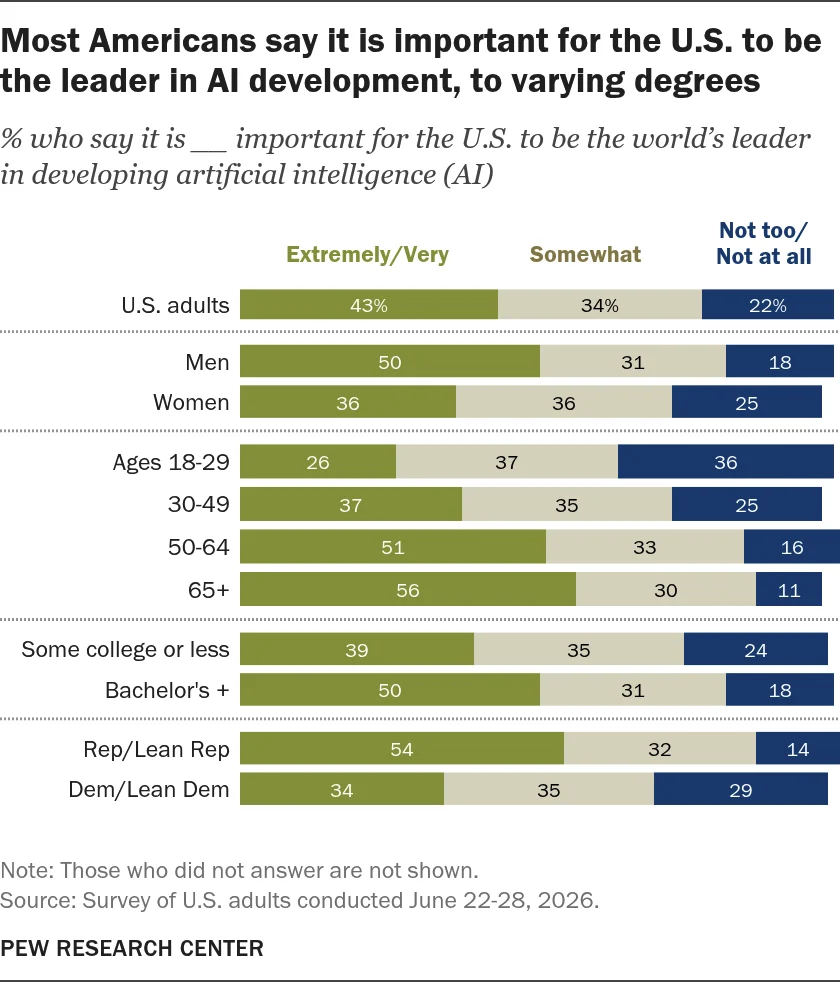
This sentiment does not exist in a vacuum; it is shaped by a pervasive, bipartisan acknowledgment that the race for AI dominance is a defining feature of 21st-century power. Despite the concern that the U.S. may be falling behind, there is a strong consensus on the necessity of victory: 43% of Americans believe it is "extremely" or "very" important for the U.S. to lead the world in AI, reflecting a deep-seated desire to maintain technological hegemony.

A Chronology of the AI Great Power Competition
To understand the current public mood, one must look back at the rapid escalation of the "AI arms race" over the past decade.
- 2017–2020: The Awakening. Following China’s release of its "Next Generation Artificial Intelligence Development Plan," the U.S. began shifting from a passive observer to an active competitor. The federal government, under successive administrations, began pouring billions into research and development, while private sector giants like OpenAI, Google, and Anthropic pushed the boundaries of large language models.
- 2023: The Generative Pivot. The mainstreaming of generative AI served as the "Sputnik moment" for the general public. As ChatGPT and similar tools became household names, the race moved from academic laboratories into the global economic arena.
- 2025: Geopolitical Guardrails. The U.S. government implemented stringent export controls on high-end semiconductors, specifically targeting the hardware required to train the most advanced AI models, in an attempt to stifle China’s progress.
- 2026: The Current Standoff. The latest Pew data arrives at a moment of peak tension, where the rhetoric from both Washington and Beijing has become increasingly focused on national security, cyber-resilience, and the preservation of global influence.
Supporting Data: Demographics and The Digital Divide
The survey data reveals that perceptions of the AI race are deeply stratified by age, education, and political affiliation.
The Partisan Divide
The urgency surrounding U.S. leadership is notably higher among Republicans. 54% of Republicans and those leaning toward the party view American leadership in AI as "extremely or very important," compared to 34% of Democrats. This mirrors the rhetoric from the Trump administration, which has framed AI superiority as a matter of national survival. Conversely, Democrats express more concern regarding the societal fallout of the technology, particularly its role in exacerbating wealth inequality.

Education and Age
There is a clear "knowledge gap" visible in the data. Those with a bachelor’s degree or higher are more likely to express strong opinions on the importance of U.S. leadership (50%) compared to those with some college or less (39%).
Furthermore, a significant generational divide exists. Older Americans, particularly those over 65, are far more likely to demand U.S. primacy (56%) compared to the 18–29 age bracket (26%). This could suggest that younger cohorts, perhaps more accustomed to the globalized nature of digital tools, view the competition through a different lens than those who lived through the height of the Cold War.
The Chatbot Effect
A fascinating nuance in the study is the correlation between AI usage and geopolitical perception. Individuals who regularly engage with AI chatbots are more likely to believe the U.S. is leading (16%) than those who do not use these tools (9%). This suggests that familiarity with American-made AI products may instill a sense of confidence in domestic capabilities that the non-user public lacks.

Official Responses and Strategic Policy
The federal government has made its stance clear: AI is no longer just a technological sector; it is a critical pillar of national security. President Donald Trump has famously asserted that the U.S. "must have the most powerful AI systems in the world," echoing a sentiment that the country is currently engaged in a zero-sum game for global dominance.
However, this is not merely a Republican platform. The previous administration, led by Joe Biden, prioritized the "de-risking" of supply chains and the strict enforcement of restrictions to prevent adversaries from accessing advanced military-grade AI applications. Both sides of the aisle agree that the risk of China weaponizing AI for cyberwarfare or strategic intelligence is an existential threat that requires immediate, state-backed intervention.
Implications: The Widening Global Gap
Perhaps the most sobering finding in the report is the widespread belief that the AI race will not result in a rising tide for all nations. A staggering 51% of Americans believe that artificial intelligence will increase the gap between rich and poor countries.

This concern is shared by global institutions. A recent report from the United Nations emphasized that without intervention, the "AI divide" could lead to a permanent stratification of the global economy, where nations with the infrastructure to host massive data centers and compute clusters capture all the value, while the Global South remains a consumer of imported, foreign-controlled intelligence.
The implications of these findings are profound. For policymakers, the challenge is twofold:
- Restoring Public Confidence: With a third of the population unsure of who leads, there is a clear mandate for the government to communicate its strategic successes—or failures—more clearly.
- Addressing Inequality: The public’s fear of a widening global wealth gap suggests that any future AI policy must include an international development component to ensure that the technology serves as a tool for global stabilization rather than a catalyst for systemic inequality.
Conclusion: A Nation at a Crossroads
The Pew Research Center’s findings paint a picture of a nation that is both wary and determined. Americans are acutely aware that they are participating in a historical transformation that will dictate the future of international relations. While there is a palpable sense of concern that the U.S. may be yielding ground to China, there remains a resilient, albeit politically divided, consensus that the stakes of this competition are too high to ignore. As the world moves further into the age of artificial intelligence, the U.S. faces the dual challenge of competing on the global stage while addressing the domestic anxieties of a public that views the future of technology with equal parts hope and apprehension.
About the Author